
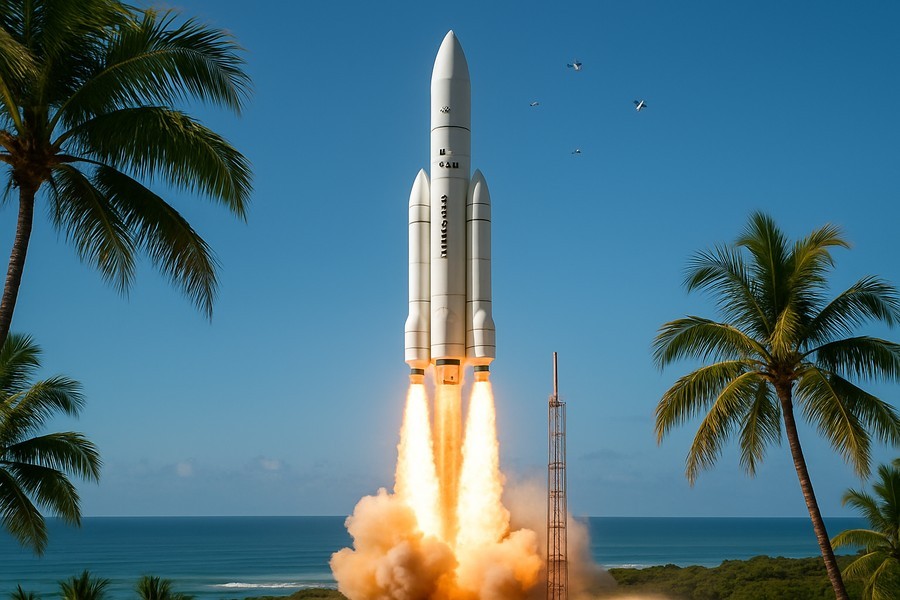
Europe's Ariane 6 Rocket Successfully Launches 32 Satellites for a Broadband Constellation
Amidst a clear sky, the potent Ariane 6 rocket from Europe completed its inaugural launch. The mission was to transport 32 satellites into low-Earth orbit for a prominent online retail company's satellite broadband network. The launch took place at a tropical spaceport on the northeastern coast of South America.
Ariane 64: A Powerful Configuration
The specific configuration used for this launch was Ariane 64, the first of its kind to employ the rocket's full set of four boosters. The rocket, powered by a hydrogen-fueled main engine and four strap-on solid rocket boosters, generated over 3.4 million pounds of thrust. It headed northeast over the Atlantic Ocean. Less than two hours after launch, the rocket's upper stage successfully released all 32 satellites into their intended orbit at an altitude of 289 miles.
Both the online retail company and the French launch services provider declared the operation a triumph. The director general of the European Space Agency, which funded the development of the Ariane 6, proclaimed that the successful launch put Europe back on the map for launching satellites to all orbits. He added that even though their rocket fleet is now complete, they are already working on upgrades for future launches.
Importance of the Launch
The CEO of the French launch services provider expressed pride in supporting the online retail company with a reliable, high-performance European launch solution. He noted that the first flight of Ariane 64 showcased its ability to handle large-scale constellation missions. The Ariane 64 was equipped with an extended payload shroud to accommodate all 32 satellites, which collectively weighed about 44,000 pounds.
The online retail company has contracted over 100 missions across four launch providers to deploy its planned fleet of more than 3,200 satellites. With this launch, the company has successfully sent 214 production satellites on eight missions with different launch providers.
Competing with Other Satellite Networks
The company's satellite constellation is a direct competitor to another tech company's Starlink Internet network, which already has over 9,000 satellites in orbit serving more than 9 million subscribers. Unlike the online retail company, which contracted various companies to launch its satellites, the tech company used its own Falcon 9 rockets for all its launches.
The online retail company has secured nine launches on a soon-to-retire rocket from another launch provider, with five of those already complete. The remainder of its 2022 launches are booked on rockets that had never launched before, including Europe's Ariane 6.
Future Launch Plans
Despite some delays, all three new rockets are now in service. The Ariane 6 had the fastest launch cadence, with six flights completed after the most recent mission. However, a malfunction on a military launch from Florida raises questions about when the online retail company will get its first ride on a new rocket from another launch provider.
Meanwhile, a rocket company owned by the founder of the online retail company is preparing for the third flight of its heavy-lift rocket from Florida. The online retail company and the rocket company have not yet announced when the first group of satellites will be launched on the heavy-lift rocket.
Of all its launch contractors, the online retail company has invested most heavily in the new rocket from another launch provider. It has committed more than $2 billion to upgrade and expand the manufacturing and launch infrastructure to support up to 25 launches per year.
With a shortage of launch capacity, the online retail company had to purchase three launches from the tech company, each carrying 24 satellites. Those three missions were completed last year, and the company confirmed last month that it had reserved 10 more launches to fill the gap created by other companies' delays.
Looking Ahead
The online retail company announced last week that it planned 20 or more launches this year, despite a recent booster problem. The company's CEO said the next launch will carry another set of satellites to orbit, with a launch date to be announced soon.