
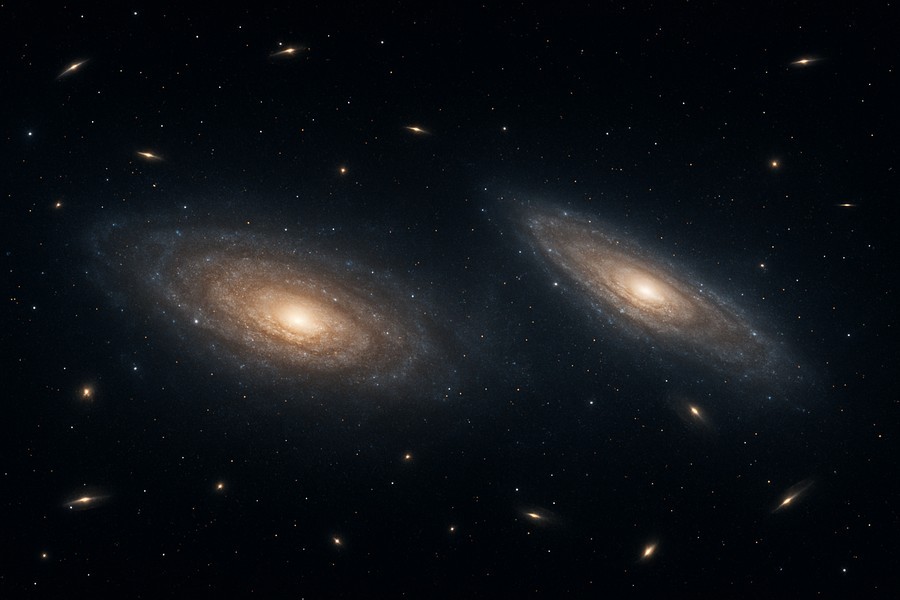
Shedding Light on the Peculiar Movements of Galaxies
For a long time, scientists have been puzzled by the movements of galaxies, particularly our closest neighbor, Andromeda. While most galaxies are drifting away from us, Andromeda is hurtling towards the Milky Way, setting the stage for a possible cosmic collision. But why is this happening? The answer seems to lie in a vast, flat expanse of dark matter.
Dark matter, which is invisible and can only be observed by its gravitational effects, has a sort of anchoring effect on visible matter. It seems that a colossal sheet of dark matter, stretching beyond the limits of the Milky Way and Andromeda, is pulling other galaxies into the depths of space. This force is so strong, it overpowers the gravitational pull between our galaxy and its neighbors.
Understanding the Universe's 'Flow'
Galaxies' movement through the expanding universe is known as the Hubble flow, named after Edwin Hubble, who first discovered the universe's expansion in the 1920s. According to Hubble's law, galaxies are moving away from Earth at speeds that correspond to their distance - the farther away, the faster they recede.
Then there's Andromeda, just 2.5 million light-years away, speeding towards us at 68 miles per second. Unlike other nearby galaxies, Andromeda is not going with the flow. It seems to defy the immense gravitational force of our Local Group, which includes the Milky Way, Andromeda, the Triangulum Galaxy, and dozens of smaller galaxies bound by gravity.
The Role of Dark Matter
In the late 1950s, scientists found evidence of dark matter around Andromeda and the Milky Way. They calculated that to oppose the expansion caused by the Big Bang, these two galaxies would need a mass far greater than the total of their stars. They found that a large portion of these galaxies' mass is contained in dark matter halos, which surround each galaxy and are responsible for their rapid approach towards each other.
This attraction, however, doesn't seem to affect galaxies outside the Local Group. These galaxies are moving away from the Milky Way faster than expected, according to Hubble's law.
Simulating a Universe
To understand why, scientists created their own universe and ran various simulations. They started with the mass distributions seen in the oldest light in the universe, emitted when the universe was just 380,000 years old, and tried to recreate certain characteristics observed in nearby galaxies.
The simulations revealed that both dark matter and visible matter just beyond the Local Group are distributed in a vast, flat sheet that spans tens of millions of light-years. This sheet of dark matter, in which nearby galaxies are embedded, counteracts any gravitational pull from our Local Group, pulling them away from us.
Galactic Motion Explained
If the mass were distributed in a spherical pattern around the Local Group, the external galaxies would be moving away from us slower than predicted by Hubble's law. The flat distribution of surrounding matter pulls these galaxies outwards, almost perfectly balancing the inward pull of the Milky Way and Andromeda.
It's also important to note that regions above and below the sheet are devoid of galaxies. These low-density regions expanded faster than average, pushing their matter outwards. By the present day, these low-density regions fill most of space, and their material has concentrated into the 'walls' separating them.
A Model That Fits
When taking the vast sheet of mass into account, the simulations accurately modeled the distribution of nearby galaxies and the voids. This reconciles experimental results with astronomical observations of galactic motions, as well as with the leading model of cosmology, known as lambda cold dark matter.
Interestingly, some galaxies farther out in the cosmos have been observed to be falling toward the flat sheet of matter at several hundred kilometers per hour. Finding additional structures falling from the directions of the voids could further support the study's results.