
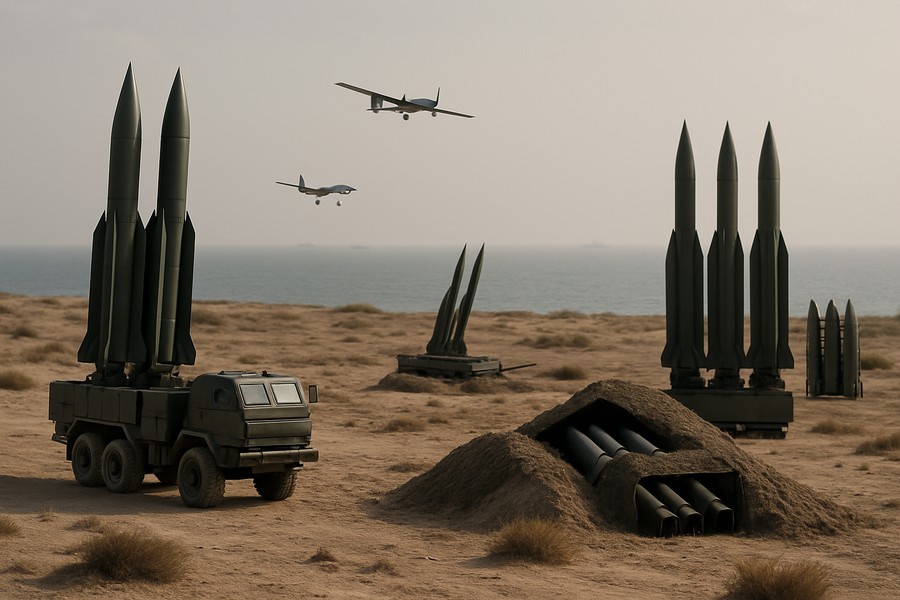
Iran Continues to Hold Strong Missile Launching Power
Despite continuous attacks over recent weeks, Iran still holds a significant portion of its missile launchers and thousands of offensive drones, ready for action. This means Iran continues to pose a serious risk to stability in the region.
Even though many launchers have been hit, around half of them remain intact, with some potentially hidden underground, shielded from further strikes.
The Remaining Arsenal
Iran's drone capabilities have been cut down to about half, but this still leaves thousands of operational drones. Furthermore, a significant portion of Iran's coastal defense cruise missiles remains unscathed, despite intense onslaughts. These missiles are a critical component of Iran's armory, enabling them to threaten shipping traffic in the strategically important Strait of Hormuz.
Despite the ongoing conflict, this provides a more complex picture of Iran's remaining capabilities, compared to the simplified victory declarations from some government officials.
Impact of the Attacks
Thousands of targets within Iran have been hit, severely impacting Iran's military capabilities. High-ranking figures in Iran's leadership have also been reportedly eliminated in these strikes, including key figures from Iran's National Security Council.
However, beyond the missile launchers, Iran still holds a significant number of missiles, increasing the complexity of the situation.
Reduction in Attacks
While there has been a significant reduction in the total number of missile attacks launched by Iran, this doesn't equate to the total number of destroyed missiles. Defense department officials have noted a 90% reduction in ballistic missile attacks against their forces, as well as a similar reduction in drone attacks.
Continued Threats
Despite these assertions, missile and drone strikes continue to be a real danger for regions in the Gulf, Israel, and American military personnel. Moreover, Iran's ballistic missiles are reportedly being destroyed at a rapid pace.
Underground Capabilities
The capability to hide launchers underground is a major reason why further degradation of the launchers has been difficult. Iran has been preparing for conflict for decades by hiding its launchers in extensive networks of tunnels and caves, making them particularly challenging to target. This strategy has proven successful in keeping the mobile platforms mobile and difficult to track.
Efforts to Target Underground Facilities
In response to this strategy, the U.S. and Israel have been targeting tunnel entrances to these underground facilities, as well as the equipment used to regain access to them.
Challenges with the Strait of Hormuz
The U.S. has found it challenging to re-open the Strait of Hormuz, a strategically crucial waterway. The coastal cruise missile capabilities of Iran, which have not been the main focus of the military campaign, could still be largely intact. These abilities have also likely been moved underground, making them hard to locate.
Naval Capabilities
While Iran's Navy has been significantly damaged, naval forces belonging to the Islamic Revolutionary Guard Corps (IRGC) still retain about half of their capabilities. This includes potentially hundreds to thousands of small boats and unmanned surface vessels.
However, it remains unclear which of Iran's naval forces is being referred to when reports of destroyed Iranian vessels are made. The IRGC Navy is largely responsible for disrupting shipping in the Strait of Hormuz, indicating that they retain significant capabilities.
Thus, while significant progress has been made in curbing Iran's military capabilities, certain areas like the use of proxies, drones, and the ability to target shipping in the strait remain potent threats that need to be addressed.