
Experimental Injection Shows Promise in Reducing Deep Belly Fat
An experimental treatment may help reduce visceral fat, a type of fat linked to serious health problems. Early human trials found that the injection lowered this deep belly fat by about 12% in people who received it.
Why Visceral Fat Matters
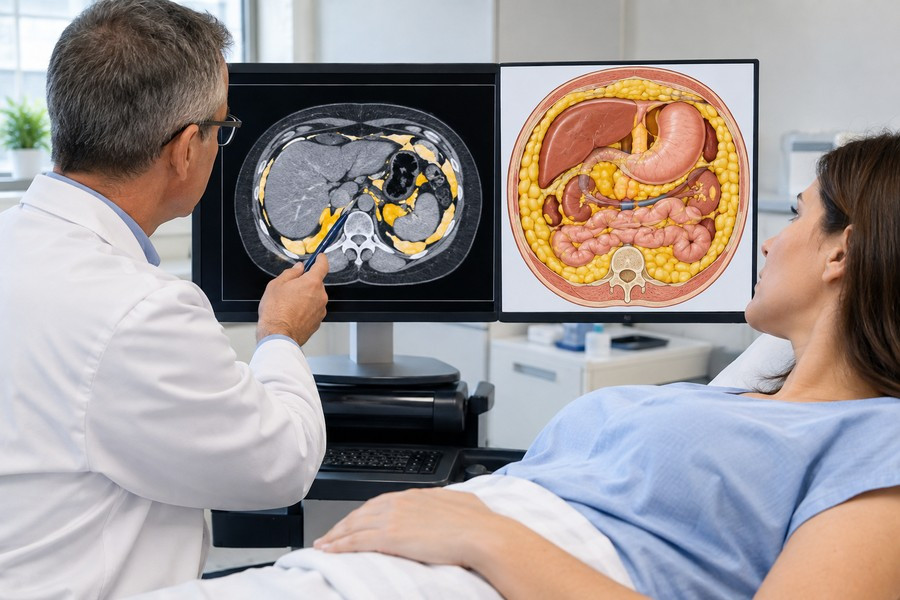
Visceral fat is stored deep inside the abdomen. It surrounds organs such as the liver, intestines and pancreas. This is different from the softer fat that sits just under the skin.
Although body weight and body mass index can provide useful health information, they do not show where fat is stored. A person may have a body size that appears healthy but still carry a large amount of visceral fat.
Deep belly fat can affect the way the body uses insulin and manages blood sugar. It has also been linked to a higher risk of type 2 diabetes, high blood pressure, unhealthy cholesterol levels and heart disease.
Research has found that visceral fat may have a stronger connection to heart failure risk than body mass index alone. This has increased interest in treatments that target fat around the organs.
How the Treatment Was Tested
The injection was studied in two phase 2 clinical trials. Participants received small injections in the lower abdomen about every three weeks. Treatment continued for as long as 12 weeks, and the largest dose used was 600 milligrams.
The number of injections depended on the thickness of each person’s belly fat. As the fat layer became smaller, fewer injections were needed.
Some participants received the experimental treatment, while others received a placebo. A placebo looks like a treatment but does not contain the active drug. This comparison helped researchers measure whether changes were linked to the injection.
MRI scans were used to examine the amount of visceral fat inside the abdomen. The scans showed that deep belly fat decreased in people who received the treatment. In the placebo group, visceral fat increased during the same period.
A Fat Cell Self-Destruction Process
The injection works by starting a process called apoptosis. During apoptosis, certain cells receive signals that cause them to break down and die naturally.
The treatment is designed to target fat cells while leaving nearby cells unharmed. This selective action is important because visceral fat is located close to major organs and other body tissues.
The injection had already shown the ability to reduce subcutaneous fat in earlier phase 2 testing. Subcutaneous fat is the layer found directly below the skin. Losing this type of fat could make the stomach look flatter, but the possible health effects of reducing visceral fat are more important.
Results From the Trial
Four weeks after the final treatment, MRI measurements showed an average 12.01% decrease in visceral fat among people who received the injection.
By comparison, people in the placebo group had an average 5.68% increase in visceral fat. The results suggest that the treatment may have an effect beyond normal changes in body fat during the study period.
- The injection was given in the lower abdomen.
- Doses reached as high as 600 milligrams.
- Treatments were given about every three weeks.
- Participants received treatment for up to 12 weeks.
- MRI scans were used to measure deep belly fat.
- Visceral fat fell in the treatment group but rose in the placebo group.
Possible Health Benefits
A flatter stomach may attract people who are interested in cosmetic changes. However, the larger goal is to improve health by reducing the fat that surrounds internal organs.
Lower levels of visceral fat could potentially support healthier blood pressure, cholesterol and body weight. It may also improve the body’s response to insulin, which could help lower the risk of type 2 diabetes.
These possible benefits still need to be studied in larger and longer clinical trials. Early results can show promise, but they do not prove that a treatment will work for everyone or provide lasting protection from disease.
Why Liposuction Is Different
Liposuction removes fat that sits under the skin. It can change the shape of areas such as the abdomen, hips or thighs. However, the procedure cannot reach visceral fat that lies deep inside the abdomen around the organs.
Because of this, liposuction does not remove the health risks linked to large amounts of visceral fat. The experimental injection is being studied for a different purpose: reducing fat inside the abdomen rather than only changing the body’s outer shape.
More research is needed before the treatment can be considered a proven option. Still, the early findings suggest that targeting deep belly fat directly may become a useful approach for improving metabolic and heart health.