
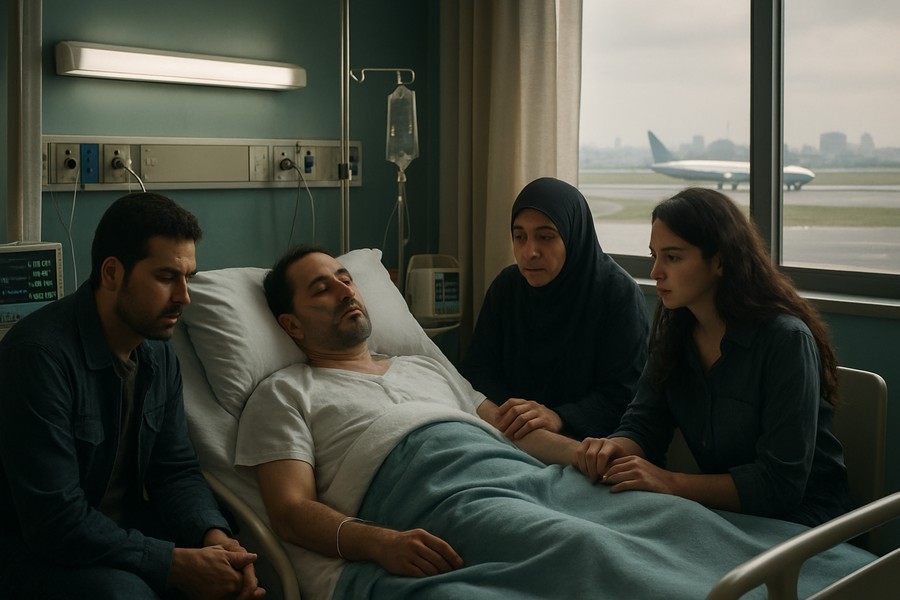
Mysterious Circumstances Surround Deportation of Comatose Man
The family of a man from Costa Rica, who was sent back to his home country in a coma-like state by the United States and passed away shortly after, is desperate for answers about his unexplained condition while in detention.
The individual, Randall Gamboa Esquivel, had left his home in Costa Rica in good health and made his way to the United States via the Mexico border. His family states that he was detained by U.S. officials for illegally re-entering the country, as he had resided there without documentation from 2002 to 2013.
Initially, Gamboa was held in a detention center in Laredo, Texas and was later moved to another detention center in Los Fresnos, Texas. Ten months later, he was returned to Costa Rica's capital, San José, on an air ambulance. Gamboa never regained consciousness and passed away five weeks later in a hospital in his hometown, Pérez Zeledón, a three-hour drive north of the capital.
A Family's Desperate Search for Answers
Distressed relatives, neighbors and past friends in Costa Rica are still trying to make sense of how Gamboa's health declined so drastically while he was in the custody of U.S. Immigration and Customs Enforcement. His younger sister, Greidy Mata, is leading the search for answers.
Mata recalls that Gamboa appeared healthy during their video chats while he was detained, up until their last conversation on June 12, after which he seemed to disappear. She waited weeks to hear from him, but Gamboa was actually in the midst of a health crisis.
"We couldn't find my brother and had to contact various agencies, lawyers, consulates, anyone who could assist," said Mata. "How can a man who was healthy, tall, and robust return in such a pitiful condition, looking neglected, covered in ulcers, in a vegetative state?" she asked.
Medical Records Reveal Disturbing Details
Medical documents relating to Gamboa's time in U.S. custody indicate that there was a request to transfer him from the detention facility to a medical center in Harlingen, Texas, on June 23. The records suggest that Gamboa was admitted to the hospital with an "altered mental state" and had been prescribed antipsychotic and antidepressant medications.
However, friends and family deny Gamboa had any history of mental illness prior to his migration to the US.
A representative from the U.S. Department of Homeland Security stated that Gamboa was diagnosed with "unspecified psychosis" while in custody and was hospitalized to receive proper mental health and medical care.
The representative further stated that those in custody receive dental and mental health screenings within 12 hours of arrival at each detention facility, a full health assessment within 14 days, and access to medical appointments and 24-hour emergency care.
Deteriorating Health Conditions
By July 7, Gamboa had been diagnosed with at least 10 conditions, including sepsis, a life-threatening reaction to an infection, and rhabdomyolysis, a condition where damaged muscle tissue breaks down rapidly. Other conditions mentioned in the records included protein malnutrition and toxic encephalopathy, caused by infection or prolonged exposure to harmful substances that ultimately affect brain function.
"Why didn't we know he was sick? Why was this information kept from us? We only found out where he was in August," said Mata.
She added that they didn't receive the information from the Costa Rican consulate or U.S. Immigration and Customs Enforcement but from a lawyer they had enlisted for help. The lawyer found Gamboa in a bed, unable to speak or move, but aware enough to follow people with his eyes.
The Costa Rican Ministry of Foreign Affairs declined to comment on Gamboa's case, and it's unclear whether any consular officers visited Gamboa during his hospitalization in Texas.
Return Home and Tragic End
Medical documents show that by August 7, Gamboa had received IV injections and more than a dozen medications. He was assessed as catatonic.
"At times, this feels like a horror story or a fabrication," said Mata, who is still grieving for her brother.
Mata recalled the brief moment of hope when Gamboa came home. "It was comforting to see and touch him again because it gave us hope that he could recover," she said. However, the doctors never gave them any such hope, and it quickly became apparent that his condition was irreversible.