
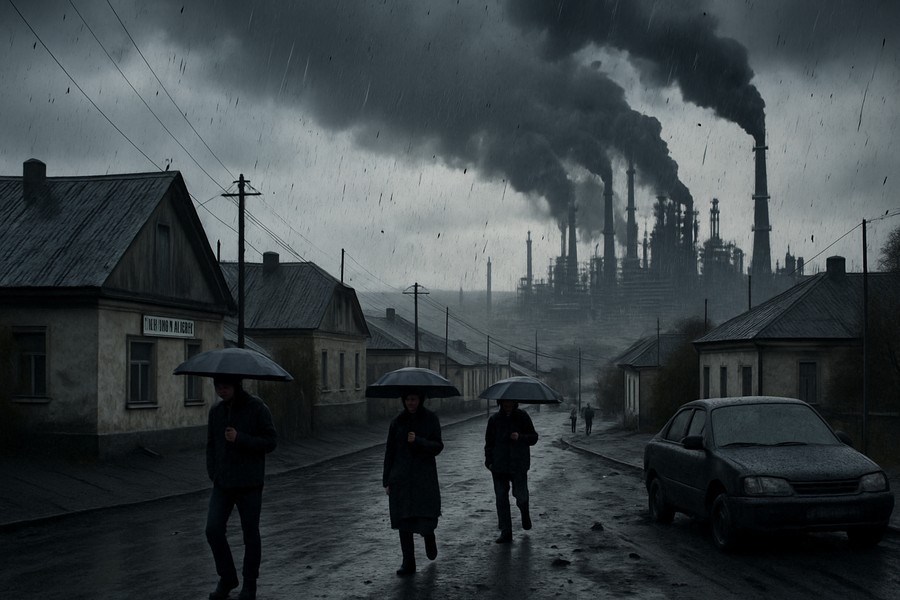
An Unsettling Forecast: Black Rain Showers Over Russia
The tranquil town of Tuapse, situated along Russia's Black Sea coast, is experiencing an alarming situation. A distinct, unpleasant, oil-like odor is ever-present, and a layer of black grime covers everything in sight. This black residue is the aftermath of what's known as "black rain".
What is Black Rain?
Black rain is a peculiar weather event where rain droplets are darkened by ash and soot, falling from the sky like black teardrops. This phenomenon has been witnessed in the past, for instance, following the atomic bomb explosion in Hiroshima in 1945, in Tehran in recent years, and during the Gulf War in 1991 when oilfields in Kuwait were set ablaze. Today, it's falling on parts of Russia.
Unmanned Aerial Attacks Target Refinery
Tuapse, home to one of Russia's largest refineries, has been targeted by a series of drone strikes over the past few weeks. These attacks are designed to undercut Russia's oil industry and have resulted in an ecological catastrophe within an already environmentally devastated war zone.
The first attack ignited a fire that raged for two days. Just four days later, another strike resulted in a massive cloud of thick smoke engulfing the sky. This fire blazed continuously for five days, releasing dangerous chemicals into the air. Air quality tests revealed benzene, xylene, and soot levels three times over the limits deemed safe.
Residents were advised to stay indoors, keep windows closed, and wear masks when venturing outside their homes. Amidst this chaos, black rain started to fall.
The Impact on Wildlife
The rain covered everything, including cars and animals. Local volunteer Elena Lugovenko shared, "All the animals are covered in oil. Volunteers have set up animal cleanup centers." Animals are being rescued, cleaned, and then sent to shelters. The oil spill is particularly hazardous for birds which struggle to fly when coated in oil, and can accidentally ingest the toxic substance while trying to clean themselves.
Environmental Catastrophe Unfolds
By the conclusion of the second attack, at least eight storage tanks at the refinery were decimated, resulting in petroleum leaking into the nearby Tuapse River. The current then carried the oil into the Black Sea, spreading it along the coast.
Authorities sent over a dozen boats to tackle the oil slick at sea, while booms were installed on beaches to contain the spill. Day and night, emergency crews and volunteers are striving to clean the rocky beaches using heavy machinery, and the oil is being gathered in barrels and plastic bags.
Despite their efforts, oil has already contaminated the coastline within a 12-mile radius. The cleanup task is mammoth, requiring the removal of soil and rocks, many of which are in hard-to-reach locations.
Volunteering in Tuapse comes with its own hazards. Tiny oil droplets in the air pose a risk when inhaled, and eye irritation can be severe. "You have to drink absorbents every two hours while cleaning it up," warned one of the volunteers. "Wear a mask and chemical protection."
Long-Term Consequences
Even with successful cleanup efforts, the long-term impacts on the local ecosystem could be significant and enduring. Oil products can settle in the bottom sediments of the Black Sea, disrupting the food chain. The oil slick blocks oxygen, leading to mass mortality of fish, shellfish, and bottom dwellers. Experts estimate that biodiversity restoration could take up to a decade or longer. Toxins can accumulate in organisms, posing a threat to birds and marine mammals, including dolphins.
The town was eventually evacuated due to unbearable conditions following the third drone strike. Russia's incursion into Ukraine has already caused environmental damage, and the escalation of strikes on Russia's oil industry seems likely.
Not the First Environmental Disaster
This is not the first time the region has faced an environmental disaster. Two Russian oil tankers sank during a storm on the Black Sea, spilling thousands of tons of petroleum. The cleanup effort for one of Russia's worst-ever environmental disasters involved emergency crews and tens of thousands of volunteers.
Need for Systemic Changes
Environmental activist Arshak Makichyan underlined the role of Russia's fossil fuel industry and its political system in these ongoing ecological disasters. He emphasized the necessity for systemic changes, as opposed to simply blaming external parties for these calamities.