
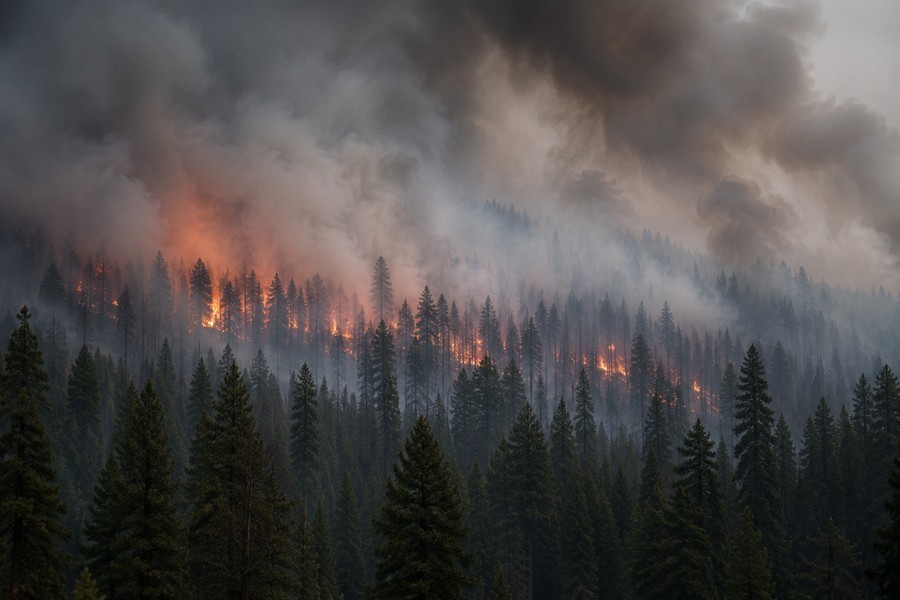
Massive Wildfires Force Hundreds of Thousands to Flee Across Southern Europe
Huge wildfires are spreading across Europe due to extreme heat and dry conditions. Hundreds of thousands of residents and tourists have been forced to leave their homes and campgrounds. The smoke is so thick that it can be smelled and seen hundreds of miles away from the active flames, turning the sky gray and making the sun look like a glowing red ball.
Massive Evacuations in France and Spain
The scale of the fires has forced emergency workers to order massive evacuations to keep people safe. In France, nearly 200,000 people have been displaced from their homes and vacation spots. The majority of these evacuations took place in the southwestern part of the country. In one region alone, tens of thousands of people had to flee their homes overnight as the flames drew closer to the suburbs of a major city.
In Spain, the situation is also critical. A national emergency has been declared, and more than 70,000 people have been evacuated from areas near the nation's capital. Another 20,000 residents in nearby regions have been instructed to stay indoors to avoid breathing the dangerous smoke. Government representatives emphasize that the primary goal is saving lives, and fortunately, no deaths have been reported.
Frightening Escapes and Ruined Vacations
The fast-moving flames have disrupted summer travel plans for thousands of families, leaving many with frightening stories of escape.
- Sudden Evacuations: One family vacationing near the coast woke up to find the sky filled with dark smoke, local shops closed, and public transportation stopped. As they tried to drive to safety, they found the roads blocked with heavy traffic. After finding a temporary place to stay, they had to pack up and flee a second time the next morning when that area also filled with smoke, causing their young child to develop a cough.
- Walls of Fire: Another traveler described seeing a literal wall of orange flames across the bay. Police officers arrived at their campground shortly after, giving everyone just 30 minutes to pack their belongings and leave. The rush caused traffic jams as families scrambled to escape, with some even leaving their tents and camping gear behind.
- Lingering Smoke: Even those who managed to escape to areas 100 miles away from the active fires report that they can still smell the burning wood. Other vacationers decided to end their trips early because the heavy smoke caused headaches and left a bitter taste in their mouths.
Where the Fires Are Burning
Dry forests and record-breaking heat have allowed fires to break out in several countries across the continent. Europe is currently warming faster than any other continent, with temperatures rising steadily over the last few decades. Here is where the major blazes are active:
- France: Massive fires are burning along the southwestern coast. One particularly large fire has cut off an entire peninsula, while another major blaze is spreading rapidly through pine forests further down the coast.
- Spain: Multiple fires are burning close to the capital city. Two of these fires recently merged, creating an even larger and more dangerous front that threatens to join a third fire in a neighboring province.
- Italy: Hundreds of individual fires have broken out on a large southern island, forcing local residents to flee their homes.
- Scotland: Emergency crews are working to contain a large wildfire in a national park that has been burning for well over a week.
International Help Arrives
Because the fires are too large for any single country to handle alone, neighboring nations are working together to share resources. An international fleet of 11 firefighting planes and helicopters has been sent to the hardest-hit areas.
France received five planes and two helicopters to assist local crews, while four additional planes were sent to Spain. Other countries have also contributed specialized equipment, including water-bombing aircraft and heavy-duty helicopters.
Despite the severe fires, government officials are encouraging tourists not to cancel their travel plans to parts of the country that are not affected by the flames, such as the capital city, though they urge everyone to stay updated on safety alerts.
Weather Challenges Ahead
Weather conditions will play a major role in whether firefighters can bring the flames under control.
In Spain, winds are expected to blow moderately from the northwest before slowing down. This is slightly helpful, as winds coming from the south would bring hotter, drier air. While there is a small chance of rain, weather experts worry it will not be enough to put out the dry ground.
In France, strong westerly winds are the biggest challenge. These winds are expected to strengthen, which could push the fires further inland. On the positive side, these winds are carrying humid air from the ocean, which may help keep the air damp, and there is a chance of scattered rain showers in some areas.