
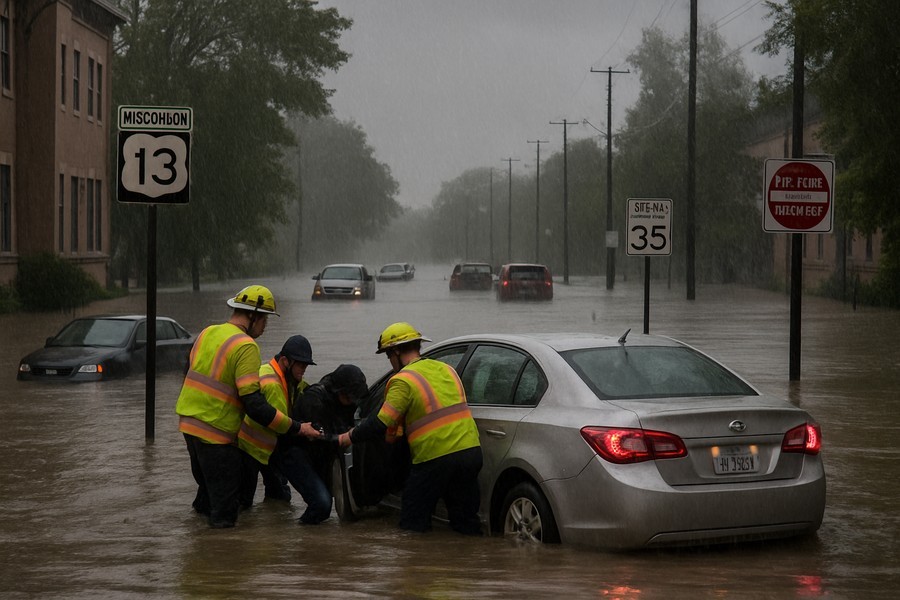
Midwestern States Grapple with Floods and Storms
Unprecedented rainfall in Wisconsin resulted in flash floods that left roads submerged and drivers stranded, necessitating the closure of certain highway sections. These events are unfolding as other Midwest states are still recovering from recent severe storms.
Motorists found themselves stuck in high water levels on a major highway in Milwaukee. A distressing video revealed a woman and her young child being saved from a trapped vehicle. Local law enforcement officials have taken to the web to warn residents in southeast Wisconsin against driving during these conditions.
As a response to the destructive storms that began on Monday, accompanied by high-velocity winds, hail, and heavy rainfall, the Governor of Wisconsin declared a state of emergency. The weather conditions have already led to the confirmation of three tornadoes, with forecasts predicting more severe weather to come.
Michigan Reeling from Storm Aftermath
Meanwhile, Michigan communities are attempting to recover from damaging overnight storms. These storms caused extensive damage to two ice arenas, flooded streets, and even uprooted trees. Wind speeds reaching up to 70 mph were recorded at a local university's football stadium and a nearby airport. Teams from the National Weather Service have been dispatched to various locations, including Ann Arbor, to assess the damage and verify whether one or more tornadoes were responsible.
Another wave of powerful storms, bringing potentially destructive winds, was predicted to hit the area from the west.
Schools and Ice Arenas Suffer Damage
Several public school buildings in Ann Arbor reported structural damage and power outages. The district was forced to shut down due to an outage that affected fire, phone, camera systems, and building access. The Mayor of Ann Arbor reported that structural engineers were evaluating damage to a wall at the city's Veterans Memorial Park Ice Arena. Part of the roof was also ripped off the university's Yost Ice Arena.
A particularly large tree was uprooted during the storm and narrowly missed a student's bedroom in Ann Arbor. The student, a 20-year-old junior, and his roommates were awakened by an alarm, followed by a phone alert urging them to seek shelter.
More Rainfall and Unexpected Fish Deaths
The storms dumped as much as 2.5 inches of rain across parts of southeastern Michigan by morning, with more rain expected across the Midwest, Great Lakes, and Ohio Valley regions. Flood warnings were issued for a large portion of Michigan’s eastern Lower Peninsula, southeastern Michigan, northern Indiana, northwestern Ohio, the Chicago area and Wisconsin.
In a tragic twist, a power outage during a storm in northern Michigan resulted in the deaths of 1,750 steelhead trout at a state facility. The blackout halted the flow of oxygenated water, leading to the death of the fish.
Flooding Continues as Weather Worsens
Wisconsin's Department of Natural Resources is closely monitoring the levees around a city of about 10,000 residents as the local river continues to rise. The river swelled to nearly 19 feet, a whole 2 feet over the flood state, and could reach up to 20 feet.
A significant amount of water is also entering a lake in northern Michigan, following a series of rainfalls and snow melts. The lake drains into a river that flows through the city and into Lake Huron. Officials have been managing the flow through the city's dam by adjusting gates, introducing pumps, raising a bridge, and restricting public access to some parts of the riverfront.
The ongoing flooding and unsafe travel conditions led local schools to cancel classes and sporting events. The situation continues to worsen in some areas, according to the district.
What's Next for the Weather?
A meteorologist from the weather service’s Storm Prediction Center described the situation as a "very dynamic weather pattern." This pattern, which combines very humid air with a strong jet stream across the central United States and Great Lakes, creates conditions for severe thunderstorms. Over 400 reports of hail, winds exceeding 60 mph, or tornadoes have been received by the weather service.
The system was expected to stretch northward from central Texas into Iowa and southern Wisconsin and then eastward across parts of Michigan, Illinois, northern Indiana and Ohio. The system is predicted to keep moving towards upper Pennsylvania and the Buffalo, New York, area.