
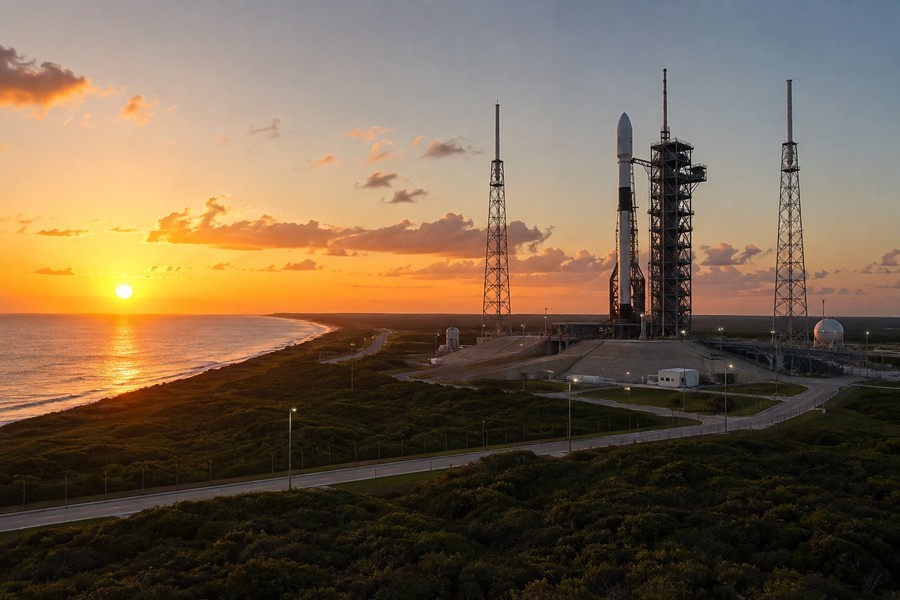
A Major Shift in Rocket Launches Will Quieten the Coast of Florida
The busiest spaceport in the world is getting ready for a much quieter period. For the past ten years, a major private spaceflight company has kept the coast of Florida incredibly busy with constant rocket flights. However, that high-speed schedule is about to slow down significantly as the company shifts its focus toward preparing a massive new spacecraft.
The company is planning to reduce its launches from Florida until its giant next-generation rocket is fully ready to fly from the region. This decision marks a big change for a coastal area that has grown used to the frequent rumble of rocket engines.
The Workhorse Rocket Takes a Step Back
For a long time, the company relied heavily on its standard workhorse rocket. This medium-sized rocket was used to launch large groups of internet satellites into orbit, helping to build a massive global network that provides web access to millions of people. Most of these missions took off from twin launch pads located on the Florida coast.
To understand just how busy this program was, consider the numbers from the previous year:
- The workhorse rocket flew a total of 165 times in a single twelve-month period.
- This schedule averaged out to about three rocket launches every single week.
- About 75 percent of those flights were dedicated solely to carrying the company's own internet satellites into space.
This year, however, the strategy has changed. Since the start of the year, the aerospace firm has been launching more of its missions from a West Coast pad located in California. This trend of moving flights to the West Coast is expected to grow even stronger throughout the rest of the year.
Waiting for the Giant Rocket to Arrive
A recent early-morning liftoff was the very last scheduled flight of the standard rocket carrying the company's own internet satellites from the Florida coast. For the foreseeable future, all future internet satellite missions departing from Florida will have to wait until the company's giant, next-generation rocket is ready to take over.
Because of this pause, the launch rate in Florida will drop dramatically. Instead of seeing eight or nine rocket departures every month, local skywatchers might only see about two per month for the rest of the year, and possibly even longer.
Not long ago, two launches a month was considered a very fast pace. This shows how quickly the company's launch operations have grown over the last decade. The neighboring launch pads in Florida share the same tracking range and essentially operate as one single, massive spaceport. The last time this combined Florida spaceport did not lead the entire world in total space launches was nearly ten years ago.
While the Florida team waits for the new giant rocket, the West Coast team in California will continue to regularly launch the older internet satellites using the standard workhorse rocket.
A Record-Setting Flight and Future Customer Missions
The final internet satellite launch from Florida using the standard rocket was special for several reasons. First, the reusable booster used for the flight set a new company record by completing its 37th successful mission. Additionally, because the rocket took off just before sunrise, people living all along the East Coast of the United States were treated to a beautiful view of the vehicle climbing into the morning sky.
Over the years, the company has completed about 260 of these internet satellite flights from Florida using its standard rocket. Now that this phase is over, all future flights of both the standard rocket and its larger, heavy-lift version from Florida will carry payloads for paying customers rather than the company's own satellites.
Some of these upcoming customer flights include:
- A mission in the coming weeks where a heavy-lift rocket will carry a highly advanced space telescope for the nation's space agency.
- A flight in the early fall using the standard rocket to deliver a new crew of four astronauts to the international space station.
Looking Toward the Future
Eventually, the company wants to completely phase out its standard workhorse rocket in favor of the giant new spacecraft, at least for commercial flights. This long-term plan has caused some worry among the company's regular customers, who are concerned about whether they will have access to reliable and proven launch services in the late 2020s.
The company still hopes to start launching its giant new rocket and its massive booster from its Florida pad by the end of this year. However, industry observers believe this goal is highly unlikely to be met. There is still a massive amount of construction work left to finish at the Florida pad. Furthermore, there have been no signs that the giant rockets are being transported from the company's main manufacturing facility in southern Texas to the Florida coast. A debut launch from Florida in a few years seems much more realistic.
When the giant rocket does finally begin flying from Florida, it will be able to carry up to 60 of the company's next-generation internet satellites. These new satellites are much larger, heavier, and more powerful than the older versions that flew on the standard rocket. To test these new systems, the company plans to use an upcoming test flight of the giant rocket to launch the very first batch of these advanced satellites from its development site in Texas as early as next month.