
America Has Faced Political Turmoil Before, Former Adviser Says
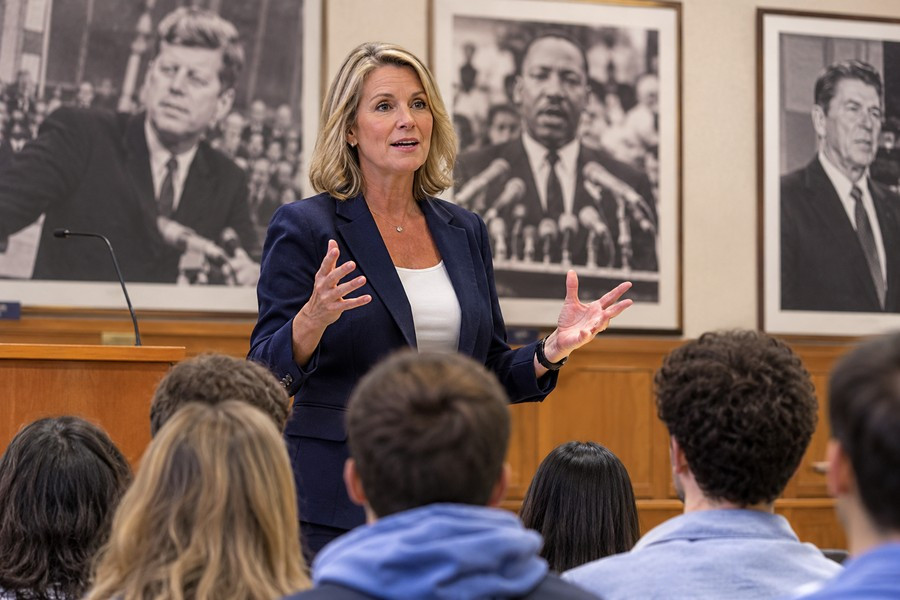
Understanding the nation’s political struggles requires looking at the difficult moments that came before them, former White House Deputy Chief of Staff Karl Rove told a public audience during a civic education event.
Before his speech, Rove met with students taking part in the program. He praised their interest and the questions they asked. He said he wished more young people across the country were involved in civic discussions.
Rove previously served as a senior adviser to President George W. Bush. He also teaches a course about modern presidential campaigns at the University of Texas at Austin.
“It Has Been Worse Before”
Rove began by asking how many people felt satisfied with the current state of American politics. No one raised a hand.
He then offered a broader view of the nation’s political history. Rove said the current level of conflict may seem extreme, but the country has experienced even more serious divisions in the past. He is writing a book about those earlier periods.
“As bad as we think it is today, it’s been worse before,” he said.
Rove then moved through several major periods in American history, showing how the country survived violence, economic hardship and deep political division.
Periods of Violence and Division
He first discussed the unrest of the 1960s and early 1970s. During that period, riots spread across cities, college campuses closed and political violence took the lives of national leaders.
He also described the economic crisis of the 1930s, when about one out of every four Americans was unemployed. Political movements on both the left and the right gained strength during that time, adding to the country’s divisions.
Rove then looked back at the Gilded Age, a period marked by major economic growth and serious political conflict. He said narrow election victories sometimes led House majorities to remove members of the opposing party from office. This happened about 60 times during the period between 1874 and 1904.
He also recalled the years before the Civil War, when some members of Congress carried weapons onto the House floor. Rove ended his historical review with the election of 1800, when Thomas Jefferson and Aaron Burr received the same number of Electoral College votes. The House of Representatives needed 36 ballots before selecting Jefferson.
Confidence in the American System
Rove said these examples show that political conflict, while dangerous, is not new to the United States. The country has repeatedly faced moments when its future seemed uncertain.
He urged the audience not to believe that the nation is too divided to continue or that the American system has reached its end.
“Do not tell me we are too polarized, too divisive, that the American experiment is somehow over,” Rove said. “Don’t tell me that because it’s not true.”
In each difficult period, he said, the country eventually found leaders who helped guide it forward. Rove argued that citizens play an important role in finding those leaders because public expectations influence the people who seek office.
“We find these people because we demand these people,” he said.
Cooperation Across Party Lines
Rove pointed to cooperation between two members of Congress as an example of how lawmakers can work together despite political differences.
Representative August Pfluger, a Republican from Texas, has worked with Representative Seth Moulton, a Democrat from Massachusetts, on veterans’ health care. Rove said Pfluger once explained that Democrats should not be viewed as enemies. They are political rivals, he said, but they remain fellow Americans.
The example reflects Rove’s larger argument that disagreement does not have to prevent cooperation. Lawmakers can hold different views while still working on issues that affect people across the country.
A Family Story About Opportunity
Rove ended his speech with the story of his great-grandfather, Olaf Julius Rove, who came to the United States from Norway in 1881.
Olaf arrived with little money or security. During his first winter, he lived in a cousin’s barn. He later worked his way through the University of Wisconsin and law school.
He was eventually invited to become Norway’s first ambassador to the United States. He turned down the opportunity because accepting it would have required him to give up his American citizenship. Rove said his great-grandfather considered citizenship in the United States too valuable to lose.
Rove keeps a desk his great-grandfather built during that first winter in his living room. He said the desk reminds him of the opportunities his family received and of what he considers the country’s greatest gift: being born in the United States.
Citizens Have a Role to Play
During a question-and-answer session, Rove discussed differences between generations in Congress, the responsibility of citizens to expect more from elected officials and the effect of social media on political debate.
He said social media often rewards anger and dramatic behavior. In his view, Congress now has fewer traditional legislators and more people focused on public performance.
Rove’s main message was that Americans should judge the present through the full story of the nation’s past. The country has faced severe division before, he said, and its future depends on citizens who remain involved, demand capable leadership and keep faith in the democratic system.