
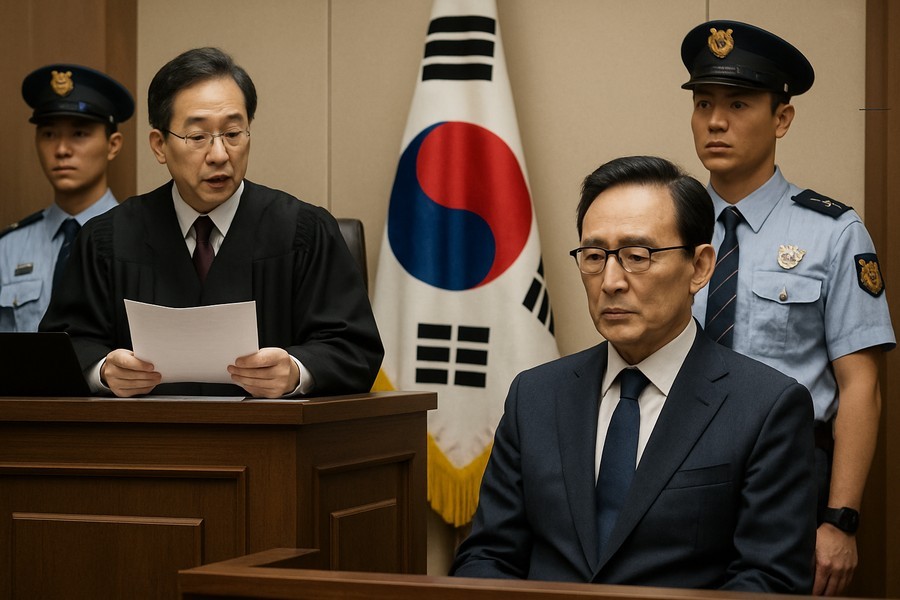
Former Leader of South Korea Receives 7-Year Sentence for Defying Arrest and Other Charges
A former leader of South Korea has been handed down a seven-year prison sentence for charges that include defying arrest and circumventing a necessary Cabinet meeting prior to his short-lived enforcement of martial law. This new sentence comes in addition to a life sentence he had already been given due to his puzzling push towards authoritarian rule, resulting in the most severe challenge to the nation's democracy in a long time.
Court's Verdict
The former leader was found guilty of numerous charges, including obstructing justice. The conservative ex-leader was found to have bypassed a legally required full Cabinet meeting before announcing martial law. He was also found guilty of falsifying documents to hide this misstep, and for using security officials as though they were his private militia to resist attempts by law enforcement to arrest him after his impeachment. The former leader offered no comment as the verdict was announced.
One of the legal representatives on the ex-leader's team expressed great disappointment at the verdict and hinted at an appeal to the Supreme Court. The ex-leader has already appealed his life sentence.
Previous Court Cases
Earlier this year, a lower court had sentenced the former leader to five years in prison, but had partially acquitted him on charges of misuse of power related to the Cabinet meeting before the declaration of martial law. The court found that he was not to blame for the absence of two members who were invited.
However, the higher court overturned that acquittal, finding the ex-leader guilty on all counts. The court ruled that he infringed upon the rights of those two members as well as seven other Cabinet members, by calling only a select few to mimic a formal meeting.
Impact on South Korea
Even though the enforcement of martial law by the former leader was short-lived, it threw the nation into a serious political crisis. It led to a standstill in politics, high-level diplomacy, and caused ripples in financial markets. The political unrest only subsided after his liberal opponent won an early presidential election.
The former leader was suspended from office after being impeached by the legislature dominated by liberals, and was formally removed by the Constitutional Court a few months later.
After his suspension, the ex-leader defied a court's arrest warrant, leading to a standoff where many investigators were blocked by presidential security forces and vehicle barricades when they arrived at the presidential residence. He was detained later that month, released by a different court a few months later, and then re-arrested. Since then, he has remained in custody and continues to face a series of criminal trials.
Additional Court Ruling
The court also extended the sentence of the former leader's spouse from four years. The charges included accepting extravagant gifts from a religious group that sought political favors from her husband's administration, and participation in a scheme to manipulate stock prices.