
How Space Fossils Reveal the Violent Childhood of Our Galaxy
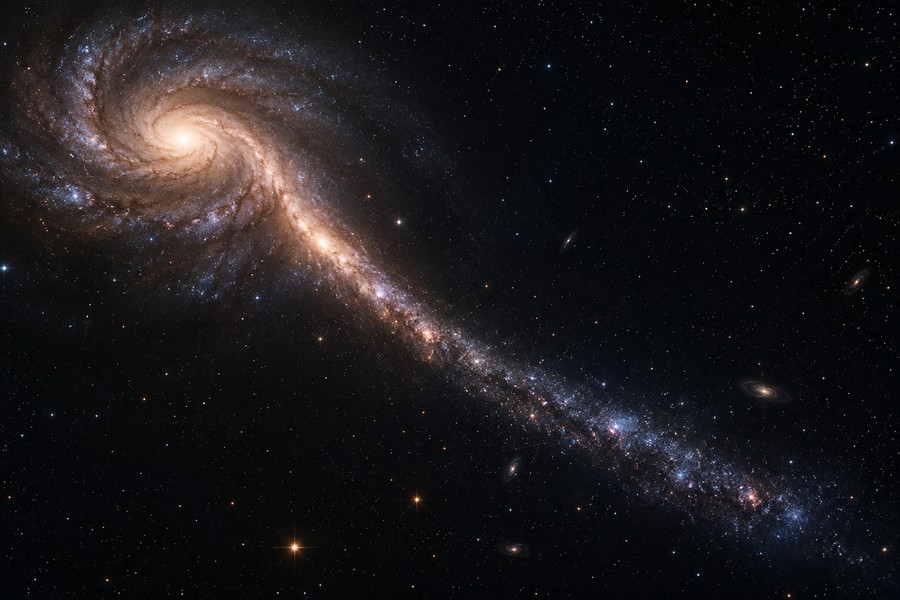
The night sky looks incredibly peaceful when we look up at the stars. But beneath this quiet appearance lies a chaotic and violent history. For more than 13 billion years, our home galaxy, the Milky Way, has grown by swallowing up neighboring galaxies. A scientific study has shed new light on one of the earliest and most massive of these cosmic collisions, helping us understand how our galaxy was built during its first few billion years.
How Galaxies Grow Through Cosmic Collisions
Galaxies do not start out giant. Instead, they grow slowly over time. Gravity plays the main role in this process. When a smaller galaxy gets too close to a larger one, the stronger gravity of the larger galaxy pulls the smaller one apart.
The stars from the swallowed galaxy do not disappear. Instead, they spread out across the larger galaxy. Even after billions of years, these stars still carry clues about where they came from. Because of this, astronomers can study these stars like fossils to reconstruct the history of our galaxy. This field of study is often called galactic archaeology.
Scientists already knew about some of these mergers. For example, a large galaxy crashed into the Milky Way about 10 billion years ago. But finding out what happened even earlier is much harder because the Milky Way itself was still small and developing, making the clues difficult to untangle.
Using Star Clusters as Cosmic Clocks
To look further back in time, researchers focused on groups of stars called globular clusters. These are tightly packed groups that contain hundreds of thousands of stars that all formed at the same time. Because they formed together, they act like highly accurate cosmic clocks.
Astronomers measured the ages of these clusters using advanced space telescope observations. They also looked at the chemical makeup of the stars, specifically searching for elements heavier than hydrogen and helium.
- When the universe first began, it was filled with only the lightest elements, mostly hydrogen and helium.
- As stars live and die, they act like factories, creating heavier elements and scattering them into space.
- Newer generations of stars inherit these heavier elements, meaning older stars have very few of them, while younger stars have more.
By comparing the ages and chemical mixtures of these star clusters, researchers mapped out three distinct groups. One group belonged to the early Milky Way itself. Another belonged to the galaxy that merged 10 billion years ago. The third group belonged to an even older collision.
An Ancient Galactic Crash Revealed
The study shows that this older collision happened about 1.8 billion years before the other major merger. The galaxy that crashed into the Milky Way during this ancient event was massive, containing about 500 million times the mass of our Sun in stars.
When this galaxy collided with the young Milky Way, most of its stars ended up in the very center of our galaxy. This discovery does more than just add a new branch to the family tree of the Milky Way. It helps scientists understand what these ancient galaxies looked like and how they behaved before they collided.
Two Ways to Study the Early Universe
Scientists have two main ways to learn about the ancient universe:
- Deep space telescopes can look at incredibly distant galaxies to see what they looked like billions of years ago. However, these galaxies are so far away that we cannot see their individual stars.
- Galactic archaeology allows us to study the surviving stars right here in our own Milky Way in great detail.
By combining these two methods, researchers are putting together a clearer picture of how our galaxy grew from a small group of stars into the massive spiral we live in today.