
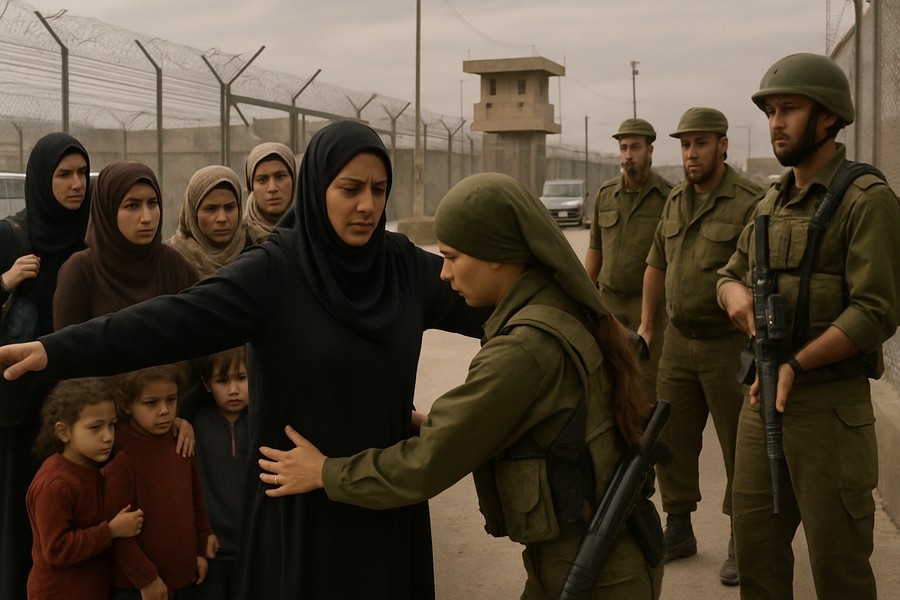
Women Report Inspections by Local Militia at Reopened Rafah Crossing
Two women from Gaza who recently crossed the reopened Rafah border with Egypt have revealed that a local Palestinian militia group, alleged to have links with Israel, conducted checks at an Israeli military checkpoint inside the Gaza Strip.
The women, one of whom was traveling with her kids, shared that Israeli forces escorted them from the border to a nearby checkpoint where the militia group, known as the Popular Forces, inspected them and their belongings.
Militia Group's Role in Border Checks
According to the women, the inspection was handled by a female member of the militia group. After the inspection, the women were then directed to the Israelis for questioning. They further added that both the Israelis and the militia group were located at the same checkpoint.
The militia group, known for its anti-Hamas stance, reportedly receives aid and weaponry from Israel, and operates in the Rafah area under Israeli military jurisdiction. The leader of the militia stated earlier that his group will play a significant role in security matters related to the Rafah crossing's entry and exit points.
Allegations of Mistreatment
One of the women, who wishes to remain anonymous for her safety, claimed that she was offered assistance with her trip to Europe if she cooperated with the group. She also alleged that she and three other women were physically and verbally abused by the militia. However, the other woman had a smooth experience without any negative incidents.
Reports of Confiscated Belongings
Both women reported that officials confiscated many of their personal items inside the Rafah crossing. Items such as perfumes, makeup, headphones, and even cough syrup were taken away from them. Additionally, they reported that there was a limit on the amount of money each person could bring into Gaza, set at $600.
Despite these reports, only 12 people managed to cross the border after a group of patients who had completed treatment in Egypt arrived at the Egyptian side of the crossing. Although all of their names had been screened in advance by Egyptian and Israeli security, the rest were sent back to Egypt with no explanation.
The Rafah Crossing Reopening
The reopening of the Rafah crossing has been shrouded in confusion. The organization in charge of civilian liaison in Gaza has not yet confirmed the total number of people who crossed in and out of Rafah recently.
Healthcare organizations have noted that a small number of patients were transferred out of Gaza for medical care, a small fraction of the thousands of Gazans in need of medical evacuations. They hope this is the beginning of a process that will allow more patients to leave.
The new travel system through the Rafah crossing has put a spotlight on the control of Hamas in Gaza, emphasizing the challenge of excluding the group from the territory's matters. This situation has also highlighted the limited role of the new National Committee for the Administration of Gaza, which has played no part in the evacuation process despite being designated as Gaza's new temporary administrators under a certain plan.
With the reopening of Rafah, a new, more challenging phase of the plan has begun, depending on the disarmament of Hamas, the withdrawal of Israeli forces, and the authority and control of a new administration. The disagreements and confusion surrounding Rafah are a warning of the tough challenges that lie ahead.
