
Unearthing Our Planet's Secrets: Fascinating Discoveries of 2025
Earth, with its rich abundance of life, was once a lifeless, magma-covered rock. Over billions of years, it has transformed into the vibrant, living world we call home today. But many questions still linger about our planet’s past. Thankfully, 2025 was a year of remarkable discoveries that have helped shed more light on these mysteries.
Discovering the World's Oldest Rock
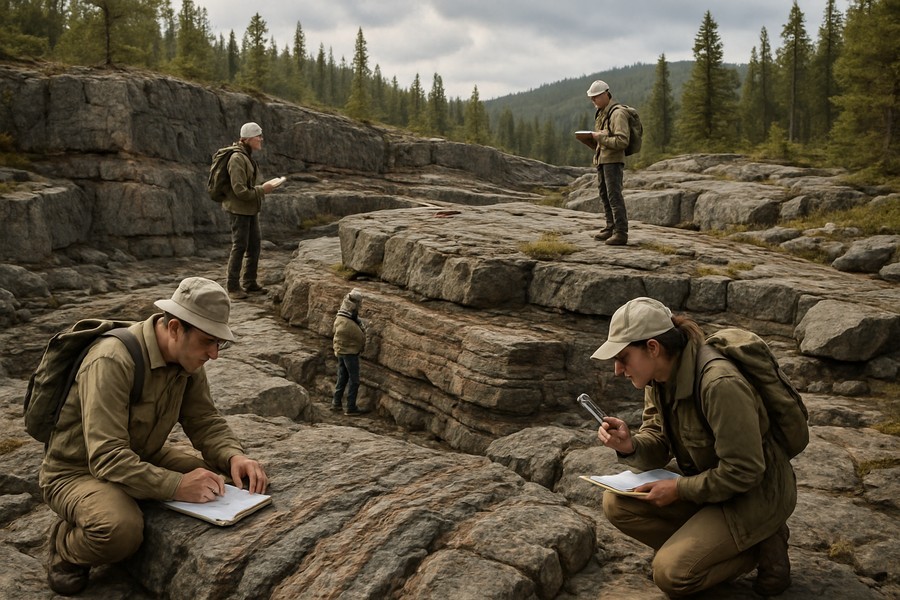
In a remote area of northern Quebec, scientists uncovered fragments of what they believe to be the oldest known pieces of Earth's crust. This ancient rock formation, hidden in an outcrop, takes us back 4.16 billion years to the first of the four geological eons, known as the Hadean.
As the name suggests, the Hadean era was a turbulent and fiery time in the Earth's history. However, these ancient rocks might hold signs of life from this distant era. But there's still a lot more to learn, as the rock sample lacked zircon, a reliable marker used for dating ancient rocks.
Micro-Lightning and Life's Origins
The enigmatic phenomena known as will-o'-the-wisps, ghostly lights seen over marshes and bogs, have been a source of mystery for centuries. Recent studies suggest that these lights are created by tiny lightning flashes that ignite microscopic methane bubbles.
These micro-lightning flashes are not sky-born but are produced when electrically charged water bubbles interact with methane. Interestingly, it's been suggested that these tiny flashes could have sparked the chemical formation of life's building blocks over 3 billion years ago.
Shifting of the Magnetic North Pole
Unlike the Earth's geographic North Pole, which remains fixed, the magnetic north pole is in constant flux due to Earth's ever-changing magnetic field. Its movement has been particularly erratic over the past few decades, speeding up significantly before slowing down after 2015.
In 2025, scientists updated the World Magnetic Model, which is vital for maintaining the accuracy of global positioning systems. The model predicts that the magnetic north pole will continue to drift towards Russia, although at a slower pace.
Life in the Deepest Depths
A dive into a deep ocean trench revealed a thriving ecosystem of organisms that use methane, not sunlight, to survive. Located between Russia and Alaska, this ecosystem exists at depths of 5,800 to 9,500 meters, making it the deepest known habitat of its kind. The organisms found here, including unique species of clams and tube worms, rely on a remarkable microbial process that converts organic matter into methane.
Hidden Supercontinents
Our planet hides many secrets beneath its surface. For instance, remnants of ancient supercontinents have been found deep within the Earth's mantle. These findings suggest that the mantle is not as uniformly mixed as once believed, and these ancient tectonic plates could be influencing the mantle's activity in ways yet to be understood.
The Mystery of Earth's Core
Our planet's core remains a mystery that scientists are still trying to unravel. This innermost layer, a solid ball of metal surrounded by a liquid outer core, can't be observed directly. Instead, scientists study it by analyzing seismic waves as they pass through it.
In 2025, it was revealed that the inner core has undergone changes in its shape, with deformations noted in its shallowest level. More intriguingly, it was discovered that small amounts of gold, one of the metals believed to be in the core, have somehow made their way to the surface. If this leakage continues, we might see more gold rising from the Earth's core in the future.