
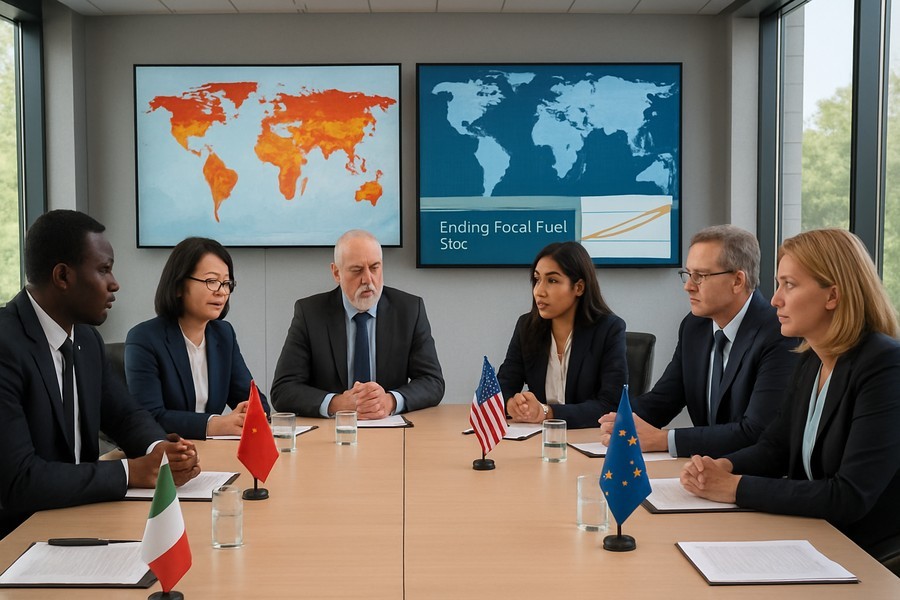
A Turning Point in Global Climate Discussions: A Move Toward Fossil Fuel Phaseout
A groundbreaking climate conference, involving almost 60 nations, has recently solicited each government to construct national “blueprints” to guide them in their journey to end the use, and production of fossil fuels. These voluntary blueprints are envisioned to serve as a solid foundation for a new global initiative, aimed at leading the world away from the reliance on coal, oil, and gas.
This innovative approach signifies a shift from the traditional UN climate negotiations, which have been ongoing for over three decades, even as greenhouse gas emissions continue to surge. While the majority of the world’s largest emitters are not part of the 59 participating nations, invitations are being extended to other countries.
A Global Endeavour
The chair of the climate discussions, who also serves as Colombia's environment minister, expressed their determination not to accept an economy built on the destruction of life. She emphasized that the shift away from fossil fuels should not merely be a slogan, but a concrete, political, and collective effort. The legacy of the delegates will not be the conference alone, but whether they rose to the challenge of their time.
Colombia and the Netherlands, the inaugural conference's co-hosts, led discussions on diverse topics including trade, debt, reliance on fossil fuel exports, and methods to reduce demand. Prior to these discussions, various stakeholders including activists, Indigenous leaders, scientists, and other experts convened in Santa Marta to discuss the social and economic impacts of fossil fuels and strategies to curb demand.
A Coalition of the Willing
Despite the absence of major players such as the US, China, India, Russia, and oil-rich nations like Saudi Arabia, Qatar, and the United Arab Emirates, the attendees were solely countries ready to commit to a phaseout. This “coalition of the willing” represents over half of the global GDP, nearly a third of energy demand, and a fifth of the fossil fuel supply.
Interestingly, almost half of the countries present are fossil fuel producers. They will be expected to outline how they plan to gradually reduce production. However, there are no specific guidelines on how these plans should be structured, nor deadlines for completing the transition.
During the conference, Colombia released a preliminary blueprint and established a scientific panel to provide guidance to countries. Shortly thereafter, France became the first developed nation to unveil a national blueprint to phase out fossil fuels.
Customized Roadmaps
The Netherlands’ minister for climate and green growth expressed that these blueprints are tools for achieving the ambition each nation brought to the table. She acknowledged that there will be varying speeds among countries due to different starting points and challenges, making a one-size-fits-all approach infeasible.
While nations already publish climate plans under the Paris agreement, these are often inadequate as they only address domestic greenhouse gas emissions, allowing fossil fuel producers to overlook the climate impact of their exports.
Support for Developing Nations
The participants agreed to assist poorer countries with the expertise needed to develop blueprints, scrutinize fossil fuel subsidies, and collaborate on trade policy and financial reform. This includes helping vulnerable countries tackle debt and raising the necessary finance to make the transition.
Looking forward, a second conference is scheduled to occur early next year on the Pacific island of Tuvalu, co-hosted by Ireland. They are encouraging governments to draft their blueprints before the next conference, emphasizing that missing this opportunity would be a loss, although participation remains voluntary.
Notably, the Santa Marta conference was driven by dissatisfaction with the UN climate summits, where consensus rules have often allowed fossil fuel interests to obstruct direct discussion of the need to phase out coal, oil, and gas. However, the participating governments have pledged to work closely within the UN system to facilitate global progress on the climate at the upcoming Cop31 UN climate conference.
The Road Ahead
The founder and chair of the Fossil Fuel Non-Proliferation Treaty Initiative hailed Santa Marta as a historic breakthrough, marking the first time a group of nations willing to act has come together. They are building a coalition of ambitious countries ready to lead and break the consensus deadlock that has hampered concrete action on fossil fuels in the UN negotiations.
Observers lauded the constructive nature of the Santa Marta talks. A representative from the University of Barcelona noted that Santa Marta broke the pattern of climate forums where everyone talks but no one understands, calling it the language of hope.
Finally, a climate justice and energy programme co-coordinator called for governments to replace fossil fuels with renewable energy, especially in the wake of the current oil crisis. She emphasized that avoiding a climate breakdown requires a systemic change to the current energy model, advocating for a shift from fossil-fueled corporate dominance to decentralized renewables that ensure energy sovereignty for all.