
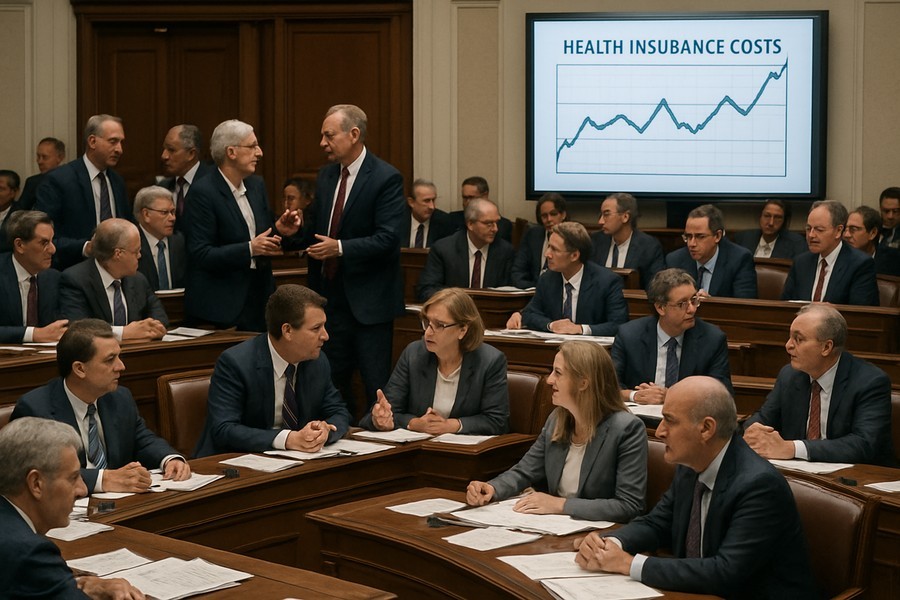
Congress to Decide on Reinstating Health Insurance Subsidies Amidst Political Disagreements
Despite the apparent hesitation from the principal parliamentary leader, the decision to revive enhanced health insurance subsidies, which ended last year, is set to be voted on by the House of Representatives.
Although it is anticipated that the proposal for a three-year extension will receive approval in the House, it might meet resistance in the Senate, where a similar proposal was declined last month. However, lawmakers from both parties in the Senate are hinting at a potential agreement on a compromise bill regarding the health insurance subsidies.
Healthcare Debate Taking Center Stage Amidst Foreign Policy Discussions
The discussion surrounding the cost of healthcare has dominated Congress's attention in the concluding weeks of the last year. The urgency to address the discontinued subsidies is emerging as members are also dealing with inquiries about the future of U.S. foreign policy in the wake of recent actions in Venezuela by the President. This also involves a predicted vote in the Senate, aimed at preventing further U.S. military engagement in Venezuela without the approval of Congress.
The vote is one of many crucial decisions that lawmakers are tasked with at the start of the year. Alongside these pressing issues, they face a looming deadline at the end of the month to finance the government and avoid a partial shutdown.
Overcoming Obstacles to Extend Subsidies
For weeks, the Republican leaders have been unwilling to permit a vote on extending the subsidies. However, just before the holiday break, four Republicans from districts that often swing between parties joined Democrats to force a vote on the three-year extension of the subsidies. This was achieved through a discharge petition, a rarely used legislative tool that allows a majority of members to bypass the principal parliamentary leader and force a vote.
A procedural motion to arrange the final vote in the House received support from nine Republicans. Despite this, even many of those who support it admit that a clean three-year extension is unlikely to pass the Senate. The hope is that success in the House would revive bipartisan negotiations in the Senate, and there are indications that this may be happening.
A small group of senators from both parties has been in negotiations this week, and several have indicated that they are nearing an agreement.
The Road Ahead in the Senate
The emerging compromise, as described by a Senator from Ohio, revolves around a two-year extension. In the second year, patients could choose to have the funds deposited in a Health Savings Account, instead of subsidies from the government going to the insurance company.
The President has advocated for patients to receive federal healthcare funding directly and has frequently criticized the subsidies as government giveaways to large insurance companies.
The plan would also include an income cap, among other changes requested by Republicans. It's also likely that the open enrollment period would be extended so people who dropped their policies due to the premium increases caused by the subsidy expiration could have a chance to sign up for coverage.
However, there are still some disagreements regarding a bipartisan deal. Some Republicans are seeking more specific language about the prohibition of federal funding being used for abortion. Despite this, the President has advised House Republicans that they may need to be "flexible on this."
There are also many Republicans strongly opposed to the enhanced subsidies altogether. So, even if the bipartisan group reaches an agreement, the final outcome remains uncertain.
A Busy Start for Congress
As legislators strive to agree on the subsidies, questions about the future of the U.S. role in Venezuela have also escalated. The Senate is set to vote on a resolution that would prevent military action against Venezuela without congressional approval. Although the resolution requires a simple majority to pass, it's expected to fall short of that threshold.
In addition to decisions on healthcare and Venezuela, lawmakers are also under pressure to fund the government by the end of the month. While Congress has already approved full-year funding for some federal agencies, the extended government shutdown last fall ended with a temporary funding solution that only covered most departments into the first month of the year.
Several of those funding bills are due to be voted on in the coming days, but the final details for bills that cover more controversial areas — such as the Department of Defense and the Department of Health and Human Services — are still being worked out.
Meanwhile, the House is set to vote on overriding two vetoes by the President just before the new year — a rare pushback from Republicans in Congress. One veto concerns water infrastructure in Colorado, while the other affects a Native American tribe in Florida.