
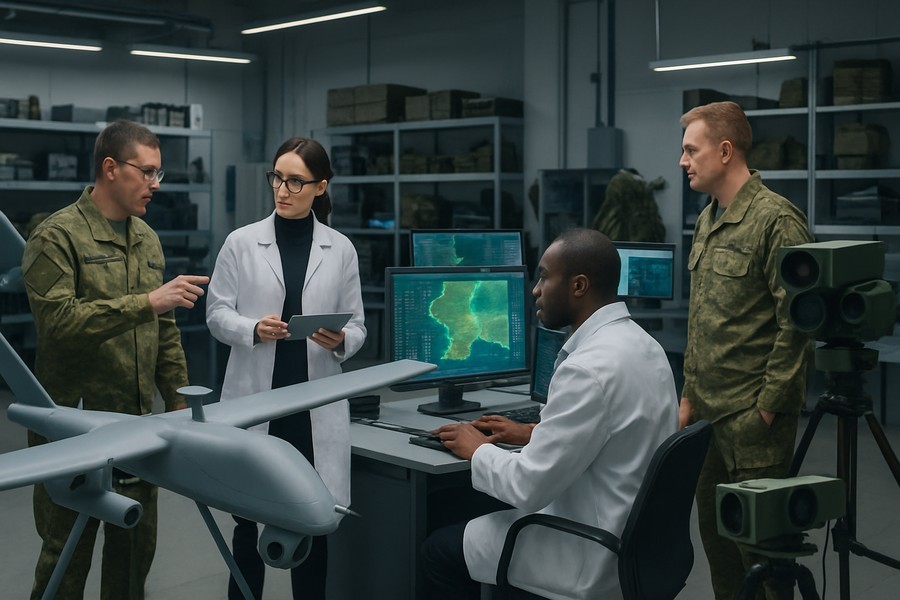
Technological Advances Fuel New Wave of American Military Power
Meet Alex Karp, the head honcho of a rapidly growing military tech company. Karp isn't one to shy away from controversy, and his recent comments about utilizing drone technology to disperse a substance have raised more than a few eyebrows. Such statements underscore a growing trend in the military tech sector, where the application of technology doesn't seem to have any boundaries.
Karp is known for his love for vigorous debates and his company, which produces state-of-the-art weaponry. His company's technology has been instrumental in escalating conflict in Gaza, increasing deportations, and identifying protestors. Karp doesn't shy away from the effects of his company's products, even reveling in them.
Earlier this year, Karp stated that critics of the immigration enforcement agency should be advocating for more usage of his company's product, which he claimed adheres to Fourth Amendment protections. However, he's made no move to prevent his software from being used to quell peaceful protests, nor has he refrained from accepting a billion-dollar contract with the agency's parent department.
From Silicon Valley to the Battlefield
Alex Karp represents a new breed of techno-militarists in Silicon Valley. Unlike the heads of traditional military-industrial companies, Karp isn't afraid to voice his radical views. This signifies a potential shift in the sector, where militarism could be openly celebrated without the need for any pretense of promoting global stability.
The new wave of techno-militarists, including Karp, believes that the future of warfare lies in superior technology and argues that the only way to ensure peace is to frighten our adversaries with our technological prowess. However, this ideology fails to consider the human cost of warfare, as evidenced by the devastating impact of recent conflicts in Gaza.
Karp, along with other leading figures in the military-tech sector, advocates for a new national mission to restore America's global dominance through superior technology. They believe that the key to achieving this lies in military applications of artificial intelligence (AI). However, such a vision lacks compassion and understanding of the human element in warfare.
A New Era of War-Making
Techno-militarists argue that they can deliver more effective defense systems at a lower cost. However, this claim needs to be scrutinized thoroughly. While a drone may be cheaper than a jet fighter, the cost could skyrocket if swarms of drones are used and replenished rapidly during combat. Likewise, the reliability of complex software that controls unmanned ships and vehicles is yet to be proven.
Moreover, there is a real danger that the temptation to wage war could increase if the United States believes it can intervene militarily with fewer casualties using AI-driven systems. Therefore, the most critical question is not whether these systems are cheaper or more efficient, but whether they can promote peace and stability rather than incite more conflict.
Before techno-militarists are allowed to shape our military budget or foreign policy, they must prove that their technology can work as advertised and that it is indeed better than what came before. Furthermore, they must be held accountable to the public, especially since they have a profound influence on American foreign and domestic security policy.
Democracy Over Disruption
What we need is not a new generation of billionaire engineers telling us that war is inevitable, but a commitment to diplomacy, restraint, adherence to international law, and economic justice. The tools that shape our security policy should be designed, deployed, and promoted by a group of people whose incentives are not purely financial and whose worldviews are not overly militarized.
The speedy and opaque development and deployment of AI-enabled targeting tools, predictive surveillance platforms, autonomous weaponry, and data-fusion systems pose a significant danger. These systems are being integrated into our military and domestic policing structures without public debate or meaningful consent from the people who will bear the brunt of their consequences.
The techno-militarists' belief that war is a natural state of our world and that efficiency is the key to waging it can lead to disastrous consequences. Real security is produced not by intimidating the rest of the planet into submission, but by building institutions that make mass violence less likely rather than more automated.