
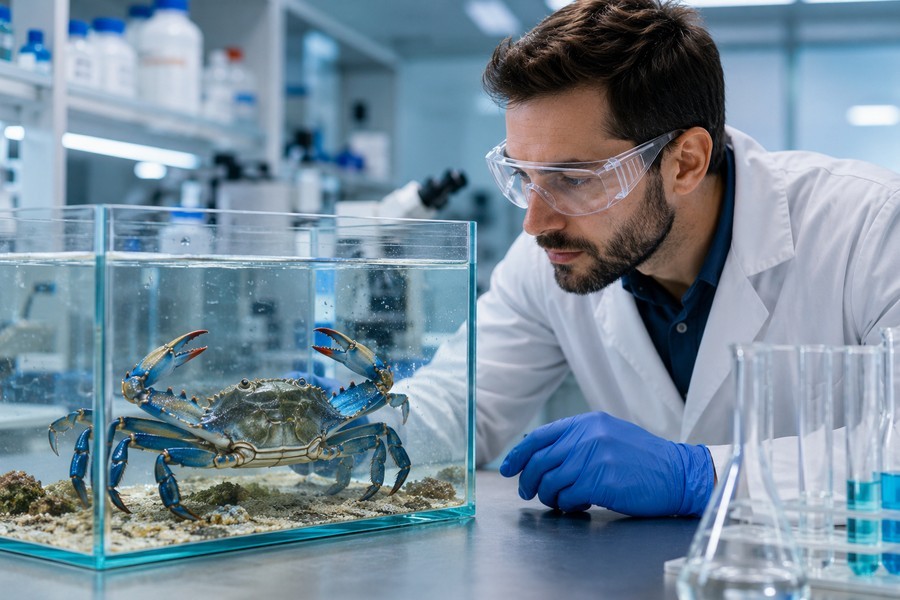
How Tiny Shellfish Could Help Feed the World and Fight Disease
As the world faces growing challenges with food production, clean water, and protecting nature, scientists are looking for solutions in unexpected places. Some of the most promising answers might come from the hard, armored shells of tiny sea creatures. For more than twenty years, a dedicated marine biologist has been studying shellfish like crabs, shrimp, and lobsters. These creatures are much more than seafood; they are complex biological systems that could help us grow more food, protect wild environments, and fight serious human diseases.
How Shellfish Grow and Adapt
Unlike humans and other animals with internal bones, shellfish wear their skeletons on the outside of their bodies. This hard outer shell protects them, but it also creates a unique challenge: as the animal grows, its shell does not grow with it. To get bigger, the creature must go through a process called molting, where it sheds its old shell and quickly builds a new one.
Rebuilding a protective armor is a race against time. While waiting for the new shell to harden, the animal is completely defenseless against predators. The entire process of shedding and hardening a new shell takes only about three days. Researchers are studying the specific genes that control this rapid growth process. By understanding how these genes work, they hope to find new ways to help shellfish grow healthier and faster in controlled environments.
A Biological Switch for Gender Control
One of the most important discoveries in this field came from a simple question: what makes a shellfish male or female? Decades ago, a researcher studying these creatures discovered a specific hormone that works like an on-and-off switch for gender. This hormone is very similar to insulin in humans.
- If the hormone is present: The shellfish develops as a male.
- If the hormone is absent: The shellfish develops as a female.
Boosting Food Production Through Farming
In underwater farming, also known as aquaculture, controlling the gender of the crop is highly beneficial. Just like in traditional land farming, male and female animals grow differently and have different advantages depending on the environment. For example, one gender might grow much larger or faster, making it more valuable for food production.
By raising single-sex populations, farmers can maximize their harvests and use resources more efficiently. This biotechnology has already moved from the research lab to the real world. In countries like Vietnam and Thailand, local businesses are using these scientific methods to produce millions of single-sex shellfish larvae for commercial farms, helping to secure a stable food supply.
Fighting Disease Without Harming the Environment
Beyond food production, this research is being used to protect human health. In many parts of the world, communities rely on freshwater sources that contain tiny snails. These snails carry a dangerous parasite that causes a disease called schistosomiasis, or bilharzia. This illness affects hundreds of millions of people globally, and children are particularly at risk because they play and bathe in the water.
Because certain shellfish are natural predators of these snails, scientists wanted to introduce them into affected lakes and rivers to eat the snails and stop the spread of the disease. However, introducing a new species into a wild environment can be risky. If the shellfish reproduce too quickly, they can become an invasive pest and destroy the local ecosystem.
This is where the gender-control technology plays a vital role. By releasing only single-sex groups of shellfish into the wild, the predators can do their job of eating the disease-carrying snails without any risk of reproducing. Since they cannot mate, they will eventually die off naturally without taking over the ecosystem. A project in Kenya is currently testing this method to control both disease-carrying snails and pests in rice fields.
Building Global Connections Through Science
While this research focuses on underwater life, it is also helping to build bridges between different countries. During a recent lecture tour through South America, including stops in Brazil and Argentina, the lead researcher was met with immense warmth and a strong desire for collaboration. Even in remote parts of the Amazon, fellow scientists traveled long distances just to attend his presentations.
Furthermore, the researcher was recently honored with a lifetime achievement award by a scientific committee in Malaysia, a nation that does not share formal diplomatic relations with his home country. This recognition highlights how scientific discovery can rise above political differences. When it comes to solving global problems like food security and disease prevention, researchers around the world are eager to work together for the common good.