
Ukraine's Cutting-Edge Drone Tech Emerges from Battlefield Necessity
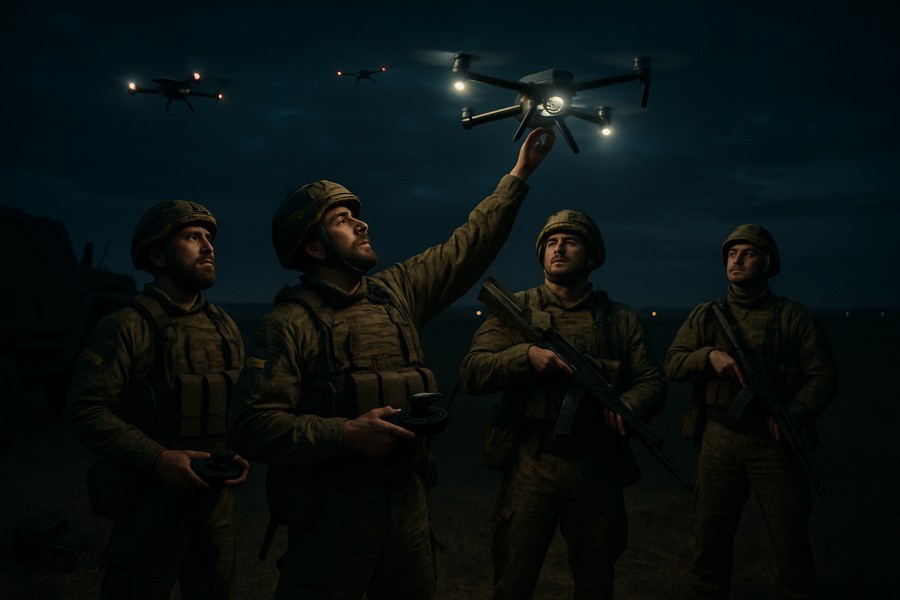
On a clear night in eastern Ukraine, a small group of soldiers vigilantly keep their eyes on the sky, looking out for drones. These drones are not the ordinary kind; they're equipped with highly destructive weapons and originate from a country known for its advanced technology.
These soldier groups are scattered across the nation, their primary task being to monitor and neutralize the threat of these low-cost drones, which have become a hot topic in modern warfare discussions globally.
While on the lookout, the soldiers from the 127th Brigade make the most of their time by testing and modifying their own interceptor drones. They aim to identify any weaknesses that could hamper the drone's performance when faced with the real enemy. Initially, when these weaponized drones first appeared, Ukraine was ill-equipped to counter them. But now, the tables have turned as the teams continuously upgrade their technology to intercept these drones mid-flight.
Ukraine's Burgeoning Domestic Drone Industry
The country's homegrown drone interceptor market has seen rapid growth in recent years, giving rise to several key players who showcase their products at global arms exhibitions. However, the true innovations are happening on the battlefield, where small groups have transformed into hubs of swift military innovation. Their locally-developed technology, born out of frontline necessity, is now garnering international attention.
The country's President has revealed that Middle Eastern allies of the U.S. have approached Ukraine for assistance in defending against these deadly drones. These drones are the same type launched in vast numbers in the ongoing war, a conflict that has already lasted four years.
The use of drones isn't just limited to warfare; they have also been used in response to joint strikes by the U.S. and Israel. These drones have often overwhelmed even the most sophisticated Western-made air defenses, emphasizing the need for affordable and adaptive countermeasures.
A pilot from Ukraine’s 127th Brigade mentioned, “We didn't just wake up one day and decide to combat with drones. We did it because we had no other choice.”
The Genesis of the Drone War
Even though these drones are designed to be disposable, due to limited resources, Ukrainian crews must ensure every piece of equipment is preserved. Often, single-use drones are reused to analyze their weaknesses and improve upon them.
The pilot stated, “Just imagine, a Patriot missile costs about $2 million, while you have a small aircraft worth about $2,200. And if it doesn’t hit the target, I can land it, fix it a bit and send it back into the air. The difference is massive. And the effect? Just as good.”
The 127th Brigade is now building an air defense unit focused on interceptor drone crews, a model that is being increasingly adopted across the military.
Leading the brigade's efforts is a young captain who had previously organized a similar system in another formation. He distinctly remembers the moment when everything changed. He was in charge of a group of soldiers tasked with intercepting enemy reconnaissance drones using shoulder-fired air-defense missiles. However, this approach quickly proved ineffective, prompting the captain to search for better alternatives.
The solution was surprisingly simple: another drone. The captain vividly recalls a day when a Russian reconnaissance drone was transmitting coordinates to guide Russian artillery. A pilot from his unit brought it down using another drone, marking the beginning of the drone war.
The Challenge of Intercepting Shaheds
The next hurdle was figuring out how to intercept the hundreds of fast and robust Shahed drones flying far beyond the front line. The captain's quest for a solution led him to cooperate with a local defense company. Their combined efforts produced interceptor drones capable of matching the speed of the Shaheds.
Working with the company allows soldiers to test interceptor drones in real conditions and swiftly refine the technology through direct feedback.
The Role of Nonprofits and Volunteers
In Ukraine, collaboration often extends beyond the military and manufacturers. Volunteers frequently act as middlemen, sometimes even helping them connect with each other. A nonprofit think tank and charity, the Come Back Alive Foundation, launched a project called “Dronopad” in the summer of 2024.
The project derived from battlefield reports that FPV drone pilots were occasionally able to track and intercept aerial targets. The objective was to turn this into a system, helping units that had already had their first successful cases build the capability and scale what they had achieved.
The project worked closely with drone manufacturers to understand what type of systems soldiers needed. As the project developed, the capabilities of interceptor drones evolved.
“Many people referred to it as air defense for the poor,” he said. “But it turns out that air defense for the poor can sometimes be more effective than air defense for the rich.”