
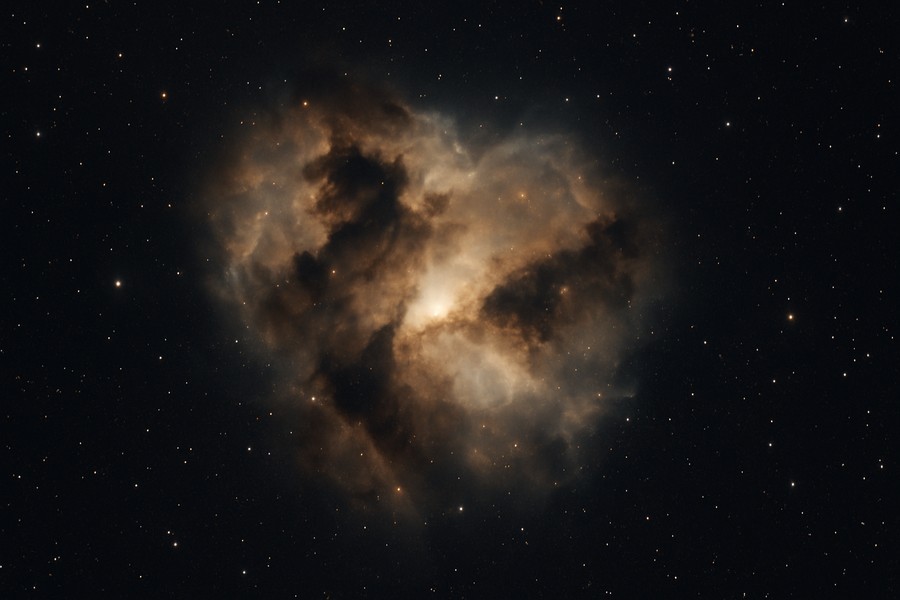
The Mesmerizing Light Display of a Fading Star
A breathtaking image of the Egg Nebula, captured by a renowned space telescope, showcases an impressive interplay of light and shadow created by freshly discharged stardust. This enigmatic structure is situated roughly 1,000 light-years away in the constellation Cygnus, and the telescope's precision has revealed intricate details about it.
The Egg Nebula: Nature's Cosmic Canvas
Also known as CRL 2688, the Egg Nebula can be found in the Cygnus constellation, also known as the Swan. This nebula holds the distinction of being the first, youngest, and closest pre-planetary nebula ever found.
The Egg Nebula is particularly interesting because it allows scientists to test theories about the late stages of stellar evolution. At this stage of its lifecycle, the nebula shines by reflecting light from its center star, which escapes through an "eye" in the surrounding dust. It's believed that this light comes from a dusty disc that was ejected from the star's surface just a few centuries ago.
Unraveling the Mysteries of Stellar Evolution
From this dying star, dual beams of light illuminate rapidly moving polar lobes that pierce through a slower, older series of concentric arcs. The shapes and movements of these elements suggest they may be influenced by gravitational interactions with one or more hidden companion stars, all concealed deep within a thick disc of stardust.
Stars like our Sun shed their outer layers when they use up their hydrogen and helium fuel. The core that is left exposed becomes so hot that it ionises nearby gas, creating the glowing shells seen in planetary nebulae such as the Helix, Stingray, and Butterfly nebulae. However, the compact Egg Nebula is still in a brief transitional phase — known as the pre-planetary stage — that lasts only a few thousand years. This makes it an ideal time to study the ejection process while the forensic evidence remains fresh.
The Birth of Future Star Systems
The symmetrical patterns captured in the Egg Nebula are too orderly to have resulted from a violent explosion like a supernova. Instead, the arcs, lobes, and central dust cloud likely stem from a coordinated series of poorly understood sputtering events in the carbon-enriched core of the dying star. Aged stars like these forged and released the dust that eventually seeded future star systems, such as our own solar system, which coalesced into Earth and other rocky planets 4.5 billion years ago.
Decades of Observation
The space telescope has observed the Egg Nebula on multiple occasions. The first image in visible light was accompanied by a near-infrared image a few years later, providing a closer look at the light emitted by the nebula. Subsequent years brought new views of the Egg, showing the full extent of the dust ripples surrounding it. A more recent image zoomed in on the central dust cloud and dramatic gas outflows. This new image combines the data used to create the 2012 image with additional observations from the same program to deliver the clearest look yet at this intricate cosmic egg.
The data used in this image was obtained so it could be directly compared with earlier observations. The high resolution of the telescope allows astronomers to study how small details in the nebula’s dusty shell have evolved over the past decade and more, by comparing new and old images. This research contributes to better scientific models of planetary nebulae, allowing astronomers to accurately compute the evolution of all kinds of similar stellar outbursts.
Being able to revisit a remarkable celestial treasure like the Egg Nebula over the decades is a benefit of the space telescope's trove of quality data. With its broad range of abilities and its now over thirty-five years of operation, it is truly unique among astronomical observatories.
Note
A pre-planetary nebula is a precursor stage of a planetary nebula, which is a structure of gas and dust formed from the ejected layers of a dying, Sun-like star. The term is a misnomer, as planetary nebulae are not related to planets.
More Information
The space telescope that captured these images is a project of international cooperation.
Image Credit: B. Balick (University of Washington)
