
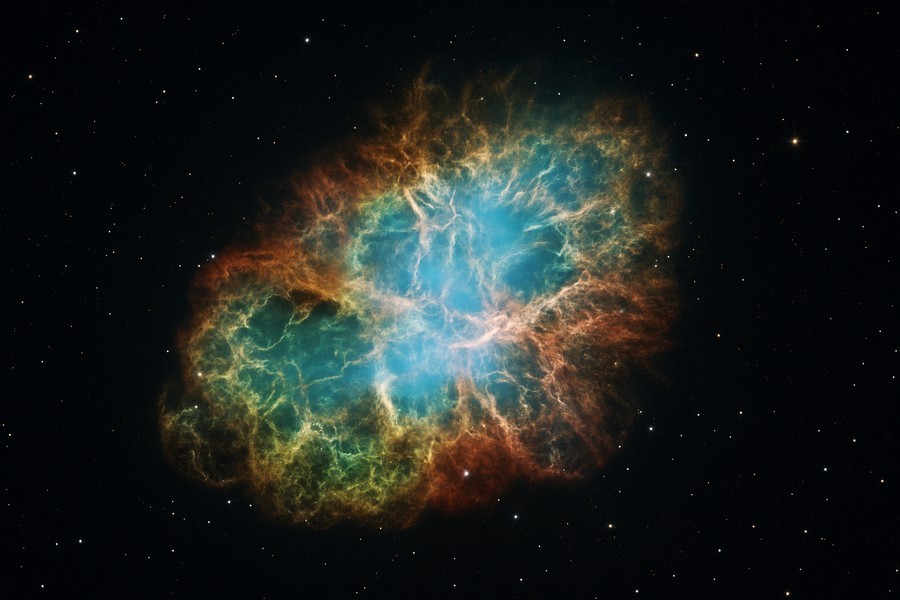
Stellar Transformation: The Crab Nebula's 25-Year Evolution
The enduring lifespan of a certain space telescope has offered scientists the unique opportunity to witness the transformations of far-off celestial bodies. A prime example of this is the remarkable evolution of the Crab Nebula, the remnants of a supernova, over a span of 25 years.
This week, an awe-inspiring image comparison was shared, showcasing two snapshots of the Crab Nebula, taken many years apart. The images illustrate the significant expansion and evolution of the nebula during this period.
Crab Nebula: A Cosmic Marvel
The Crab Nebula is undoubtedly one of the most celebrated celestial objects. This cosmic cloud bridges the gap between ancient astronomy and contemporary space exploration technology. In 1054, a supernova in the constellation Taurus was so bright that it was visible in the daytime sky for several weeks. This significant event was meticulously documented by pioneering astronomers in Japan, China, and the Middle East. Although it eventually disappeared from sight, it remains one of the most well-recorded cosmic explosions in human history.
Fast forward several centuries to the mid-18th century, and the Crab Nebula was discovered in the constellation Taurus. Astronomers, including one particularly famous one in the 1950s, connected the Crab Nebula to the 1054 supernova. Their conviction was solidified with the finding of a pulsar, a swiftly spinning neutron star, at the nebula's epicenter.
Crab Nebula's Expansion
This pulsar has had a significant role in powering the expansion of the nebula in the past quarter-century. The telescope’s most recent observations of the Crab Nebula gave astronomers the ability to track the outward movement of the nebula's complex filaments.
While the differences between the two images may seem minor, the filaments have been expanding at an impressive speed of approximately 3.4 million mph. This expansion is not propelled by shock waves from the initial explosion, as is the case with many supernova remnants, but by the pulsar. Its formidable magnetic field propels charged particles outward, driving the nebula's expansion and illuminating its glowing filaments.
Insights from the Images
The images captured by the high-resolution camera installed by astronauts in 2009, allow scientists to discern 3D structures and intricate details. Blue regions represent the hottest, lowest-density gas, while yellow and red tones reveal energized sulfur and oxygen.
"We tend to think of the sky as being unchanging, immutable," said an astronomer from Johns Hopkins University who spearheaded the new observations. "However, with the longevity of the space telescope, even an object like the Crab Nebula is revealed to be in motion, still expanding from the explosion nearly a millennium ago."
Other Observations of the Crab Nebula
It isn't just this particular telescope that has managed to capture this magnificent supernova remnant. In 2023, another powerful space telescope also captured a highly detailed image of the Crab Nebula. This image later aided scientists in mapping out the cosmic dust within its expanding shell.
