
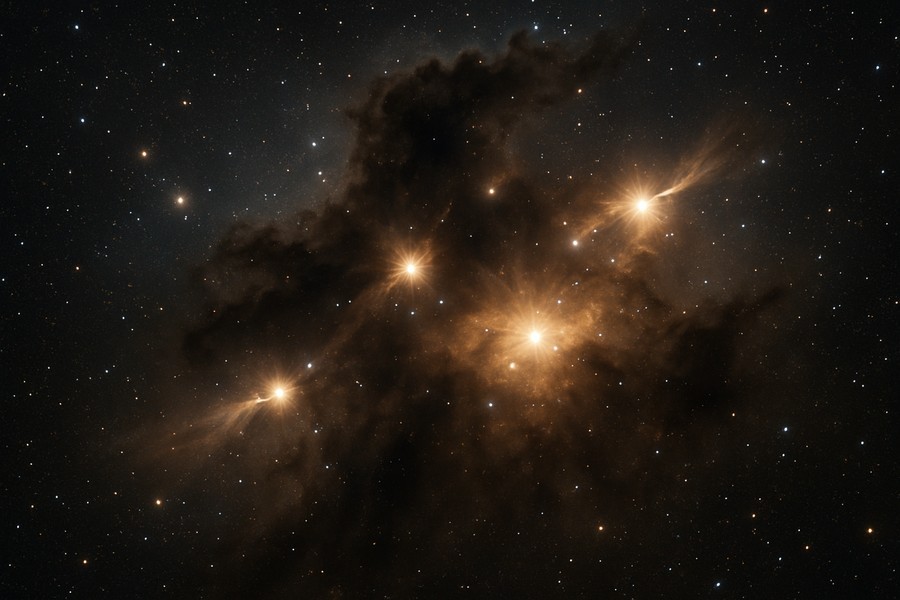
Infant Stars at Work Spotted Through Space Telescope
Stars are not born fully developed. They originate from clumps of gas and dust that are denser than their environment. These clumps are pulled together by gravity, gradually forming a dense, warming core - a burgeoning star, or protostar, that continues to draw from the cloud that birthed it.
This process was recently captured in an image by a renowned space telescope. The picture displays a star-creating region known as NGC-1333, which is home to a protostar and other young celestial bodies.
What is a Protostar?
Protostars are complex and dynamic. They consume material in irregular bursts and release potent outflows of wind and jets that penetrate the surrounding clouds. This results in a continuous tug-of-war between growth and disruption. Stars gather from their disk and at the same time, eject material, creating hollow spaces and molding the environment that neighboring stars and planets will eventually inhabit.
When the light from the star seeps out and reflects off dust particles, it can light up a cloud in a phenomenon known as a reflection nebula. This can be seen as two dark bands surrounding the bright point of the growing star. Researchers who studied the image from the telescope explained that these bands are the signature of a protoplanetary disk, and the disk's shadow is cast over the larger envelope of material that still encircles the young star.
Where is This Happening?
The star-creating region, NGC 1333, is located in the Perseus molecular cloud, which is approximately 950 light-years away from our planet.
Why is This Fascinating?
Regions like NGC 1333 are essential for scientists to gain a better understanding of the intricate process of star formation. By mapping these regions in both infrared and visible wavelengths of light, different aspects of this process are revealed. Recent research in the broader NGC 1333 area has used high-resolution observation of protostellar jets to read outbursts like "time stamps". This helps astronomers link bursts of activity to changes in the flow of material, indicating that the growth of stars is sporadic rather than continuous.
Ultimately, comprehending how stars form is vital to understanding our own origins. Every rocky planet, ocean, or atmosphere is born from the same ingredients: gas, dust, gravity, and time. Images like this don't just demonstrate how stars come into existence, but also how their dynamics influence the universe around us.
Interested in Learning More?
Stay tuned for more exciting discoveries about our universe.
