
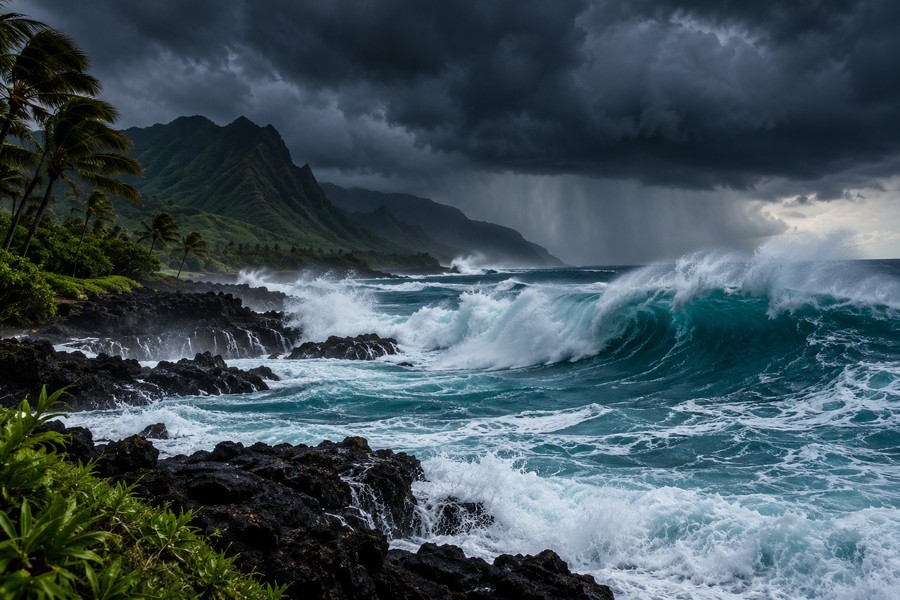
Powerful Pacific Storm Threatens Hawaii with Heavy Rain and Dangerous Waves
A massive storm is spinning through the Pacific Ocean, bringing the threat of dangerous waves, heavy rain, and mudslides to Hawaii. Even though the storm is expected to pass just to the west of the main islands, its outer edges could still cause serious problems for residents. Families are being urged to prepare immediately before the weather worsens.
The storm was incredibly strong, briefly reaching the highest level of intensity as a Category 5 hurricane with winds of 157 miles per hour or faster. It has since weakened slightly to a Category 4 hurricane. However, it remains extremely dangerous, carrying sustained winds of 145 miles per hour as it moves across the ocean.
Where Is the Storm Heading?
The storm is moving toward the west-northwest at a slow pace of about 7 miles per hour. It is located several hundred miles south-southwest of Honolulu. Weather experts project that the center of the storm will pass just to the west of the islands from south to north.
Because of this path, emergency alerts and storm watches are expected for Kauai County and the Papahānaumokuākea Marine National Monument. Even though the center of the storm might not make direct landfall on the main islands, the outer edges can still bring severe weather. Forecasters emphasize that being near the edge of the storm's path does not mean an area is safe from harm.
Heavy Rain and Flooding Concerns
The storm is carrying a massive amount of moisture, which could cause flash flooding and landslides. Different islands are preparing for different levels of rainfall:
- Kauai could receive up to 10 inches of rain, which raises the risk of dangerous mudslides.
- Maui could see up to 8 inches of rain.
- Other islands are also bracing for high surf, strong winds, and potential flooding.
Local leaders are taking steps to protect communities before the weather gets worse. Emergency workers are moving to key areas, harbors are being secured, and dams are being watched closely to make sure they do not overflow or break. People living in the path of the storm are being urged to finish their emergency preparations, pay attention to local alerts, and stay away from flooded roads and rough ocean waves.
These preparations are especially important because some areas are still recovering from previous weather events. Just last month, parts of Oahu and the Big Island experienced severe flooding and high winds from a tropical storm named Lala.
A Busy Season in the Pacific
This current storm is not alone in the Pacific Ocean. Two other tropical systems are active right now:
- Karina, which was once a major hurricane, is spinning hundreds of miles to the east-northeast of Hilo.
- Marie is a tropical storm located hundreds of miles west of the southern tip of the Baja California peninsula.
While Marie is far from the islands, it is expected to create large waves that could affect the beaches of Southern California over the holiday weekend, making conditions hazardous for swimmers and surfers.
So far, this weather season has seen 15 named storms in the region. This high number of storms is linked to unusually warm ocean waters and the presence of El Niño, a natural climate pattern that warms parts of the Pacific Ocean.
How Warm Water Fuels Stronger Storms
Scientists explain that warm ocean water acts like fuel for hurricanes. When the water is extra warm, it gives storms more energy, allowing them to grow larger and more intense very quickly. This extra heat allows storms to push down on the accelerator, making them much more dangerous than they would be in cooler waters.
The current El Niño pattern has been particularly strong. Some global climate experts have described this year's El Niño as being "supersized," which they point to as a clear sign of how global warming is changing weather patterns around the world. This situation serves as a serious call to action to address climate change as ocean temperatures continue to rise.