
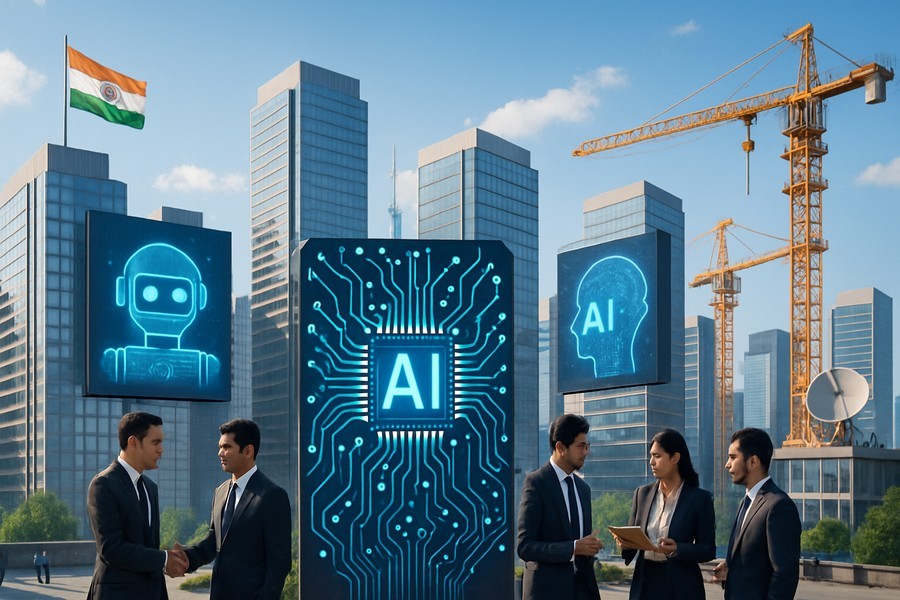
India's Ambitious Plan to Invite $200B for AI Infrastructure Development by 2028
India is taking bold steps to draw in a whopping $200 billion investment in its artificial intelligence (AI) infrastructure within the coming two years. The country's motivation is to emerge as a worldwide hub for AI computing and applications, at a time when resources, funding, and regulations are strategically important.
Government's Strategy to Attract Global Tech Giants
The strategy was unveiled recently by India's IT minister. A five-day AI Impact Summit, supported by the Indian government, was held in New Delhi. The summit saw the participation of top-ranking executives from significant tech companies worldwide. The government is planning to entice these investments by offering a mix of tax breaks, government-backed venture capital, and policy backing to bring more of the global AI value chain to India.
The timing of India's proposition is strategic. Major U.S. tech corporations, such as those specializing in e-commerce, search engines, and software, have already pledged approximately $70 billion to expand AI and cloud infrastructure in India. This provides a solid base for New Delhi to make a case that it can combine scale, cost benefits, and policy incentives to draw the next wave of global AI computing investment.
Investment Forecast and Expectations
Most of the anticipated $200 billion is predicted to be invested in AI infrastructure, including data centers, chips, and supporting systems. This also includes the around $70 billion already promised by major tech corporations. India's government also predicts an extra $17 billion of investment in deep-tech and AI applications, signaling a push to move beyond infrastructure and capture more of the value chain.
The initiative is bolstered by recent policy decisions designed to make India an appealing base for AI computing. These include long-term tax concessions for export-oriented cloud services and a government-backed venture program worth about $1.1 billion targeting high-risk areas such as AI and advanced manufacturing. New Delhi recently extended the period for which deep-tech companies are considered startups to 20 years and increased the revenue threshold for startup-specific benefits to about $33.08 million.
India's Plan to Boost AI Mission
India aims to increase its shared compute capacity under the IndiaAI Mission beyond its current 38,000 GPUs. An additional 20,000 units are set to be added in the upcoming weeks, marking the next phase of the country's AI strategy.
In the future, the Indian government plans to prepare a second phase of its AI Mission, with more emphasis on research and development, innovation, and broader distribution of AI tools. This also includes further expansion of shared compute capacity, as India seeks to extend access to AI infrastructure beyond a limited group of companies.
Challenges in the Path
However, the initiative also faces structural obstacles, including access to dependable power and water for energy-demanding data centers. This highlights the execution risks as India aims to accelerate years of AI infrastructure development into a considerably shorter time frame.
Government officials acknowledge these challenges, understanding that AI infrastructure would put a strain on power and water resources. However, they point to India's energy mix, with over half of installed generation capacity coming from clean sources, as a benefit as power demand from data centers increases.
The success of India's vision will have implications beyond its borders, as companies look for new locations for AI computing in the face of rising costs, capacity limitations, and escalating global competition.

