
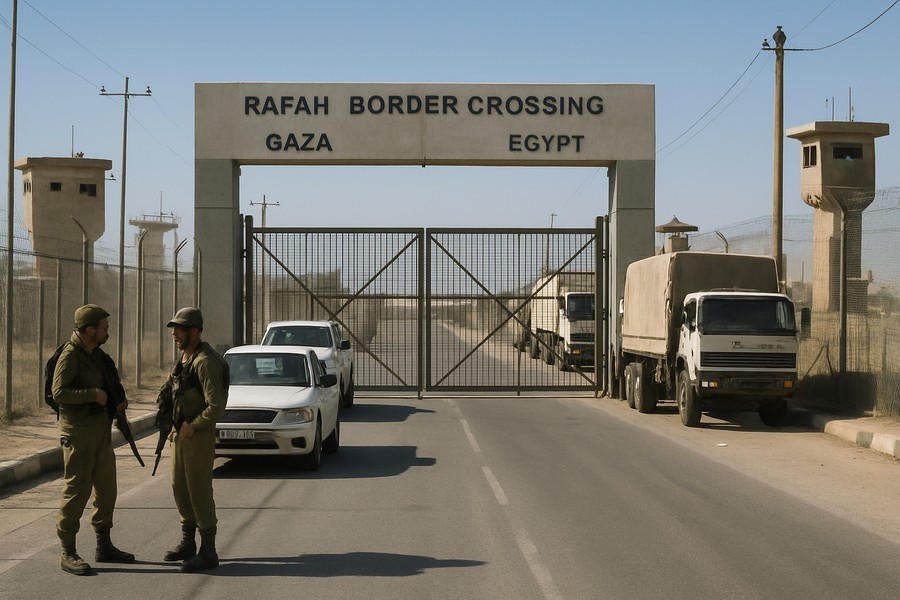
Key Border Crossing in Gaza Awaits Reopening Post Hostage Search Completion
The key border crossing between the Gaza Strip and Egypt is expected to resume operations after the final Israeli captive's body is recovered, according to Israel. The last remaining hostage was Master Sgt Ran Gvili, a police officer.
Since May, the Rafah crossing has remained primarily shut because Israeli forces took control of the Palestinian side. The plans were to reopen during the ceasefire's initial phase between Israel and Hamas, which began in October. Yet, the Israeli government has made the reopening conditional on Hamas’s full cooperation in returning Gvili's remains.
Search for Ran Gvili's Remains
On Sunday, the Israeli military announced the commencement of a new search for Gvili's remains in Northern Gaza. While Israel hinted at a possible timeline for the crossing's reopening in its announcement, the search's duration remains unknown.
Reports suggest that the operation is happening in a Gaza City cemetery and could take several days. The Israeli military is currently running a focused operation to leverage all gathered intelligence in the effort to locate and return Gvili's remains.
Palestinian Government's Stance on Rafah Crossing
The new technocratic Palestinian government in Gaza's head mentioned on Thursday that the Rafah crossing would open "in both directions" this week. This statement was made as US and other mediators continued to urge both sides to progress with the peace plan.
On Sunday night, the Israeli Prime Minister's office announced that Israel had agreed to a limited reopening of the Rafah crossing for pedestrian passage only, subject to a full Israeli inspection mechanism.
Monitoring Mechanism and Additional Screening Point
Reports suggest that there will be a comprehensive Israeli monitoring mechanism at the crossing, overseeing the entry and exit lists. Furthermore, Israel plans to set up an additional screening point for all individuals entering Gaza in an area around the Yellow Line, which marks the territory still under Israeli control as per the ceasefire agreement.
Operation to Retrieve Gvili's Body
Earlier on Sunday, the Israeli military announced that troops had initiated a targeted operation in the Yellow Line area in northern Gaza Strip to recover Gvili's body. The operation was based on intelligence collected over a long period, suggesting that Gvili's remains might be buried in the Shejaiya and Daraj Tuffah areas of Gaza City, east of the Yellow Line.
Specialized units, including rabbis, search teams, and dental experts equipped with portable X-ray machines, were reportedly on the ground.
Hamas's Cooperation in the Operation
The military wing of Hamas, the Izzedine al-Qassam Brigades, has claimed that it has provided mediators with all details and information regarding Gvili's body's location. They confirmed that Israeli forces were searching one of the sites.
Meanwhile, Gvili's family has expressed their strong opposition to the Rafah crossing's reopening before his body is returned to Israel for burial. Gvili, who was 24 years old, was killed during a Hamas-led attack on southern Israel at Kibbutz Alumim and his body was taken back to Gaza as a hostage.