
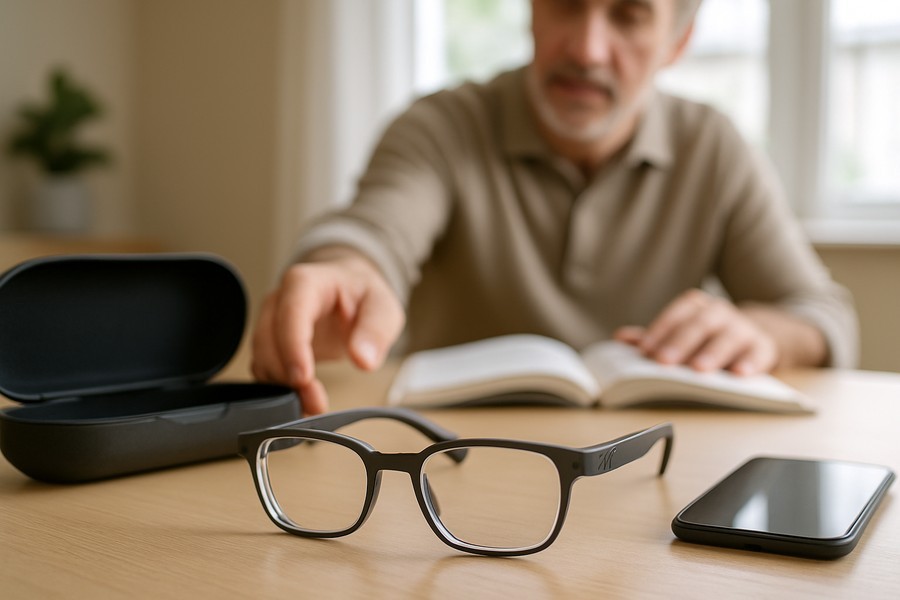
Revolutionizing Eyewear: The Arrival of Autofocusing Glasses
Despite the influx of high-tech wearables and smartglasses, the design and functionality of traditional glasses have remained largely unchanged for centuries. The most notable advancement came in the form of progressive multifocal lenses in the 1950s, which combined prescriptions for both near and farsighted vision. However, a new development in the eyewear industry promises to bring this stagnant technology into the modern era.
An innovative startup has developed a lightweight prototype frame that houses autofocusing lenses, which could revolutionize the way we see. This groundbreaking technology is primarily aimed at addressing age-related farsightedness, a condition that commonly affects individuals over 45.
How Do These Glasses Work?
These glasses are a blend of cutting-edge technology and traditional eyewear design. They employ a cameraless eye tracking system in conjunction with liquid crystal lenses to automatically adjust focus based on the user’s visual needs. This means the lenses can shift between prescriptions, eliminating the need for separate lenses for near and farsightedness. Despite this advanced functionality, the frames maintain a lightweight and unassuming design, akin to any pair of regular glasses.
The eye tracking system uses a set of LEDs and photodiodes positioned around the lens. These LEDs emit invisible infrared light that bounces off the eyes and is then measured by the photodiodes. This system accurately captures the subtle movements of the eyes and how they converge when focusing on an object close by. Even minute details like blinking and the direction of the gaze are captured, all while consuming a mere 4 milliwatts of power.
Most of the tech components, such as memory, sensors, driving electronics, and the eye tracker, are cleverly integrated into the front frame of the glasses and the part of the arms closest to the hinge. The lightweight batteries used are similar to those found in wireless earbuds, giving an idea of the overall size and weight of the technology. A charging port is included in the glasses’ left arm hinge, and a single charge is touted to last a full day.
Design and Comfort
The prototype frames feel as light as any pair of conventional glasses. The team has diligently worked on refining the nose pieces and arms of the glasses to accommodate different face shapes. The lenses are made up of layers of liquid crystal and a transparent conductive layer of indium tin oxide. Despite the multiple layers, the lenses are incredibly thin and seamlessly switch into a prescription lens. Their thinness allows them to be integrated easily into lenses with existing prescriptions, and they can even provide correction for astigmatism.
Benefits and Future Possibilities
These autofocusing lenses can potentially eliminate the need for multiple pairs of glasses, such as bifocals and progressives. Even if the glasses run out of power, they would still function as a pair of traditional glasses with the standard prescription, just without the near-sighted boost.
Moreover, the sensor sensitivity of these glasses can offer insights into other health conditions, detect dry eyes, estimate attentiveness and even suggest corrections to posture and neck movement. There is also the potential for dynamic prescription adjustments, such as stronger corrections as the eyes become more fatigued throughout the day.
Despite the promising features, the final product still needs to receive the necessary medical certifications before it can be sold. The company has already partnered with a renowned Swiss lens manufacturer to ensure top-notch quality. The autofocusing glasses are expected to be positioned as a luxury eyewear option and will be sold through existing opticians. The launch of the first pair is anticipated in the coming year.