
Taking a Closer Look at the Universe with a Revolutionary Telescope
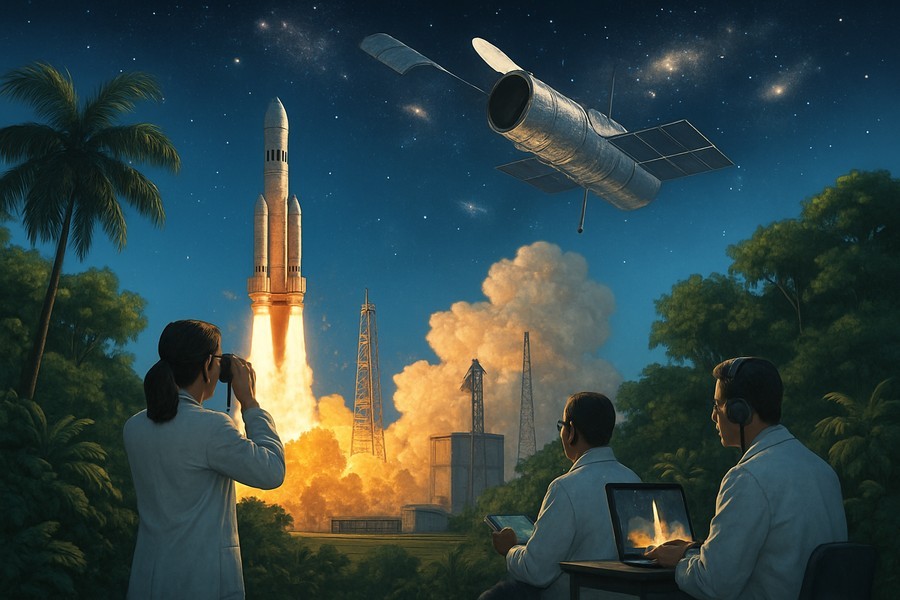
A monumental event occurred recently when a spacecraft, carrying an exceptional scientific instrument, soared into the skies from a launch site nestled deep within a tropical rainforest. This wasn't just any launch, it was a moment that would forever alter our perception of the cosmos.
The spacecraft was carrying onboard a unique telescope, destined to travel at speeds of 25,000 mph, from the dense jungles of Earth to the farthest reaches of the universe. This telescope, after approximately a month of travel, would settle into a stable orbit approximately 930,000 miles away. Situated at this perfect balance point between the Earth and the Sun's gravitational pull, the telescope began to transmit astonishing images back to Earth in July 2022. The influx of data received since then has significantly enriched our understanding of space and time.
The Eye into the Cosmic Dawn
One of the reasons why this telescope has made such a significant impact is due to its ability to gaze back in time, all the way to the "cosmic dawn". This era, which occurred a few hundred million years after the Big Bang, marked the point in time when the first stars began to twinkle in the universe.
Experts are in agreement that this telescope has demonstrated an extraordinary capability to see 98% of the way back to the Big Bang. Astoundingly, this was achieved by an instrument that was initially conceptualized in the late 1990s, but almost didn't get off the ground due to a series of setbacks and obstacles.
The Journey to Launch
The telescope's journey from concept to launch was not an easy one. Facing issues like a soaring budget, several delays, and numerous mistakes, the project faced its share of difficulties. Despite these issues, it was launched and has since been hailed as the most sophisticated telescope ever constructed.
Getting this instrument into space required the combined efforts of over 20,000 engineers and hundreds of scientists. Its unique 21.3 feet mirror had to be designed in a foldable honeycomb pattern to fit within the confines of the rocket, and then successfully unfold once in space. The surface of the mirror was so smooth that if it were to be scaled up to the size of a continent, there would be no elevation greater than the height of an ankle.
Unlocking the Secrets of the Universe
To probe the earliest moments of the universe, the telescope needed to be equipped with infrared vision. This is because the ancient light from the distant past has been stretched, or red-shifted, into infrared wavelengths over the vast expanses of space and time. However, to effectively capture these faint infrared signals from the most remote starlight, the telescope needed to be situated in the frigid darkness of outer space, well beyond the infrared radiation emanating from Earth.
Once the telescope began its work, it started to challenge our existing models of the universe. It quickly confirmed the Hubble tension, a discrepancy in the measured rate of the universe's expansion. It has also hinted at the possibility of life-supporting atmospheres surrounding far-off exoplanets, and has observed incredibly bright galaxies and seemingly "impossible" black holes at the dawn of time. All these discoveries are guiding us towards new insights about the universe.