
Japan Begins Mission to Bring Back Samples From a Martian Moon
A Journey to Phobos
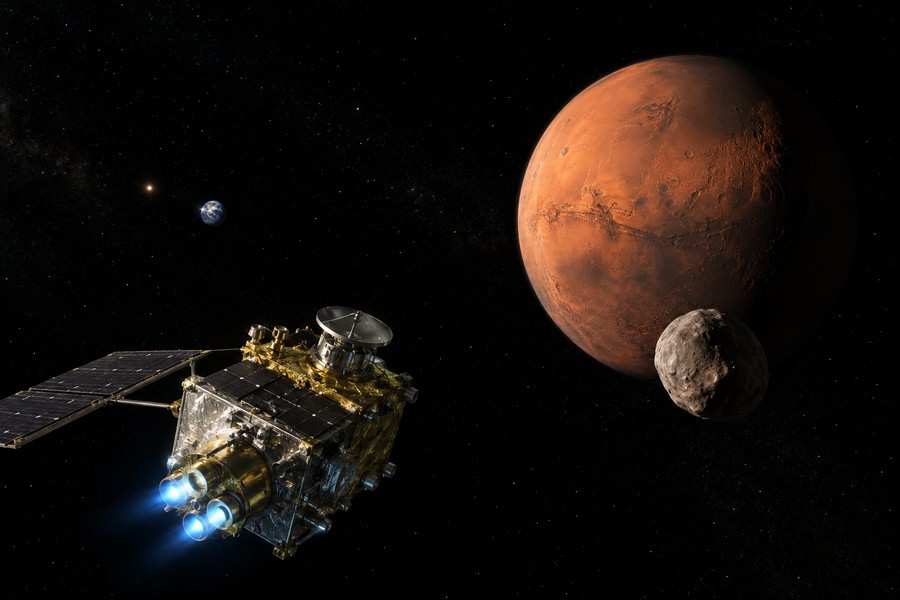
A spacecraft launched from southern Japan on a mission to collect pieces of Phobos, one of Mars’s two small moons. The samples may help scientists learn how the moons formed and how the solar system developed. They could also offer clues about how life began on Earth.
The spacecraft rode into space on a Japanese rocket that lifted off from Tanegashima Island before sunrise. After launch, it separated from the rocket’s upper section. The separation confirmed that the spacecraft was on its way.
The probe is expected to reach Mars and begin orbiting the planet next year. Its goal is to gather at least 10 grams of soil and rock from Phobos, then carry the material back to Earth. The return trip is planned for 2031.
A First Visit to the Martian Moons
Spacecraft from several countries have reached Mars, and some have landed on the planet. But no mission has yet tried to land on either of its moons, Phobos or Deimos. This mission will be the first to attempt it.
Five space agencies are working together on the project, which is planned to last five years. The main spacecraft weighs about five tonnes. When it reaches Mars, it will match the close orbit of Phobos, which circles the planet about 6,000 kilometers above its surface.
Phobos is shaped somewhat like a potato and has many craters. It is about 22.5 kilometers across and circles Mars three times each day. Deimos, the other Martian moon, is smaller and farther away.
A Rover Will Scout the Surface
Before the main spacecraft tries to collect samples, it will release a small rover built by teams in France and Germany. The rover is named Idefix, after a small white dog in a French comic series.
Because gravity on Phobos is only about one-thousandth as strong as gravity on Earth, the rover may bounce across the surface for several minutes after landing. Once it settles, it will spend about 100 days studying the moon. Its work will help identify safe places for the main spacecraft to land and gather material.
The sample-collecting lander has four legs and will stay in one place. It is expected to spend only about two hours on Phobos. During that short visit, it will drill into the surface and use a vacuum system to collect soil and rock. Then it will lift off and carry the samples back toward Earth.
On the way out of Mars’s orbit, the spacecraft is also expected to make several close passes by Deimos to observe it.
What the Samples Could Reveal
Scientists do not yet know how Phobos and Deimos formed. One idea is that a large object struck Mars, throwing material into space that later came together to form the moons. Another idea is that the moons were asteroids captured by Mars’s gravity.
Studying material from Phobos could help show which explanation is more likely. The answer may also help scientists understand how conditions that could support life arose on rocky planets such as Mercury, Venus, Earth, and Mars.
The findings may guide future trips to Mars, including missions that could carry people. Bringing samples back from a Martian moon could also teach researchers how to plan future landings and collect material in the Mars system.
A Race to Return Mars Material
The mission is part of a wider effort to bring samples from the Mars region back to Earth. A rover already exploring Mars has collected rocks, but plans to return those samples were stopped after a government funding decision.
China is preparing a separate mission to collect material directly from Mars. It is planned to launch around 2028, with a possible return as early as 2031. That means it could bring Mars samples to Earth before the Phobos mission returns.
For the Japanese-led project, success would mark the first return of samples from the Martian system. The material from Phobos may be small, but it could help answer major questions about the history of Mars, its moons, and the conditions that made life possible on Earth.