
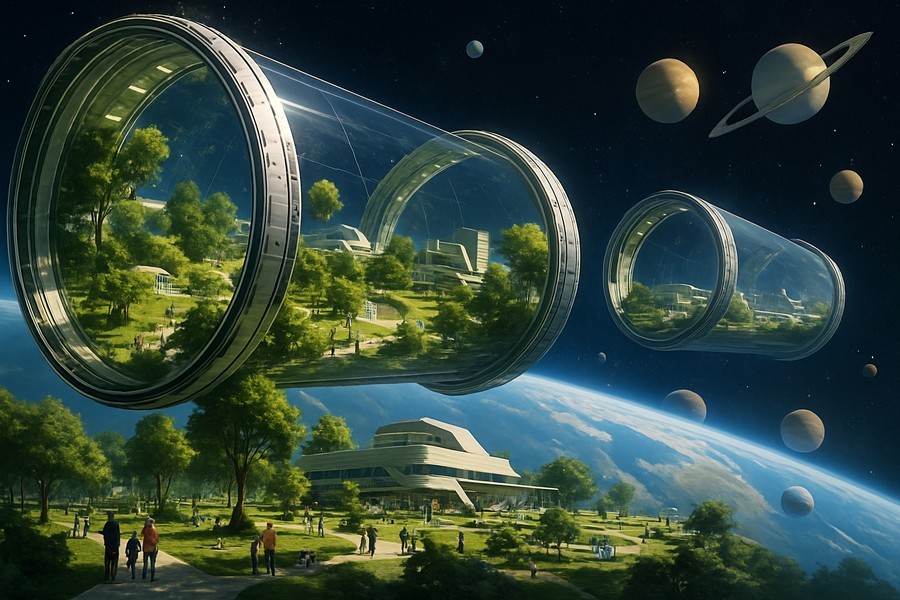
The Vision of Populating the Solar System with Trillions of Humans
The famous entrepreneur behind one of the biggest online retail platforms has an ambitious dream that may seem more like a plot straight out of a sci-fi novel. He envisions a throng of a trillion humans inhabiting the solar system. The idea is that with such a massive population, we could have a thousand Mozarts and a thousand Einsteins at any given time, leading to an explosion of intelligence, creativity, and energy.
The Problem with Planets
According to him, the pursuit of this grand vision cannot rely on planetary surfaces. He argues that these natural bodies are far too small to accommodate the kind of population he's imagining. Today, our planet Earth supports around 8 billion people. Attempting to multiply this figure significantly would undoubtedly stretch any planet beyond its physical capacities. There's a finite amount of land, energy, and usable space available.
His solution? Instead of looking at planets as the answer, he suggests that we should turn our attention to the vastness of space itself.
Space Stations as Floating Cities
His proposal is not just about random space habitation, but organized, self-sustaining, and massive rotating space stations that could function like self-contained worlds. These structures could be built using materials sourced from the Moon or nearby asteroids and designed to simulate gravity. They could house entire cities, farmlands, and industries.
He believes that while most people would still prefer to live near Earth, they wouldn't necessarily have to be in Earth's orbit. The advantage of this approach is the scale it offers. The limitless resources and constant solar energy available in space far outweigh what any planet could provide. If we could construct enough of these stations, the limits on human population and productivity could be greatly expanded.
The Bigger Picture
His vision is not merely about population expansion. The idea is that with more people, there would be more breakthroughs, more creativity, and more progress happening simultaneously. This ties into his long-standing belief that we should strive to preserve Earth rather than overexploit it, treating it more like a protected home base than the center of industry.
A Gradual Process
While he hasn't provided a detailed timeline for this colossal project, he has been clear about the initial steps. The first priority is to reduce the cost of transporting materials into space and then utilize the materials already present there. His own company's heavy-lift rocket is a part of this early groundwork, even though the full realization of these giant space habitats could still be many decades away.
The key takeaway from all this? The idea of a trillion humans living in space may not be imminent, but it's not entirely impossible either. He sees a path where growth doesn't have to be limited by the confines of a planet—it simply moves off the planet.
