
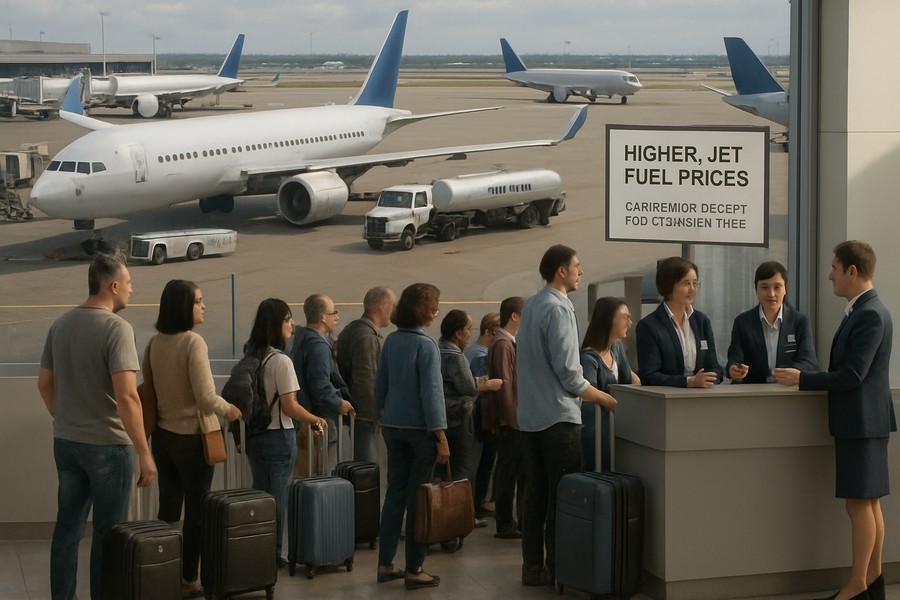
Rising Fuel Costs Propel Airlines to Elevate Ticket Prices and Baggage Fees
The cost of jet fuel has seen a dramatic increase, nearly twice as much as before the ongoing conflict in Iran. This surge, sharper than those observed in gasoline and diesel costs, has forced airlines globally to adjust their operations. Strategies include cutting back on certain routes, hiking fares, adding fuel surcharges, and increasing baggage fees to offset the rising fuel costs.
Asia in Crisis: Fuel Rationing and Export Restrictions
In Asia, the fuel crisis is so severe that several countries have had to resort to fuel rationing and export restrictions. The sudden and significant shock to fuel supplies, especially jet fuel, has left Asia in a precarious position. George Shaw, an analyst at a trade analytics firm, suggests that Asia's situation is worse than other regions.
Europe: Anticipating a Systemic Jet Fuel Shortage
In Europe, airport operators have expressed their concerns to the European Commission. They warned that if a "significant and stable" passage doesn't resume through the Strait of Hormuz by April's end, the European Union could face a systemic jet fuel shortage. Some experts, however, are skeptical that the shortage would occur that swiftly.
Global Impact: Top Jet Fuel Producers Crippled
Shipping through the Strait of Hormuz has slowed to a crawl, affecting jet fuel production and transportation. The Persian Gulf, which hosts many refineries that produce and export jet fuel, is experiencing major disruptions. The blockade at the strait is preventing the processed jet fuel from reaching the market.
Moreover, crude oil from the Gulf, typically shipped to refineries around the world, is also being blocked at the strait. As a result, both the finished product and raw material are experiencing supply shocks. "It's really a double whammy," says Shaw.
The top three global exporters of jet fuel—China, South Korea, and Kuwait—have been significantly affected. China has banned jet fuel exports, and South Korea has had to scale back production due to insufficient crude oil. Meanwhile, Kuwait can produce jet fuel, but the blockage prevents it from being shipped.
America's Dilemma: Not Immune to Global Crisis
Even though the U.S. is the world's largest oil producer and a net exporter of jet fuel, it is not insulated from this global crisis. California, for instance, has been importing jet fuel from Asia due to refineries shutting down in the state.
Although the U.S. produces abundant jet fuel in Louisiana and Texas, it's cheaper and easier to import from South Korea. However, with the current crunch, there might be problems with imports reaching the West Coast.
Delta Airlines: A Hefty Price Tag for Fuel
In the U.S., airlines have stopped practicing fuel hedging, a financial strategy used to lock in fuel prices in advance. This means they are now left grappling with a hefty fuel bill due to the current price spike.
Delta Airlines recently estimated that the increased fuel prices would cost them an extra $2 billion this quarter. Despite owning a refinery, Delta is still feeling the pinch. The airline is considering reducing unprofitable flights and increasing ticket prices to recoup the higher fuel costs.
However, Delta isn't worried about immediate shortages. According to Shaw, increasing ticket prices and reducing unprofitable routes should be enough to prevent shortages in the U.S. and Europe. Asia, however, may face a different scenario.
Price Hikes: Here to Stay
Even if the Strait of Hormuz reopens tomorrow, jet fuel prices would remain high for weeks. Restarting production in the Middle Eastern oil fields and getting refinery processes back to normal takes time. On top of that, oil and gas facilities in the Middle East have suffered considerable damage from the war, estimated to be worth $50 billion.
Once everything is back up and running, there's still the time it takes for tankers full of oil and fuel to make their way around the world. This delay provides some cushion from immediate shocks but also means a long wait before relief is felt if the war does end.
In conclusion, the global fuel market is in a precarious position. "It will take a long time for it to get back to a semblance of normality, even in the most optimistic scenario," says Shaw.