
Two Robotic Explorers Reach the Innermost Planet After a Long Journey
A major space mission is finally reaching its destination after a long and winding journey. The spacecraft, which began its trip years ago, took a complicated, looping path through space to reach the closest planet to our sun: Mercury. Now, the long trip is almost over, and the mission is preparing for its highly anticipated arrival.
The Big Separation Event
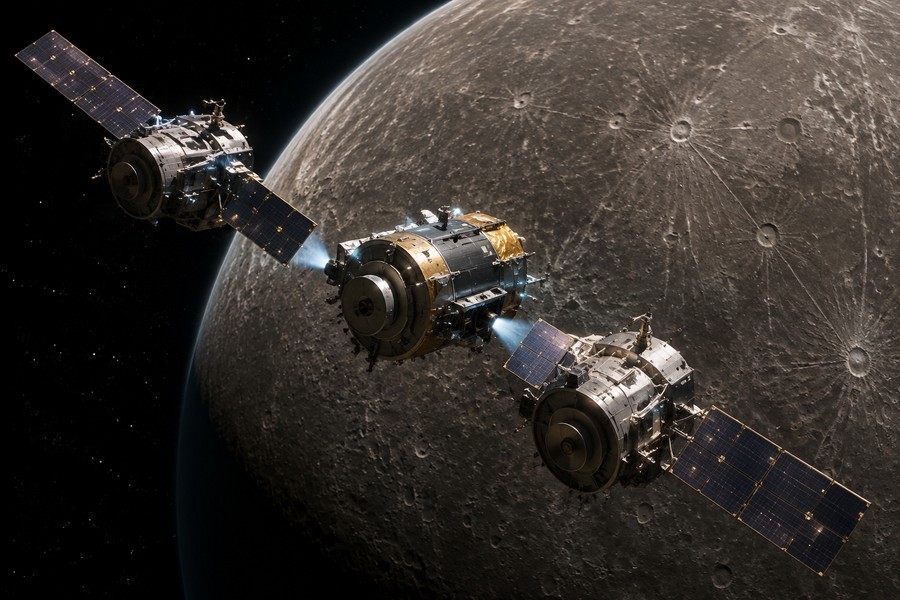
The mission features two separate science orbiters. One of these robotic explorers was built by a European space team, while the other was created by a Japanese space agency. For the long journey to Mercury, these two explorers have been connected to a shared power and propulsion module that pushed them through space.
The two orbiters are scheduled to separate from this main transport module on a Thursday morning at around 8:00 a.m. Eastern Time. People interested in space exploration can watch this major milestone happen live online. The broadcast is scheduled to begin fifteen minutes before the separation, at 7:45 a.m. Eastern Time.
The live video feed will pause shortly after the separation, at 8:30 a.m. Eastern Time. It will then start up again about an hour later. This second part of the broadcast will show the mission teams as they try to establish communication with the newly independent spacecraft.
The teams expect to hear back from the two free-flying orbiters no earlier than 9:53 a.m. Eastern Time. The online broadcast will follow these communication efforts and show the teams checking the health of the systems. The entire live event is expected to wrap up between 10:15 a.m. and 10:45 a.m. Eastern Time.
Getting into Position Around Mercury
Splitting apart from the main transport module is only the first step in a very long process. Even after they separate, the two science orbiters will still be joined together as they approach the planet.
The gravity of Mercury will not actually capture the linked spacecraft until later in the autumn, specifically in late November. Once they are safely captured by the planet's gravity, the next phase of the mission will begin.
If everything goes according to the plan, the planetary orbiter will release the magnetic explorer—which is nicknamed Mio—into its own separate path in early December. This orbit will be highly oval-shaped. At its closest point, Mio will fly just 367 miles (590 kilometers) above the surface of Mercury. At its farthest point, it will swing out to 7,233 miles (11,640 kilometers) away.
About a week after releasing its partner, the planetary orbiter will start moving toward its own final path. It will take a few years for this spacecraft to reach its final destination. In the spring of a future year, the planetary orbiter is scheduled to settle into an oval-shaped path that ranges from 298 miles to 932 miles (480 to 1,500 kilometers) above the planet.
Unlocking the Secrets of Mercury
The official science phase of the mission is scheduled to begin in the spring, about a month after the planetary orbiter reaches its final path. The entire mission is named in honor of a famous Italian mathematician and engineer named Giuseppe "Bepi" Colombo.
Once the science work starts, it will last for at least one full Earth year. The data collected during this time should be incredibly valuable. Mercury is currently the least explored planet in the inner part of our solar system, making this mission a rare opportunity to learn more about it.
The two spacecraft will work together to study the planet in different ways:
- The planetary orbiter will focus on mapping the surface of Mercury.
- The magnetic explorer will study the magnetic region surrounding the planet.
During their time at the planet, the two robotic explorers will perform several key investigations:
- They will create a complete map of Mercury using different wavelengths of light.
- They will study the minerals and chemical elements that make up the planet's surface.
- They will attempt to find out if the inside of the planet is liquid or solid.
- They will investigate the origin and size of Mercury's magnetic field.
By working together, these two spacecraft will help scientists solve some of the deepest mysteries of this small, hot world.