
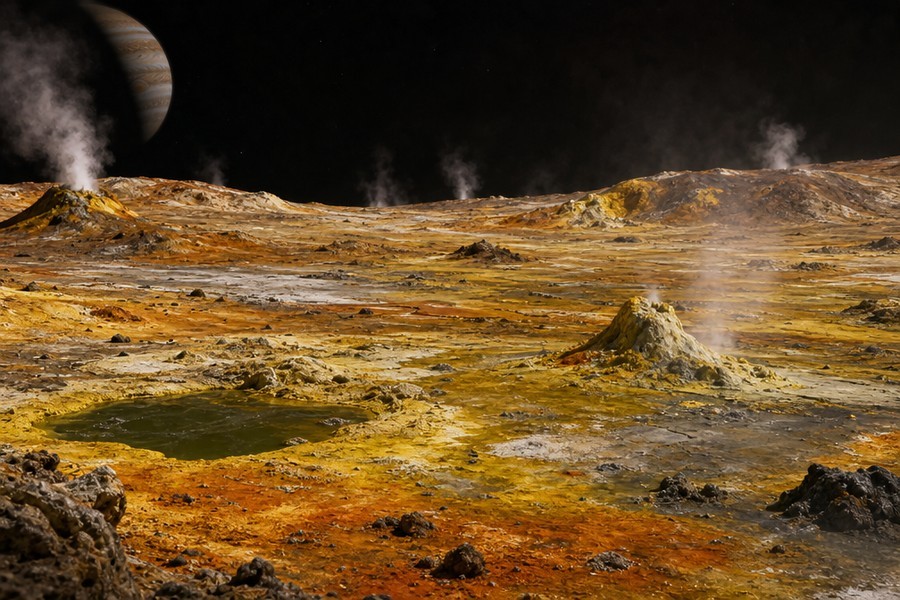
The Squeezed Moon: How Jupiter’s Gravity Powers Hundreds of Active Volcanoes
When scientists sent the first robotic probes to explore the outer solar system, they expected the moons of giant planets to be frozen, quiet, and covered in craters. Instead, they discovered a world that defied all expectations. One of Jupiter's closest moons, called Io, turned out to be a colorful, hyperactive world with no visible craters at all. Instead of a dead ball of ice, it is a place of constant volcanic eruptions.
An Unexpected Discovery in Space
The discovery of volcanism beyond Earth happened almost by accident. While analyzing navigation photos taken during a spacecraft's flyby of Jupiter, an engineer noticed something unusual. She was adjusting the contrast of an image to see background stars when a bright, curved shape appeared just past the edge of the moon.
At first, researchers investigated whether this glowing feature was another moon hiding in the background or simply a camera error. However, further study revealed it was actually a massive, umbrella-shaped cloud rising nearly 300 kilometers into space. It was the first active volcanic plume ever seen on another world. Later, scientists looked back at older photos and found even more of these giant eruptions, proving that the moon’s activity was continuous rather than a rare, one-time event.
The Cosmic Tug-of-War
Today, space scientists estimate that Io is home to about 400 active volcanoes, making it the most volcanically active place in our solar system. But how does a small moon, which should have cooled down billions of years ago, stay so incredibly hot?
The answer lies in a giant game of gravity tug-of-war. Io is caught between the immense gravitational pull of Jupiter and the weaker pulls of two neighboring moons, Europa and Ganymede. Here is how this process works:
- Elliptical Orbit: The gravity of the neighboring moons keeps Io’s orbit slightly oval-shaped rather than perfectly circular.
- Tidal Flexing: As Io moves closer to and farther from Jupiter, the giant planet's gravity stretches and squeezes the moon.
- Friction and Heat: This constant bending causes the solid ground of Io to rise and fall by up to 100 meters. The internal friction generates massive amounts of heat.
This intense heat melts the rock inside the moon, creating magma that forces its way to the surface. The constant flow of lava and volcanic ash repaints the moon’s surface, burying old impact craters under fresh layers of rock and sulfur.
Volcanic Plumes That Reach Space
Because Io is relatively small, it has very weak gravity and almost no atmosphere. This allows its volcanic eruptions to behave very differently from those on Earth. Without heavy air resistance or strong gravity to hold them back, volcanic gases and dust can shoot incredibly high into the sky.
A typical eruption on Io can easily reach dozens of kilometers into space. In some extreme cases, space probes have documented giant plumes reaching as high as 500 kilometers above the surface. To put this in perspective, that is higher than the altitude where the International Space Station orbits Earth.
The colorful surface of the moon—stained with bright shades of yellow, orange, red, and black—comes from the sulfur and sulfur dioxide ejected by these eruptions. Some of the volcanic material even escapes the moon’s gravity entirely. This lost material gets trapped by Jupiter's powerful magnetic field, forming a giant ring of charged particles that circles the planet.
Rethinking the Moon’s Interior
For a long time, researchers believed that Io’s volcanoes were fed by a single, continuous ocean of liquid magma just beneath a thin outer crust. However, data gathered from more recent spacecraft flybys has challenged this theory.
By measuring how the moon deforms under Jupiter’s gravity, scientists have gained a clearer picture of what lies beneath the surface. The latest findings suggest that Io behaves more like a mostly solid body. Instead of a global magma ocean, the moon likely contains separate, regional pockets of magma that feed the hundreds of individual volcanic systems scattered across its surface.
Even with this new understanding, the moon remains one of the most extreme environments in the solar system. The strange feature first spotted on a navigation photo decades ago was not a camera glitch. It was our first glimpse of a world being constantly reshaped, melted, and rebuilt by the gravity of a giant planet.