
A Minimally Invasive Knee Procedure Shows Yearlong Pain Relief
A treatment that blocks tiny blood vessels near an arthritic knee was linked to less pain and better movement in a study of 194 patients. The improvement lasted at least a year. Among patients who completed the one-year pain check, 80% had a meaningful reduction in pain.
The procedure, called genicular artery embolization, uses a thin tube to deliver tiny particles into selected blood vessels around the knee. It does not replace the joint or require an open operation. The results suggest it may offer another option for people who still have pain after standard treatments and cannot or do not want to have knee replacement surgery.
Why Knee Arthritis Can Limit Daily Life
Osteoarthritis is the most common type of arthritis worldwide. It develops as cartilage, the tissue that cushions the ends of bones, wears down. Inflammation, changes in nearby tissues, and sensitive pain nerves can also contribute to ongoing pain.
For some people, knee pain makes walking, climbing stairs, exercising, or standing for a long time difficult. Treatment often starts with physical therapy, medication, or injections into the joint. If these options do not help enough, a doctor may discuss knee replacement. Surgery, however, is not suitable or appealing for every patient.
How the Procedure Works
In an arthritic knee, extra blood vessels may grow in and around the joint lining. These vessels can be linked to inflammation and to the growth of nerves that carry pain signals.
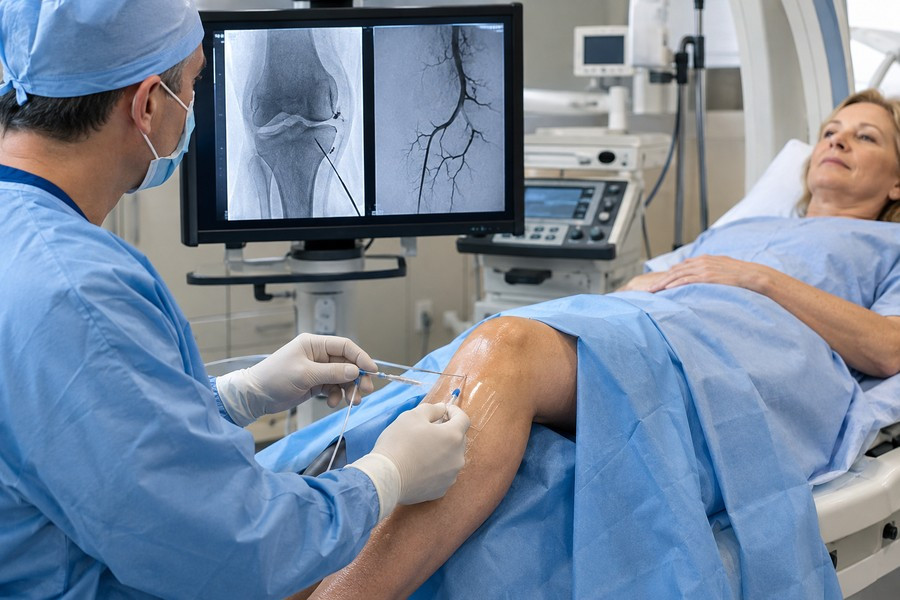
During embolization, a specialist guides a thin catheter through an artery to selected small vessels near the knee. Tiny particles are released to block those vessels and reduce their blood flow. The goal is to calm inflammation and pain while keeping the knee’s normal circulation intact.
The study tested gelatin-based particles designed to dissolve within hours. They are shaped and sized for controlled delivery. Researchers are studying whether these temporary particles can offer benefits while avoiding some drawbacks of other materials that either dissolve differently or remain in the vessels.
The procedure is not proven to stop cartilage damage or reverse arthritis. Although reducing inflammation could affect how the disease develops, this study did not test whether the treatment slows the loss of cartilage.
What the Patient Study Found
The study included 194 people with knee pain related to osteoarthritis. There were 114 women and 80 men. Their median age was 69, and their median body mass index was 28.4. All had ongoing symptoms despite at least three months of usual care, such as exercise therapy, anti-inflammatory medicine, or knee injections.
Forty-five participants had arthritis in both knees and received treatment on each side in separate procedures. In all, doctors performed 239 procedures. X-ray imaging helped guide the catheter and the particles. Every procedure successfully treated the intended vessels.
No moderate or severe complications were recorded. Mild, short-term problems occurred in 6.7% of procedures. These included temporary skin discoloration near the treated area and one small collection of blood near the catheter entry site. The problems resolved without lasting effects.
Pain Relief and Movement Improved
Patients rated their pain on a scale from zero to 10. The median score was 7 before treatment, fell to 4 after six weeks, and reached 3 by six months. The median remained 3 at the one-year check.
Patients also answered questions about symptoms, everyday activities, exercise, and quality of life. Scores improved in all five areas measured. The median score for daily activities rose from 53 to 71.5. The sports and recreation score increased from 15 to 36.
Scores for arthritis symptoms climbed from 51 to 68, while the pain score rose from 44 to 65. For these measures, higher scores mean fewer problems. Quality-of-life scores increased from 19 before treatment to 40 after a year.
Researchers used established benchmarks to judge whether changes were large enough to matter in daily life. At the one-year mark, 80% of patients who completed the pain assessment met the benchmark for meaningful pain relief.
More Research Is Needed
Other studies have also found improvements after knee artery embolization. However, findings from controlled trials have been mixed. In some trials, people who received the procedure improved more than those receiving usual care. In other trials, people who received a sham procedure also improved, and the difference between groups was not statistically clear.
Reviews of multiple studies have reported better pain and function after treatment, but have also found that the overall evidence is uncertain. A study without a comparison group, like this one, cannot show how much improvement came from the procedure itself. Patient expectations and other factors may also affect reported pain.
More controlled research is needed to learn which patients are most likely to benefit, how long the relief lasts, and whether dissolving particles have advantages over other materials. Future studies will also need to determine whether the procedure affects arthritis progression or changes the need for knee replacement.
For people whose symptoms continue despite standard care, the procedure is a treatment being studied as a possible middle option between injections and joint replacement. Its promise is encouraging, but its benefits and limits still need to be confirmed through stronger long-term research.