
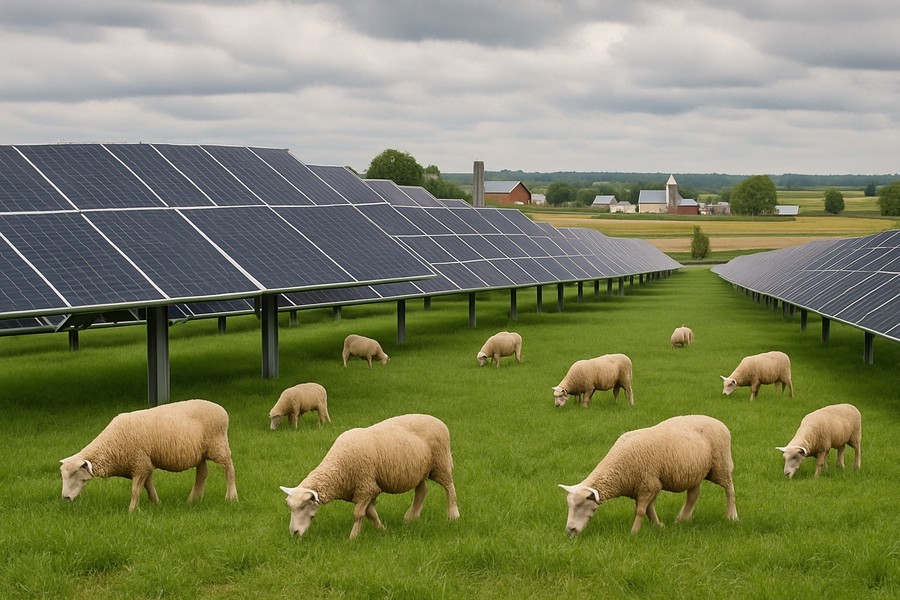
Farmland Versus Energy: The Role of Sheep in Solar Energy Projects
In an unusual attempt to combine renewable energy production with agriculture, property owners in Lancaster County, PA, proposed installing a 25-acre solar panel array on their farmland. Their unique twist was to have sheep graze under the solar panels, arguing that this qualified the project as an agricultural venture.
Despite the innovative idea, local zoning authorities and courts rejected the proposal. They reasoned that a solar farm, even with grazing sheep beneath the panels, didn't meet the criteria for agricultural land use in the area. The ruling was viewed as a victory for those who aim to preserve farmland, affirming their stance that solar installations should not be classified as agriculture.
A Setback or a Chance for Sustainable Farming?
Those who advocate for renewable energy saw this decision as a setback. They argue that integrating solar panels into farmland could provide multi-generational family farmers with a means to sustain their businesses while conserving the land. Unlike building a housing subdivision or shopping center, solar arrays can be removed after their useful lifespan, usually between 30 to 50 years, leaving the land available for farming once again.
However, some local residents view solar installations as an industrial intrusion, detracting from the natural beauty of verdant fields and pastures.
The Intersection of Solar Energy and Agriculture
The idea of combining farming and solar energy – a practice referred to as "solar grazing" or "agrivoltaics" – is gaining traction. It not only includes raising livestock under solar panels but also growing crops in their shade.
With some estimates suggesting that rural communities might host 90% of new solar installations, it's thought that up to 80% of land used for solar power production could be on farmland. Practices such as growing crops under solar panels or grazing sheep beneath them, could help make solar energy more cost-effective and commercially viable.
From Natural Gas to Solar Energy
As a major energy producer, Pennsylvania has long relied on its abundant natural gas resources. However, with many nearby states setting ambitious renewable energy goals, Pennsylvania is also seeing an increase in solar, wind, and hydroelectric energy developments.
As the cost of solar panels has fallen, solar energy has become increasingly viable, and the state is now home to numerous solar projects. Despite this, Pennsylvania still lags behind other states in its total renewable energy production.
Small-scale Solar Installations and the Amish Community
In contrast to large-scale solar projects, smaller solar arrays are becoming more popular. Property owners, including many Amish and Mennonite communities, are turning to solar power as a cost-effective alternative to power their businesses. Other farmers have installed solar arrays on their barn roofs to offset their energy costs, a practice known as "net-metering".
The Aesthetics of Solar Fields
Despite the potential benefits, solar installations are not universally welcomed. Some residents worry that the presence of solar fields could negatively impact their property values. However, initial studies suggest that solar fields have little effect on property values.
The Potential of Solar Grazing
Solar grazing has started to attract attention. The practice involves using sheep to maintain the vegetation around solar arrays. While sheep require access to water, prefer certain types of grass, and need adequate fencing to keep them on-site, they can be an effective and environmentally-friendly solution for managing vegetation growth around solar installations.
Despite some local resistance to solar developments, sheep grazing under solar panels has been well-received by the public, adding a charming agricultural element to the high-tech solar installations. As a result, more solar developers are considering solar grazing as part of their normal maintenance operations.
In the ongoing debate over the best use of farmland, solar grazing represents a novel approach to integrating agriculture and renewable energy production. The question remains whether practices like these will become widely accepted or remain a niche solution in the energy transition.