
Unlocking the Mystery of Ultra-Bright Stellar Explosions
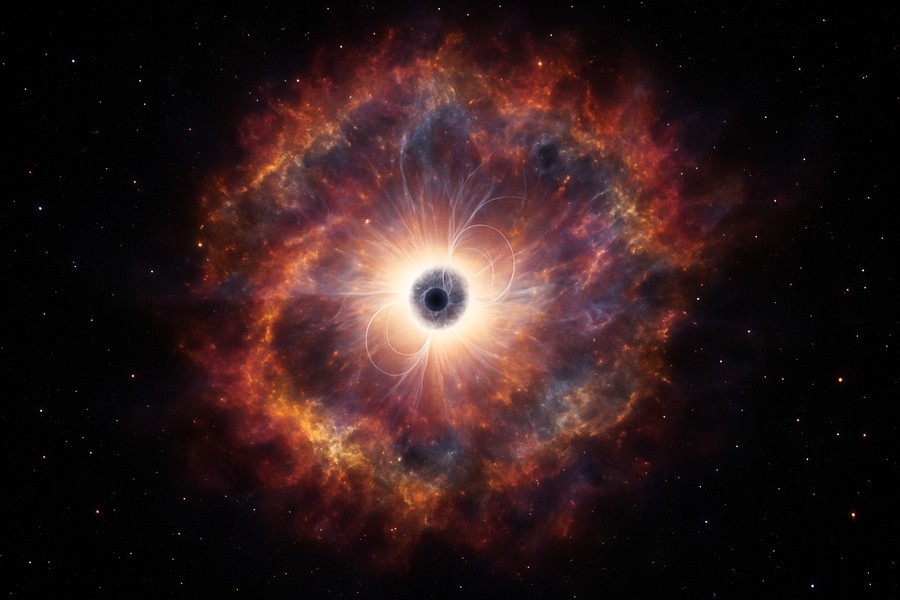
Superluminous supernovae are some of the most intensely brilliant events in the cosmos. These celestial outbursts have puzzled scientists for years due to their incredible power. Recent findings suggest the key to their extraordinary energy could lie with magnetars, a type of rapidly spinning neutron star with a strong gravitational pull that distorts space and time around them.
The Power of Magnetars
Scientists have long suspected that magnetars might be the energy source behind superluminous supernovae. The theory is that these extremely magnetic stars originate from the collapse of a progenitor star's core and release their energy through magnetic dipole radiation. As a magnetar's rotation slows, it releases its stored energy into the surrounding matter of the deceased star, causing it to brighten.
Challenging the Theory
However, previous models did not entirely align with observational data. In a typical magnetar model, the supernova's light curve should quickly rise and then gradually fade as the neutron star loses its rotational energy. But observations of superluminous supernovae often show unexpected modulations and unpredictable light curve variations over several months. Scientists proposed several explanations—ranging from debris colliding with irregular material shells to sporadic, violent flares from the magnetar. Yet, these theories required incredibly specific conditions to align with the observed data.
A Peculiar Discovery
The breakthrough came when researchers detected an unusual object behaving like a typical superluminous supernova. However, it then started to exhibit a unique "chirping" behavior—a term in physics referring to a signal whose frequency steadily increases over time. The object's emissions fluctuated, but the intervals between these fluctuations were decreasing.
The Chirping Star
After observing the third fluctuation, researchers were able to predict when the next fluctuation would occur. This regularity challenged existing magnetar models, as the steady decrease in intervals didn't align with the previous explanation of random space debris interactions.
Researchers proposed a new model that incorporated a phenomenon known as frame-dragging or the Lense-Thirring effect. This effect, predicted by Einstein's General Relativity, posits that a large spinning object can drag the space-time around it. This effect had not been previously observed around a magnetar, but when applied, it perfectly mirrored the observed actions.
The Role of Space-Time
The researchers suggested that the observed light fluctuations in the superluminous supernovae were a result of the intense gravity of a newborn magnetar pulling the surrounding space-time as it spins. To understand this phenomenon, one can imagine a spinning bowling ball creating a vortex in a vat of molasses. This swirling effect is similar to how a spinning, massive object affects spacetime. Around a rapidly spinning magnetar, space-time is thrown into a chaotic spiral.
The Wobbling Disk
When the parent star exploded, some of its material fell back towards the magnetar, forming a misaligned disk. This disk, amidst the twisted space-time, began to wobble or precess around the magnetar's axis. As this happened, it intermittently blocked, redirected, or reflected the intense radiation from the magnetar, causing the observed rhythmic fluctuations in brightness.
Why the Chirping?
The researchers proposed that the chirping signal was due to the shrinking of the accretion disk. As the disk falls closer to the magnetar, the Lense-Thirring effect intensifies, causing the disk to spin faster and the wobbles to tighten, resulting in a chirping light curve. By studying these chirps, researchers could extract information about the magnetar, including its spin period and magnetic field strength.
Exciting Prospects
This new "magnetar+LT" model also aligns with the observed data from other superluminous supernovae. This suggests that a single model could explain a whole class of stellar explosions that previously required multiple conflicting theories.
While this model is promising, it still leaves many questions unanswered. The formation of the accretion disk, how it affects the light from the magnetar, and how this light interacts with the ejected material before reaching observers are all areas needing further study. As more objects like the chirping supernova are discovered, it will provide additional data and opportunities to refine and test this model. This exciting breakthrough marks just the beginning of our understanding of these incredible celestial events.