
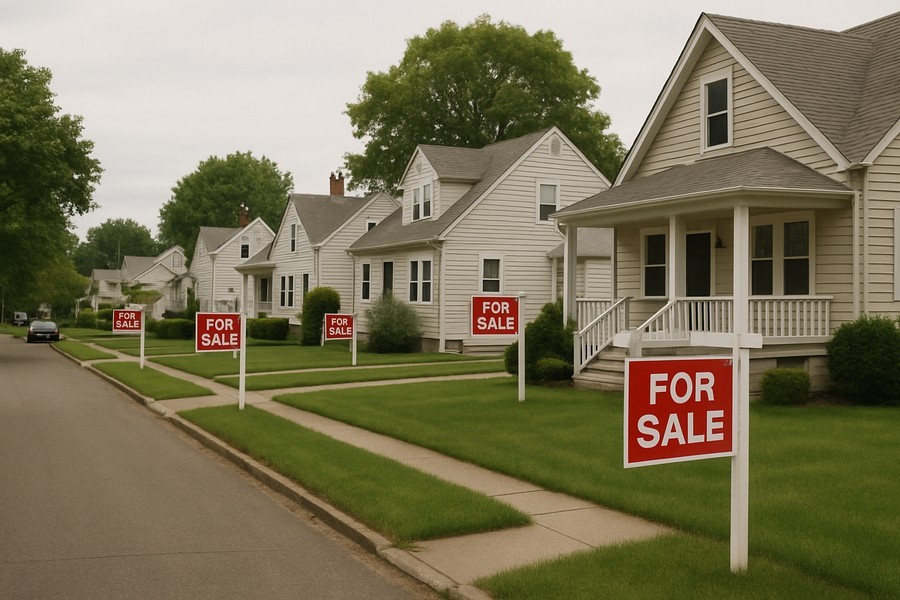
Housing Market Sees a Shift as Big Investors Divest
Recently, there's been a noticeable shift in the for-sale housing market, with a large number of institutional investors choosing to sell their single-family homes. This change has been observed for a couple of years now, even before any legislative moves to ban such investors from purchasing family homes to rent out.
Investor Activity in Housing Market
Current trends suggest that major investors are selling more homes than they are purchasing. In every significant city, the percentage of for-sale listings exceeds the share of the total housing stock owned by investors. For example, in cities like Dallas, Philadelphia, and Houston, this selling trend is particularly pronounced. In Dallas, investors own around 9.2% of the housing stock but make up approximately 22.8% of new for-sale listings.
One company seems to be leading the pack, with more than double the listings of its competitors. This company is also offering significant discounts, averaging 10% off original list prices, and regularly reducing prices approximately every 20 days.
Why the Selling Spree?
Experts point to the volatile housing market as the primary reason for this trend. "People are trying to minimize the risk by selling," said a co-founder of a housing data and analytics firm. He pointed out that the returns from renting are not as profitable as selling in the current market conditions.
He further added, "It's better to get the cash now and see how things develop."
Investor Activity Data
One of the most prominent landlords, which is also publicly traded, reported that all of its 368 acquisitions in the latest quarter of 2025 were newly built homes purchased from various homebuilders. It reported selling 315 existing homes. For 2025, almost all of its 2,410 acquisitions were made through relationships with homebuilders, while it sold 1,356 homes, "frequently to families purchasing for their own use."
Regulatory Efforts
In late January, an executive order was signed to limit large, institutional investors from buying single-family homes to use as rentals in an effort to make housing more affordable. This order exempted the purchase of new constructions that are specifically built as rentals.
The executive order was followed by proposed legislation that would ban investors owning more than 100 single-family homes from buying any more. However, they would not have to sell their existing properties. The Senate and House bills differ slightly on what constitutes large investors but are generally in agreement.
The Bigger Picture
To provide some context, single-family rentals account for about 10% of U.S. housing stock. Most of these, around 80%, are owned by small operators, with fewer than 10 homes each. Smaller investors, those who own between 10 and 1,000 homes, make up 17% of landlords. Large institutional investors who own more than 1,000 homes constitute just 3% of the single-family rental market.
However, these numbers are declining.
Historical Perspective and Future Directions
Investors had surged into the market following the subprime mortgage crash that led to the Great Recession. As markets recovered, there were fewer entry-level homes for sale, as investors focused on that segment. By 2022, before the second term of presidency, investors had already started to pull back.
Now, investors are turning their focus to build-for-rent. One major investor has been buying homes from builders but recently acquired a build-to-rent developer in high-growth markets across the Southeast. This move is expected to expand its portfolio and improve control over costs, product quality, and delivery pace.
Meanwhile, another company, previously known as American Homes 4 Rent, has been constructing entire rental communities for several years. The company's CEO stated, "Our results in 2025 and outlook for 2026 reflect continued focus on expanding the nation’s housing supply, elevating the resident experience, and creating value for all our stakeholders."