
Revitalization of Major Retailer Sees Progress Yet Expects Sales Dip in Upcoming Year
A popular retail company exceeded financial predictions for the final quarter of last year. Nevertheless, it predicts a conservative outlook for the coming year. The corporation, which includes a well-known department store chain, a high-end retailer, and a beauty store, anticipates annual sales to range from $21.4 billion to $21.65 billion with adjusted per-share earnings of $1.90 to $2.10.
This shows a decrease from the previous year when revenue hit $21.8 billion and adjusted earnings per share were $2.15. The sales predictions are in line or slightly above the industry's expectations of $21.42 billion, but the adjusted earnings forecast falls short of the expected $2.17 per share.
The company also anticipates comparable sales, a key industry measure that excludes the impact of store openings and closures, to vary from a 0.5% decrease to a 0.5% increase.
Positive Signs of Growth
The company's CEO believes these results demonstrate the effectiveness of their business strategy. Each of the three brands showed growth in the previous fiscal year and holiday quarter. This represents the fourth consecutive quarter where the company surpassed the industry's sales predictions. For the first time in three years, the company reported positive growth, with comparable sales rising by 1.5% for the entire year.
Recent weeks have also seen a continued resilience in customer spending, with emphasis on fresh clothing and trendier, newer brands. However, the CEO acknowledges the unpredictability of the retail landscape which has led the company to maintain a cautious outlook for the year ahead.
The CEO highlighted external factors such as fluctuating gas prices, geopolitical tensions, and potential shifts in tariffs as elements that could affect the company's performance in the coming months. The company's full-year guidance takes into account these potential macroeconomic and geopolitical influences on discretionary spending.
Impact of Store Revamp and Closure
The company's financial projection also accounts for its ongoing investment in revitalizing its stores and the effect of fewer store closures. The CEO stated that the company continues to incorporate the pre-Supreme Court ruling level of tariffs in its year-long forecast. If the company receives a refund or if tariffs end up at a lower level, it would benefit the company financially.
During the final quarter of the last fiscal year, the company's performance surpassed industry anticipations. The earnings per share were $1.67 adjusted versus the expected $1.53, and revenue was $7.64 billion versus the anticipated $7.62 billion. The company's shares saw a 6% rise in early market trading.
Net income for the final three-month period rose to $507 million, or $1.84 per share, compared to $342 million, or $1.21 per share, during the same period in the previous year. Adjusting for one-time items like impairment and restructuring costs, the company reported earnings per share of $1.67. However, sales fell from $7.77 billion in the same quarter of the previous year.
Efforts to Strengthen Brand
The retail company is two years into a three-year initiative to bolster its struggling flagship brand, prioritize its better-performing and more luxury-focused chains, and accelerate its supply chain and tech operations. As part of this plan, the company intends to close about 150 of its flagship stores by the start of 2027.
So far, the company has closed just over 80 of its flagship stores, with plans to reach the target of approximately 150 closures. The CEO did not disclose how many new high-end and beauty stores the company might open or their potential locations, but he did express optimism about the opportunity to expand into new markets.
Throughout the company, comparable sales for the fourth quarter grew 1.8%, including owned and licensed merchandise and its third-party marketplace. The company's high-end chain posted its best holiday season ever, attributed to the retailer's variety, robust in-store and online experience, and ability to attract shoppers across generations.
During the holiday season, the company attracted customers and seasonal shoppers who were willing to spend on more expensive brands and items. Even after the holiday season, the company has not observed a change in consumer spending. As the CEO noted, the company's strategy of offering products across a wide range of prices has been a successful response to an unpredictable economic backdrop.
Revitalizing Store Experience
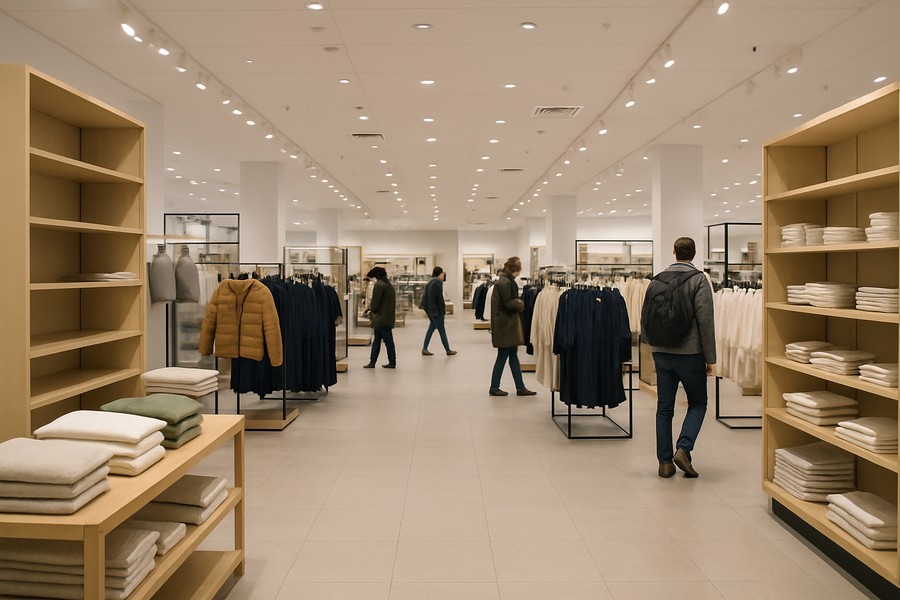
Under the CEO's leadership, the company has been addressing criticisms about its main department stores carrying stale merchandise, understaffing, and disorganized displays that had driven shoppers away. The company is committing to invest in the approximately 350 stores that will remain open. Efforts have been made to increase staffing, introduce new brands, and improve visual displays at a growing number of locations.
These changes have been well-received, and the company plans to add these improvements to more locations. As of Tuesday's close, the company's stock has risen nearly 25% over the past year, outpacing the roughly 20% gains of the S&P 500 during the same period. The company's market value stands at $4.5 billion, although its shares have fallen about 23% year to date.