
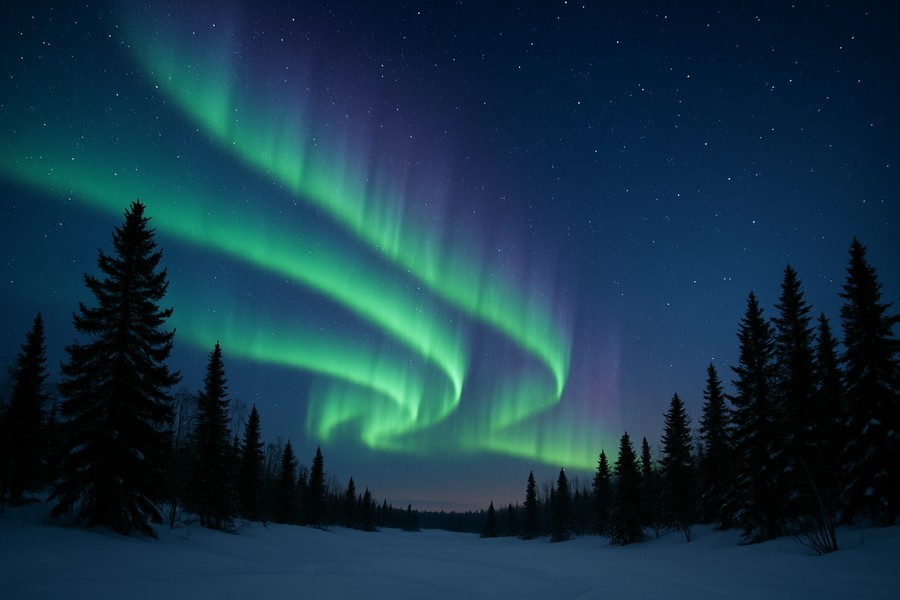
March Promises a Spectacular Show of Northern Lights
March presents a great opportunity to witness the extraordinary display of northern lights, thanks to the increased solar activity and approaching spring equinox. The upcoming weeks are expected to showcase a vibrant array of dancing lights in the night sky.
The forecast of a potential G1 geomagnetic storm on Friday, though, has been called off by a space weather prediction center.
Understanding the Northern Lights
So, what's behind these breathtaking displays of lights? The answer lies in the solar activities taking place millions of miles away from us. The primary source of the solar activity that leads to these displays is a high-speed stream of solar wind escaping from a negative polarity coronal hole in the sun's atmosphere.
These northern light displays, also known as auroras, are a result of the interaction between solar wind and the atoms and molecules in our planet's atmosphere. When the charged particles from the sun collide with the upper atmosphere, the atoms light up, creating a kaleidoscope of colors in the night sky.
Spring Equinox and Aurora Season
The frequency of northern light activity is likely to rise throughout the month, thanks to the upcoming spring equinox. The period before and after the spring and fall equinox is often referred to as "aurora season."
The spring equinox in the northern hemisphere is on the horizon, starting when the sun crosses the celestial equator. During this phase, geomagnetic storms become more likely due to the way solar wind interacts with the Earth's magnetosphere.
The Role of the Magnetic Field
The Earth's north-pointing magnetic field and the sun's south-pointing magnetic field - brought towards Earth by solar wind - can counterbalance each other during this time. This clash creates a gap in Earth's magnetic field, making it easier for solar wind to reach Earth's magnetic poles and generate auroras. This event is often referred to as the "Russell-McPherron Effect," named after a 1973 research paper by geophysicists Christopher Russell and Robert McPherron.
This effect increases the potential for auroras in the weeks leading up to the equinox. However, whether these auroras will be visible or not depends on how the high-speed stream from the coronal hole arrives, its magnetic orientation, and local weather conditions.
Best Time to Watch the Northern Lights
For those in the U.S., the ideal time to catch this celestial spectacle is usually between 10 p.m. and 4 a.m. local time. Choosing the darkest location possible will enhance the viewing experience.
Solar Maximum and Increased Aurora Displays
The arrival of the spring equinox is in line with the end of the solar maximum. The sun's 11-year cycle peaked around late 2024 and has continued to emit strong solar activity and geomagnetic storms, resulting in more frequent and vibrant aurora displays.