
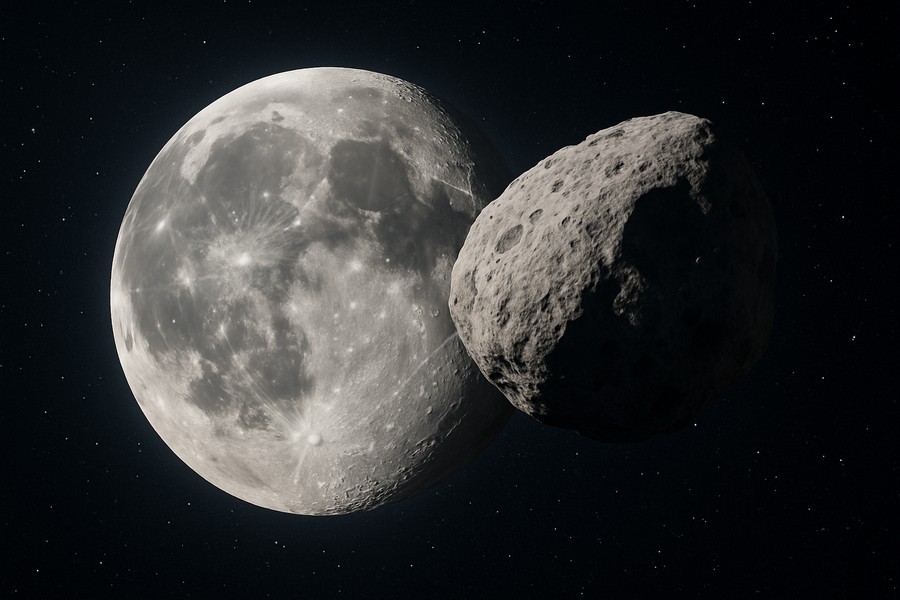
Close Shave for the Moon: 'City-Destroying' Asteroid to Pass Relatively Close
The moon, our closest celestial neighbor, is set to dodge a potentially catastrophic collision with a massive asteroid, coined as a "city destroyer," in 2032. This revelation is courtesy of the latest data gathered by one of the most sensitive space telescopes.
These new findings, obtained from the telescope's sensitive infrared instruments, were able to provide an updated trajectory of the near-Earth asteroid, known as 2024 YR4. This has eliminated any previous fears of a possible lunar impact, which were once thought to be a 4.3% probability.
Contrarily, it has been ascertained that this enormous asteroid will skim past the moon, at a distance of roughly 13,200 miles (21,200 kilometers) from the lunar surface. To put this into perspective, this is closer than the distance many man-made satellites maintain while orbiting our planet. Furthermore, when 2024 YR4 circles back through the inner solar system after six years, it will steer clear of Earth by hundreds of thousands of miles.
The Power of Advanced Observational Tools
It's worth noting that these recent observations were made possible due to the extreme sensitivity of the space telescope used. Nonetheless, this task pushed the limits of the telescope's capabilities.
Since the spring of 2025, the asteroid has been impossible to observe from both Earth and space-based observatories, barring this one exception. The latest snapshots of 2024 YR4 are among the faintest ever observations of an asteroid, a testament to the technological prowess of our observational tools.
Unprecedented Asteroid Risks
The asteroid 2024 YR4 was first detected in late 2024 by a network dedicated to tracking potential terrestrial-impact asteroids.
Follow-up observations swiftly revealed that this space rock was a giant, boasting a diameter between 174 and 220 feet (53 to 67 meters) – roughly the height of the Leaning Tower of Pisa. Moreover, its trajectory indicated an uncomfortably close approach to Earth. An asteroid of this magnitude colliding with our planet could potentially demolish a city with the force equivalent to 500 Hiroshima bombs. This potential for destruction led to its nickname, "city killer."
Initially, astronomers estimated a slim possibility of this asteroid crashing into Earth. The projected probability of an impact once reached a peak of 3.1%, marking the highest ever recorded likelihood of a potential asteroid collision. However, within a few months, fresh data from the aforementioned space telescope and other observatories reduced these odds to zero. Yet, the probability of a lunar collision was still pegged at 4.3% until the latest observations.
Consequences of a Lunar Collision
What if an asteroid of this size were to strike the moon? It wouldn't be the first instance of the moon enduring a hit from a space rock. However, it would be the first time scientists could anticipate a large lunar impact from a known asteroid and observe it in real time.
Some astronomers speculated that the resulting explosion could have been visible from Earth with the naked eye. Others cautioned of a potential shower of debris that could initiate a new meteor shower over our planet. Fortunately, for now, it seems the moon - and by extension, Earth - is safe from any such eventuality.