
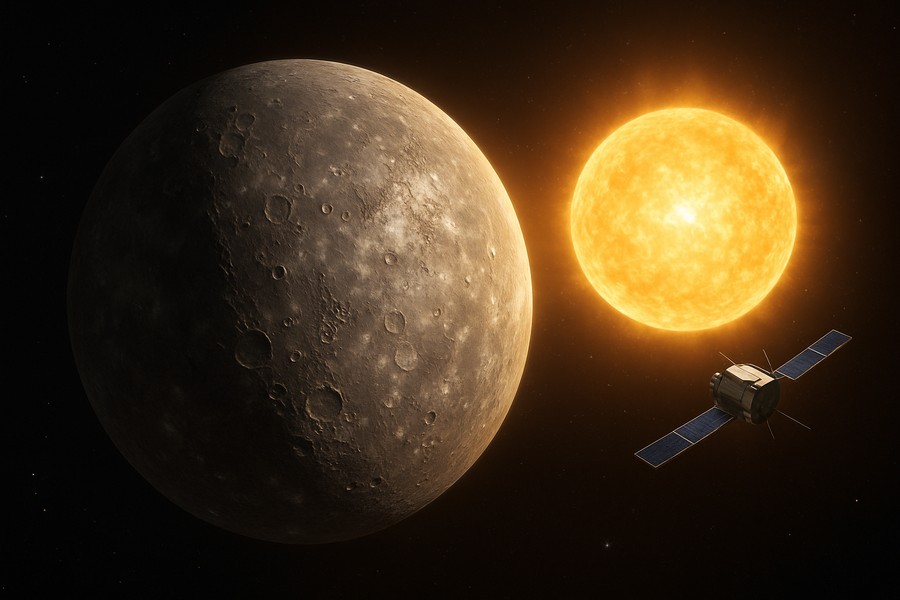
Unraveling the Mystery of Mercury: The Planet That Defies Formation Theories
The smallest planet in our solar system, Mercury, has been perplexing astronomers for years. Its proximity to the Sun, its size, and its peculiar characteristics do not align with what we understand about planet formation. This enigma might soon be resolved by a space mission set to arrive in a few years.
Mercury: A Close-up Look
Mercury's unremarkable surface, lack of water evidence, and its thin atmosphere might make it seem like the least interesting planet. But a closer look reveals that Mercury is a captivating world with many unsolved mysteries. The smallest planet in our solar system, it's just a bit larger than Australia and has an extraordinary density, second only to Earth. This is due to its huge metallic core, which constitutes a significant portion of its mass.
Despite being so close to the Sun, the planet's formation remains a puzzle. Experts in planetary formation and dynamics admit that there's a significant detail they're missing when it comes to understanding Mercury's existence.
Unlocking Mercury's Secrets
Current space missions may soon shed light on the secret of Mercury's formation. When the spacecraft, a joint venture between European and Japanese agencies, enters Mercury's orbit, it will strive to unravel the planet's origins. The mission will not only enhance our understanding of our own solar system but also offer valuable insights into exoplanets—planets beyond our solar system.
Unusual Characteristics
Initial visits to Mercury in the mid-70s revealed its unique internal structure, unlike other planets such as Earth, Venus, and Mars, which have iron-rich cores that make up about half their radius. Mercury's core makes up about 85% of its radius, with only a thin mantle and crust on top, contributing to its extreme density. However, why it evolved this way remains unclear.
Further mysteries were uncovered during a more recent mission to Mercury. Despite the extreme temperatures on the planet due to its proximity to the Sun, volatile elements were found on its surface, which should have evaporated long ago due to solar radiation. In addition, complex molecules, including water ice in the planet's shadowed polar craters, were discovered.
Theories About Mercury's Formation
Astronomers have been working on various theories to explain Mercury's formation. One popular theory proposes that Mercury was once much larger and farther away from the Sun. It might have been hit by a massive object early in its existence, stripping it of its outer layers and leaving behind the dense core that we see today. This theory is supported by the presence of certain elements detected on Mercury's surface, similar to those found on Mars, which is farther from the Sun.
Another theory suggests that Mercury was the impactor, crashing into another planet and ending up in its current position. This could explain how Mercury's mantle was stripped off.
An alternative theory proposes that Mercury formed near the Sun from iron-rich material. In this scenario, the young Sun's heat would have evaporated most of the lighter dust in Mercury's position, leaving behind heavy iron-rich material to coalesce together. However, why Mercury stopped growing at its current size remains a mystery in this theory.
A less conventional theory proposes that Mercury is the core of a gas giant that had its atmosphere stripped away.
Future Missions to Mercury
Future space missions may provide essential clues to solve Mercury's formation mystery. The upcoming mission, a joint venture between the European Space Agency and the Japanese Space Agency, will separate into two spacecraft upon entering Mercury's orbit. These spacecraft will study the composition of Mercury's surface and its weak magnetic field, among other things.
If successful, these missions could reveal evidence of an ancient magma ocean, a better understanding of Mercury's core structure, and more information about the volatile elements present on the planet. The spacecraft might also provide insights into why Mercury's surface is so dark, suggesting the presence of a layer of dark material such as graphite. However, to truly understand Mercury, scientists believe that a future mission should aim to land on the planet and bring back samples to Earth.
While no such mission is currently planned, it could prove critical in unraveling the mysteries of this fascinating planet that, according to our current understanding, shouldn't exist.
