
A Rare Martian Rock Holds Clues to the Planet’s Early Crust
A meteorite found in the Sahara is a rare piece of Mars’s ancient crust. The rock, called Teghaza 001, formed at least 4.1 billion years ago, during an early stage in the planet’s history.
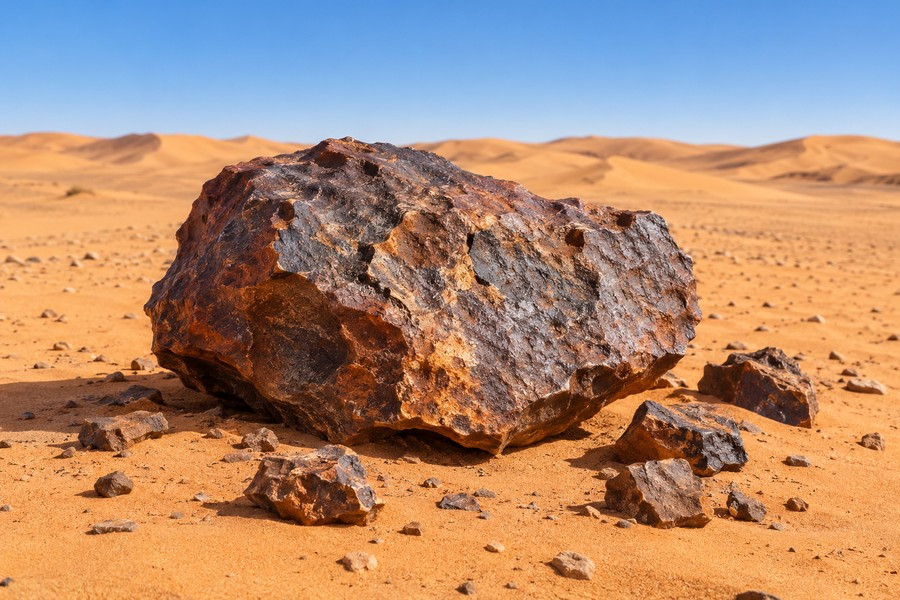
The meteorite is made up of eight pieces with a combined weight of 798.5 grams. Its largest piece weighs 442 grams and is about 10 centimeters across. Scientists say its age and makeup make it unlike most Martian rocks found on Earth.
Older Than Nearly All Known Martian Meteorites
About 300 meteorites from Mars have been identified. Most are much younger than the oldest parts of the planet’s surface, where many areas are more than 3 billion years old. The three most common groups of Martian meteorites formed 2.4 billion years ago or later.
Only a small number of known samples are as old as Teghaza 001. One is Allan Hills 84001, which crystallized about 4.1 billion years ago. Another is a group of rocks that includes Northwest Africa 7034. Some pieces in that group are more than 4.3 billion years old.
Teghaza 001 stands apart from those samples. It is a coarse-grained volcanic rock called plagioclase-rich gabbro. Its structure suggests it cooled slowly, likely below the surface of Mars. Unlike a meteorite made from many kinds of rock, Teghaza 001 is a single, relatively unchanged type of rock.
Two Tests Reveal Its Age
Scientists measured tiny zircon crystals inside the meteorite using uranium and lead. That test gave an age of about 4.11 billion years. A second test, using rubidium and strontium, produced a similar but less exact result of about 4.24 billion years.
The two measurements may not mark the exact same event. The older estimate could reflect a time when hot water carrying minerals moved through the rock, rather than the moment the rock first became solid. Either way, the meteorite had formed by about 4.1 billion years ago.
That places its origins in one of the earliest periods of Mars’s geologic history. It is the oldest known Martian igneous rock found as a single, clear rock type, rather than as a mixture of older pieces.
Signs of Water on Mars
The meteorite also contains clues that water once interacted with it. Its oxygen atoms have a different mix of forms, called isotopes, than those in other Martian meteorites. The pattern points to contact with fluids rich in a heavier form of oxygen.
That contact may have happened in the planet’s crust or within the magma from which the rock formed. Some minerals in the meteorite were also changed by chemical reactions on Mars. Those changes took place long before an impact blasted the rock off the planet and sent it through space.
Together, the rock’s age and water-related signs offer a look at an early Martian environment that is not well represented in other samples. The findings suggest that fluids moved through or affected some of Mars’s ancient rocks.
A Possible Home in Mars’s Southern Highlands
Researchers compared the meteorite’s chemical makeup with measurements taken from Mars from orbit. The closest match points to the planet’s southern highlands, especially an area northwest of the Hellas impact basin.
The meteorite’s original location cannot be pinned down with certainty from the information available. But the comparison gives scientists a likely region to investigate as they study where this unusual rock came from.
Teghaza 001 is valuable because it captures several clues in one sample: an ancient age, a distinct rock type, and evidence of chemical changes linked to water. Its unusual nature also means a similar sample may be difficult to find again soon.