
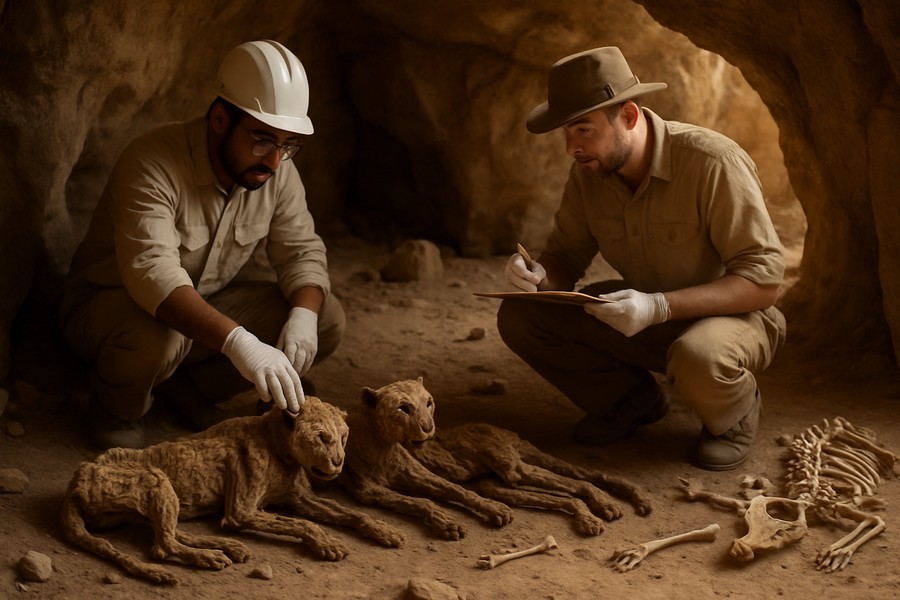
Unearthing Ancient Cheetah Mummies in Saudi Arabian Caves
A recent discovery inside caves located in northern Saudi Arabia has left scientists in awe. They have stumbled upon the mummified remains of cheetahs, some of which are up to 1,800 years old. The age of the mummified remains varies, with the youngest estimated to be about 130 years old. In total, seven mummified bodies and the skeletal remains of 54 cheetahs were found near the city of Arar.
Understanding Mummification
Mummification is a preservation process that halts the decay of dead bodies. While most people associate mummies with ancient Egypt, the natural world can also create mummies in places like icy glaciers, desert sands, and sludgy bogs. The cheetah mummies found in Saudi Arabia have a husk-like appearance, with their cloudy eyes and shrunken limbs.
Joan Madurell-Malapeira, who teaches at the University of Florence in Italy, and was not involved in the study, expressed astonishment at the discovery. She confessed that she had never seen anything like it before.
Exploring the Mystery of the Mummified Cheetahs
Scientists are still trying to piece together the puzzle of how these large cats ended up mummified. It's believed that the dry conditions and stable temperatures inside the caves might have played a part in their preservation. However, the reason behind the large concentration of cheetahs inside the caves remains unknown. Some speculate that the location might have been a denning site, a place where mother cheetahs gave birth and raised their cubs.
Finding mummified remains of large mammals is a rarity. Not only do the bodies need the right environment to prevent decay, they also need to escape detection from hungry scavengers like birds and hyenas. Ahmed Boug, a lead author of the study from the National Center for Wildlife in Saudi Arabia, shared his excitement, stating that such an intact discovery of ancient cheetahs in this region is "entirely without precedent".
Cheetahs: A Disappearing Species
Historically, cheetahs were known to roam widely across Africa and parts of Asia. However, today, they only inhabit 9% of their previous range. It's been decades since cheetahs have been spotted in the Arabian Peninsula. The drastic decline in their population is attributed to habitat loss, unregulated hunting, and scarcity of prey, among other factors.
Interestingly, in an unprecedented achievement for large naturally mummified animals, scientists were able to analyze the genes of the mummified cheetahs. They found that the ancient cheetahs were genetically similar to the present-day cheetahs found in Asia and northwest Africa. This new information could significantly contribute to future efforts to reintroduce cheetahs to regions where they no longer exist.