
Construction Begins on Revolutionary Nuclear-Driven Drone for 2028 Mission to Titan
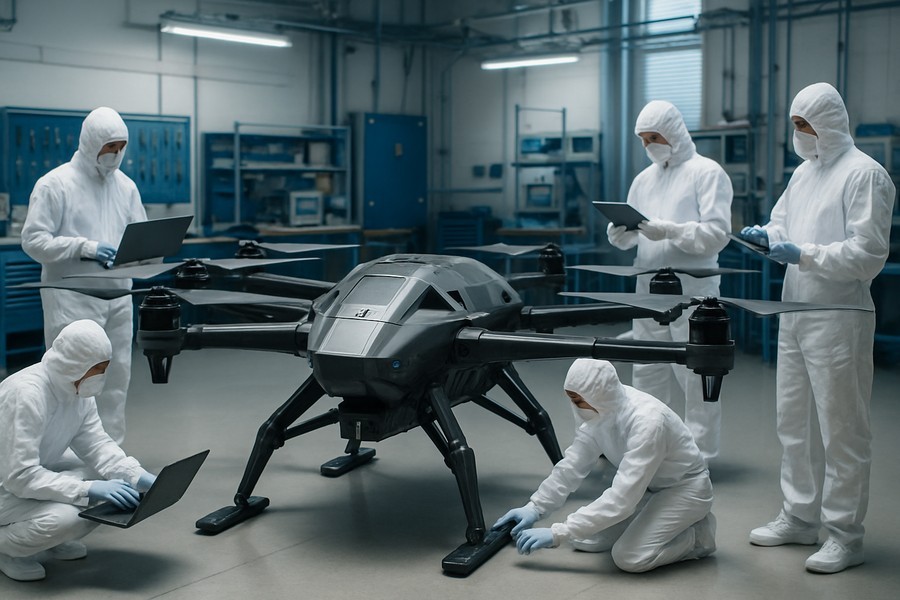
The exciting journey of sending a drone to another world is moving forward. The drone, known as Dragonfly, is under construction and being tested in Maryland. The highly anticipated mission, set for 2028, aims to explore Titan, the largest moon of Saturn.
"We are ecstatic to have reached this significant milestone in the mission," stated the project's lead investigator. "We're pushing the boundaries of our capabilities with this unique vehicle, designed to fly across an ocean world in our solar system. The team has accomplished fantastic work, and each element we add, each test we conduct, brings us an inch closer to launching Dragonfly to Titan."
The Second Aerial Vehicle to Venture Beyond Earth
Dragonfly, the size of a car, will be the second rotorcraft to venture the skies beyond our planet. The first was a Mars helicopter called Ingenuity, whose body was as tiny as a tissue box. Unlike Dragonfly, Ingenuity was solar-powered and designed for a few hops. However, it surpassed expectations and lasted a remarkable three-year flight campaign.
Dragonfly plans to build on the lessons learned from Ingenuity but with added features. While Ingenuity was a tech demonstrator costing $85 million, Dragonfly is a full-fledged mission with a budget of approximately $3.35 billion. Unlike its predecessor, Dragonfly will be nuclear-powered, not solar.
Titan: A Fascinating Destination
With its launch set for 2028, Dragonfly is destined for Titan, Saturn's largest moon and the second-biggest satellite in our solar system, only smaller than Jupiter's Ganymede. Titan is known to have a wealth of precursor molecules to life, making it an intriguing target for researchers. It has been studied up close just once, by a European lander that survived a few hours in Titan's skies and on its surface in 2005.
Once Dragonfly lands on Titan, the mission aims to "investigate various locations to understand the moon's chemistry, geology, and atmosphere, which will ultimately enhance our knowledge about the chemical origins of life," stated officials. But before that, the mission needs to be prepared for space.
Preparations Underway
The initial weeks of testing will concentrate on the spacecraft's integrated electronics module, the "brain" of the mission responsible for functions like guidance, navigation, and data handling, as well as power-switching units.
Testing and integration are expected to continue into early 2027, after which the spacecraft will be shipped for system testing before a brief return to assess how Dragonfly will fare in the space environment. The spacecraft is then scheduled to be sent for a 2028 launch aboard a heavy rocket.
Tests are also underway for Dragonfly's protective shell for its journey through space. The shell has completed aerodynamic tests and is now in the integration and testing stage. Other components like the science payload and flight radio are also being put together.
Despite several years until the launch, moving into the build-and-test phase marks a significant milestone. "For years, we've been designing and refining this incredible rotorcraft digitally and in labs. Now, we get to bring all those elements together and transform Dragonfly into an actual flight system," stated the project's integration and test lead.