
Unanswered Queries on Upcoming Moon Mission Risks
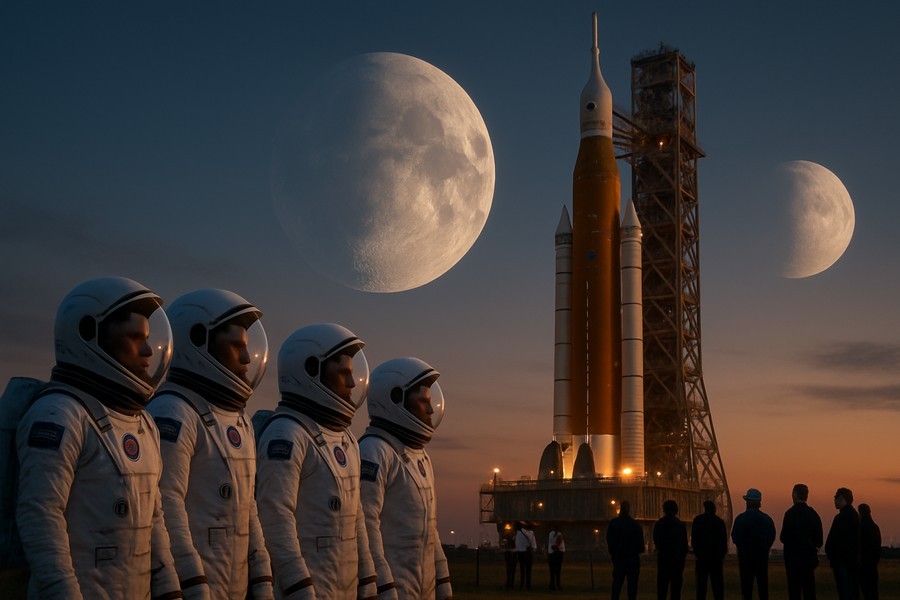
During a recent press meet, queries about the risks involved in the upcoming lunar expedition, Artemis II, were met with vague responses from the officials in charge.
These questions surrounding the risks were indeed crucial, especially considering the fact that the public, the workforce, lawmakers, and even the White House are all invested in this spaceflight. The astronauts who will be embarking on this dangerous journey are the most affected.
A New Leap for Mankind
Significantly, the Artemis II will be the first mission since 1972 to transport humans to the vicinity of the Moon. This mission is not a routine journey to the International Space Station, which is just a few hundred miles above Earth.
The Artemis II will travel more than a thousand times the distance from Earth to the International Space Station. The mission will take the astronauts several thousand miles beyond the far side of the moon. The entire journey from the liftoff in Florida to the splashdown in the Pacific Ocean will span nine days. The four-person crew will be aboard a rocket and a spacecraft that have only flown together once before. The mission's novelty makes it challenging to assess the risk, as stated by the officials.
The Lone Test Flight
Based on the single test flight, Artemis I, the managers were hesitant to release the bottom-line number from the risk assessment for Artemis II.
One of the officials stated that while risk numbers can be informative, it is easy to fall into the trap of believing that they are telling us something critically significant. She added that the risk numbers can help measure what's more or less risky in a relative sense.
A recent meeting in Florida allowed for an open and transparent discussion about the risks involved in the Artemis II launch and the measures being taken to mitigate these risks. The decision-makers present at the meeting unanimously agreed to proceed with the final preparations for the Artemis II mission.
Astronaut Concerns
The astronauts training for Artemis II participated in the meeting virtually from Houston. They discussed various aspects, including the spacecraft's heat shield and reentry trajectory. This was a topic that required additional review after the appointment of a new agency administrator.
One of the primary concerns was ensuring safe reentry and maintaining communication with Earth. Other risks discussed included environmental control, life support systems, and power systems.
Launch Delays and Risks
The Artemis II launch was initially scheduled for early February. However, technical issues, including a leaky hydrogen seal in the rocket's fueling line and a problem loading helium into the rocket's upper stage, led to delays. The rocket had to be returned to the hangar for repairs and is slated to be back on the launch pad next week.
The officials have decided against performing another fueling test. They are confident that the seals are now leak-tight. The next time the vehicle is tanked will be during the launch attempt.
There are six launch opportunities in early April, or the team will have to wait until the end of April for the next series of launch attempts.
Assessing Risks
When asked about the risk of a catastrophic accident on Artemis II, one official said that NASA has been wrestling with the risk probability for a while. He noted that they understand the risks associated with individual components, subsystems, and overall systems.
Statistically, about half of all rockets fail on their first flights. The aim is to bring the probability of a failure on an Artemis flight to less than 1 in 50. The official added that achieving this failure rate would mean that NASA is progressively reducing the risks.
However, the long gaps between the Artemis missions pose their own risks. The longer the wait between flights, the less it contributes to safety. This understanding led to a change in plans to fly the next mission, Artemis III, next year to low-Earth orbit to demonstrate docking with a commercial lunar lander in low-Earth orbit.
As of now, Artemis IV is set to attempt the program's first human landing at the Moon's south pole, with a tentative launch date in 2028. However, the schedule depends on a near-flawless execution of Artemis II and Artemis III, and speeding up the availability of human-rated Moon landers.
Astronauts Prepare for Risk
The Artemis II mission’s commander, Reid Wiseman, has been attempting to prepare his family for the hazards of the circumlunar flight. He acknowledged that while the numbers surrounding the mission may seem daunting, test pilots and astronauts take calculated risks for a living. Despite the unknowns, Wiseman expressed his readiness and confidence in the mission.