
Deep Space Probe Uses Mars as a Slingshot to Reach a Rare Metal World
The universe is filled with countless mysteries, and some of the most exciting secrets are waiting right inside our own solar backyard. A specialized robotic explorer is currently traveling through deep space to visit a highly unusual target: a distant asteroid that is completely different from any world humans have ever explored.
While most space rocks are made of cold ice or hard stone, scientists believe this particular destination is made almost entirely of solid metal. On its long journey to this metallic world, the spacecraft recently passed very close to Mars, capturing stunning views of the Red Planet and getting a much-needed speed boost along the way.
A Close Shave with the Red Planet
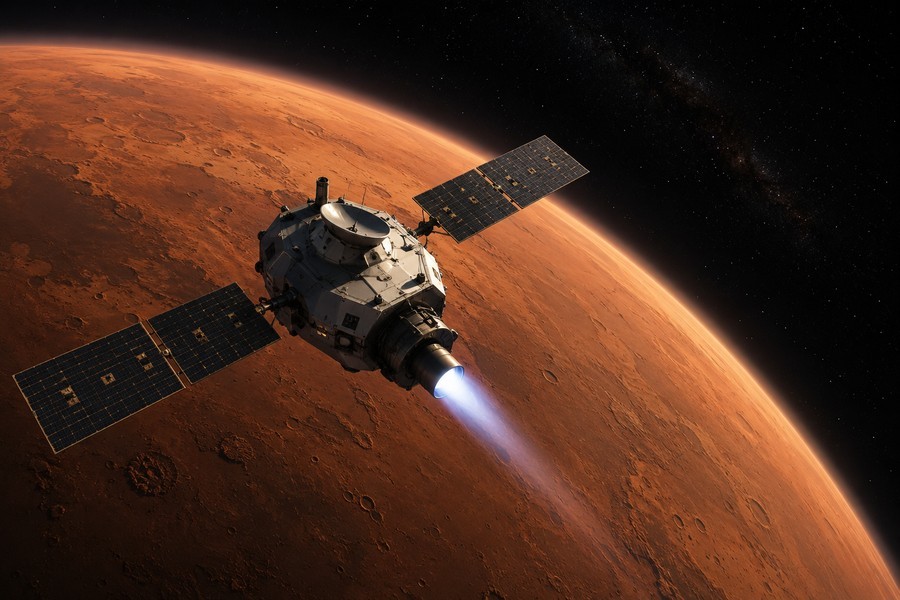
During its journey, the spacecraft executed a flyby of Mars, passing just 2,800 miles (4,600 kilometers) above the planet's dusty surface. At the time of the flyby, the probe was traveling at an estimated speed of more than 12,000 miles per hour (19,848 kilometers per hour).
As the spacecraft zipped past, its cameras captured a beautiful, shifting timelapse video of Mars. It also took photos of the planet appearing as a thin, glowing crescent against the darkness of space. Beyond taking these pictures, the flyby allowed the spacecraft to achieve two major goals:
- Testing the instruments: The flyby served as a valuable practice run. Scientists used the opportunity to test the spacecraft's sensors on Mars. They successfully observed the planet's "bow shock," which is a boundary where solar particles bend around Mars like water flowing around the front of a moving boat. The cameras also captured images of Mars' icy southern pole and a massive, double-ringed crater.
- Gaining speed: The spacecraft used the gravity of Mars to slingshot itself forward. This maneuver increased the probe's speed by 1,000 miles per hour and slightly shifted its path toward its final destination.
Stealing Energy to Save Fuel
Using a planet's gravity to speed up is a clever trick in space travel. By passing close to Mars, the spacecraft was able to pull a tiny bit of the planet's orbital energy. This gave the probe a free speed boost without requiring it to burn any of its own onboard fuel. While the spacecraft gained speed, Mars slowed down by an incredibly tiny, unnoticeable amount.
Mission controllers spent years planning this gravity-assist maneuver. They confirmed that the spacecraft flew along the exact path needed to keep it on schedule. The spacecraft remains in good condition and will continue using its solar-powered engines to push deeper into space.
The Mystery of the Metal Asteroid
The spacecraft's ultimate destination is a giant asteroid named after an ancient goddess of the soul. First spotted by astronomers in the mid-1800s, this potato-shaped space rock is located in the main asteroid belt between Mars and Jupiter, which is about three times farther from the Sun than Earth is.
What makes this asteroid so special is its composition. Scientists suspect it might be the exposed iron core of an ancient "baby planet" that was destroyed billions of years ago. In the early days of our solar system, young planets frequently crashed into each other. These violent collisions may have stripped away the rocky outer layers of this object, leaving only its metallic center bare.
The asteroid is quite large, measuring about 170 miles (280 kilometers) at its widest point, which is roughly the size of a small U.S. state. However, because no spacecraft has ever visited it, no one knows for sure what its surface looks like.
A High-Tech Explorer
The spacecraft sent to study this metallic world is roughly the size of a singles tennis court and is powered by large solar panels. It is equipped with a variety of advanced scientific instruments designed to study the asteroid from orbit:
- Advanced Cameras: These will take photos of the asteroid using different wavelengths of light to reveal what materials are on the surface.
- Chemical Sensors: These instruments will analyze the light and particles coming off the asteroid to determine its exact chemical makeup.
- Magnetic Sensors: These will check if the asteroid still has a magnetic field, which would help indicate if it was once the core of a planet.
- Radio Systems: By measuring how the asteroid's gravity pulls on the spacecraft, scientists can map the density and interior of the metal world.
The spacecraft is also testing a futuristic laser communication system. Instead of using traditional radio waves, this system uses near-infrared lasers to beam data back to Earth at much faster speeds. During early tests, this laser system successfully transmitted a high-definition video of a cat back to Earth from deep space.
The spacecraft is scheduled to arrive at the metal asteroid by the end of the decade. Once it arrives, the data it sends back will help scientists gain a better understanding of how the rocky planets in our solar system, including Earth, first formed their metallic cores.