
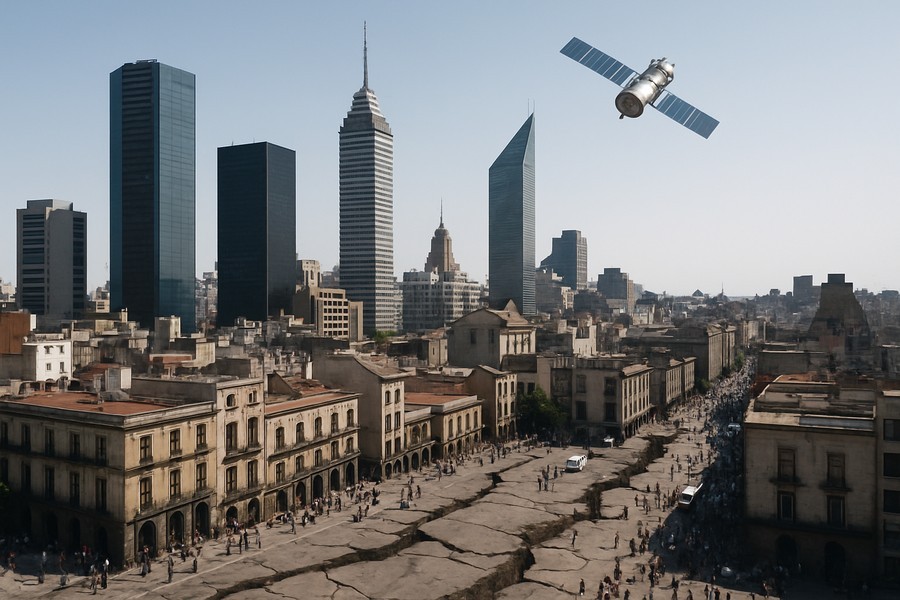
Unbelievable Speed at Which Mexico City is Descending
Mexico City, one of the world's most populated urban sprawls, is descending at an alarming rate of nearly 10 inches or approximately 25 centimeters every year. This shocking revelation is based on the latest satellite images that have been captured.
Mexico City: A Metropolis on an Ancient Lake Bed
Spread across an area of nearly 3,000 square miles (close to 7,800 square kilometers) and housing around 22 million people, Mexico City and its surrounding areas were originally constructed on an ancient lake bed. Many of the central downtown streets were former canals, a custom that is still preserved in the outskirts.
Urban Development and Groundwater Pumping: Two Major Reasons
Over a century of urban development and extensive groundwater pumping has significantly depleted the aquifer, causing the city to continually sink. This sinking has left visible marks on numerous monuments and older structures, including the Metropolitan Cathedral which began construction in 1573, as they are noticeably tilted to the side.
This shrinking aquifer has not only resulted in the city's descent but also led to a severe water crisis which is predicted to escalate further in the future.
The Impact on Mexico City's Infrastructure
The sinking city is causing significant damage to its critical infrastructure including the subway, the drainage and potable water system, housing, and streets. Enrique Cabral, a geophysics researcher at the National Autonomous University of Mexico, describes it as a "very big problem."
Space Observation Reveals the Extent of the Problem
The rate of subsidence of Mexico City is so rapid that it can be observed from space. Certain areas are descending at an average rate of 0.78 inches (2 centimeters) per month. This includes the main airport and the well-known monument often referred to as the Angel of Independence.
This translates to an annual subsidence rate of approximately 9.5 inches (24 centimeters). In less than a hundred years, the city has sunk more than 39 feet (12 meters). According to Cabral, "We have one of the fastest velocities of land subsidence in the whole world."
Advanced Satellite Technology to the Rescue
These estimates are based on measurements taken by a powerful satellite known as NISAR. This satellite tracks real-time changes on the Earth's surface and is a collaborative project between two space research organizations. The satellite's observations provide crucial information about what's happening beneath the surface.
As NISAR scientist, Paul Rosen puts it, "You can see the full magnitude of the problem." The satellite provides a comprehensive documentation of the changes occurring within a city. The team hopes to refine the technology to focus on specific areas and eventually measure changes on a building-by-building basis.
Future Applications of the Technology
Researchers aim to use this technology globally to monitor natural disasters, changes in fault lines, and the effects of climate change in places like Antarctica. The technology could also enhance alert systems, enabling scientists to notify governments about the need for evacuations in the event of volcanic eruptions, for instance.
A Step Forward in Understanding and Mitigating the Problem
For Mexico City, this technology represents a significant advancement in studying and mitigating the effects of subsidence. In the past, the government's response to the problem has been limited to stabilizing foundations under monuments like the cathedral.
However, with recent exacerbations of the water crisis, officials have started funding more research. The data and images from the NISAR satellite will be instrumental for scientists and officials as they strategize on how to approach the problem. As Cabral explains, "the first step is to just understand."