
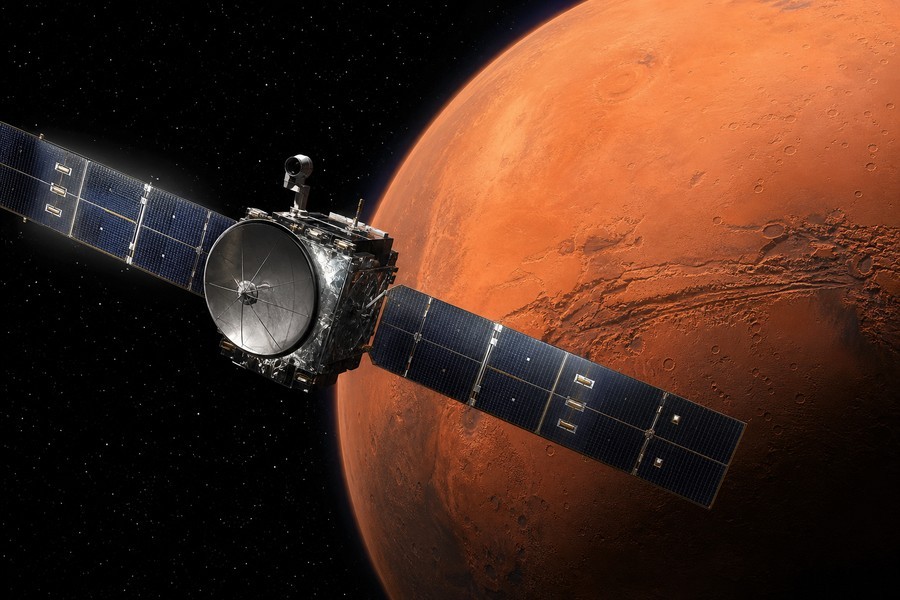
Deep Space Traveler Sends Back Incredible Pictures of Mars During Flyby
A robotic explorer traveling through deep space recently captured spectacular views of Mars as it swept past the Red Planet. The spacecraft is on a long-term mission to study a mysterious, metal-rich asteroid located in the main asteroid belt between Mars and Jupiter. While the probe is not scheduled to reach its final destination for several years, its journey recently brought it close to Mars, providing an excellent opportunity to take photos and test its systems.
During the close pass, the spacecraft came within about 2,864 miles (4,609 kilometers) of the Martian surface. The images and video collected during this encounter offer a dramatic look at what it would be like to glide high above the dusty red world.
Using Mars for a Speed Boost
Space travel is rarely a straight line. To travel the vast distances between planets, engineers must find clever ways to save fuel. One of the most common methods is a maneuver known as a gravity assist.
During this maneuver, a spacecraft flies close to a large planet to harness its gravitational pull. This pull acts like an invisible slingshot, giving the spacecraft a significant boost in speed. It can also be used to change the spacecraft's direction or slow it down without burning valuable rocket fuel. This is exactly what happened during the recent flyby.
For this particular mission, the flyby of Mars was carefully planned to tweak the spacecraft's path and propel it toward the outer solar system. The maneuver kept the spacecraft on its precise path to meet its target asteroid.
Testing the Cameras on the Red Planet
The month-long encounter with Mars was not just about gaining speed. It also gave the flight team a great chance to test the spacecraft’s scientific instruments, especially its high-tech cameras.
As the spacecraft approached Mars, the planet initially appeared as a thin, glowing crescent. This unique view was caused by the angle of the spacecraft and Mars relative to the Sun. As the probe drew closer, the cameras captured highly detailed views of the Martian landscape.
Some of the notable features visible in the images include:
- The planet’s dusty craters and rugged canyons.
- The frozen south polar ice cap, confirming the presence of ice on the Martian surface.
- The massive, double-ringed impact basin known as the Huygens crater.
Beyond taking photos of the surface, the camera team used this flyby to test how sensitive the lenses are to scattered light. They even practiced searching for small objects by spotting Mars’s two tiny moons, Phobos and Deimos, from a great distance. This practice will help the team search for any undiscovered mini-moons when the spacecraft finally arrives at its target asteroid.
Checking the Scientific Instruments
The spacecraft carries several other advanced tools designed to study the composition of its target asteroid. The Mars flyby served as a crucial test run to ensure these tools are working properly after traveling through the harsh environment of space.
One of these instruments is a special sensor designed to analyze the chemical elements on planetary surfaces. It works by measuring energy emissions. When high-energy cosmic rays from deep space strike a planet, the elements on the surface absorb this energy and release particles called neutrons and gamma rays. By measuring these emissions, scientists can determine what the planet is made of.
During the closest approach to Mars, the sensor detected a surge in neutrons that matched what scientists anticipated. This test suggested that the instrument is functioning well and ready for its future work.
Another key tool on board is a device that measures magnetic fields. Scientists want to know if the target asteroid has a magnetic field, which would suggest it was once the core of an ancient, rocky planet. The pass by Mars allowed this instrument to detect its very first magnetic signature from a celestial body. It measured the intense area where the solar wind—a stream of charged particles from the Sun—slams into Mars's magnetic field, validating the instrument's performance under dynamic conditions.
The Journey Continues
With the Mars flyby complete, the mission team has confirmed that all systems are functioning as intended. The data collected during the flyby closely matches existing knowledge of Mars, proving that the spacecraft's instruments are highly accurate.
The spacecraft is now continuing its journey into the asteroid belt. Engineers plan to engage the probe's solar-electric propulsion systems to keep it moving steadily toward its destination. If everything continues to go according to plan, the spacecraft will begin its detailed study of the mysterious asteroid in a few years, potentially unlocking secrets about how rocky planets first formed in our solar system.