
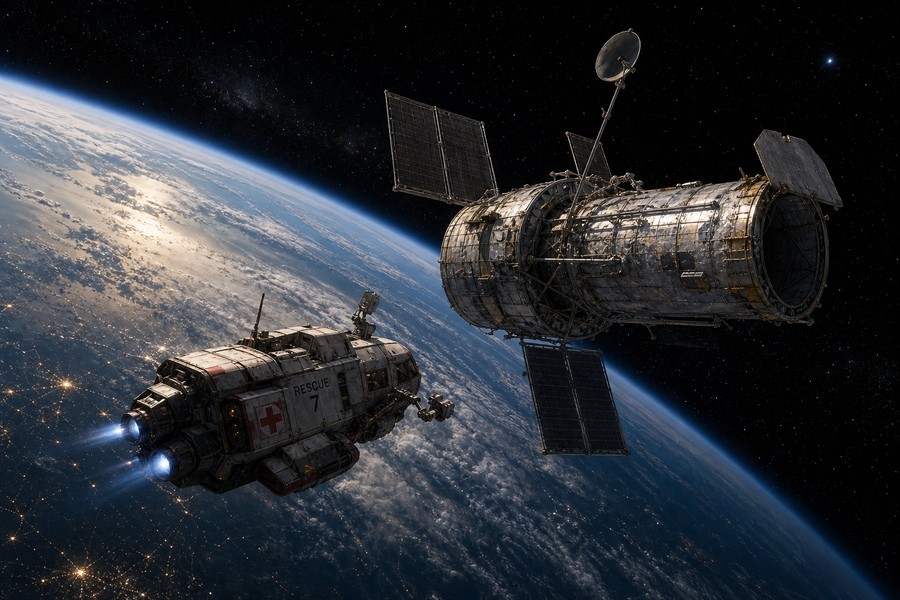
Rescue Spacecraft Sent to Save Falling Observatory Spins Out of Control
A high-stakes mission to rescue a failing space observatory has run into serious trouble. The small recovery vehicle sent to save the scientific satellite is now spinning in deep space and struggling to talk to ground controllers. Engineers are working to stop the spin and get the mission back on track before time runs out.
The rescue vehicle was launched on a special mission to catch up with an aging space observatory that is slowly losing its fight against gravity. Without help, the observatory will fall into Earth's atmosphere and burn up. However, the rescue vehicle is now facing its own critical systems failures that could jeopardize the entire operation.
Steering Wheels in Space Stop Working
To understand what went wrong, it helps to look at how spacecraft steer. Unlike cars, vehicles in space cannot turn wheels on a road. Instead, they use devices called reaction wheels. These are heavy, spinning metal disks inside the spacecraft. By changing how fast these disks spin, the vehicle can rotate and point itself in different directions without using up valuable fuel.
The rescue vehicle has three of these reaction wheels to control its orientation, steering, and stability. Unfortunately, two of the three wheels have stopped working. Without these wheels, the spacecraft cannot easily hold still or point its antennas toward Earth.
Because of this failure, the vehicle has entered a multi-axis spin. This means it is tumbling in multiple directions at once. This constant tumbling makes it very difficult for the spacecraft to send and receive signals. Ground controllers are experiencing sporadic communications, meaning they can only talk to the vehicle in short, unpredictable bursts. Fortunately, other major systems on the spacecraft are still working as expected.
Using Back-Up Thrusters to Stop the Spin
Despite the communication troubles, the engineering team has not given up. They are currently using the spacecraft's electric propulsion thrusters to try to halt the spin. These thrusters use electricity to push small amounts of gas out of the back of the spacecraft, creating a gentle nudge.
Normally, these electric thrusters are saved for the journey to catch up with the observatory. Now, they are being used as emergency brakes to stop the tumbling. The team has reported that they are starting to see the desired effects from this strategy. If they can stop the spin and stabilize the vehicle, they plan to take the following steps:
- Update the navigation and control software to work with the vehicle's new configuration.
- Test the new setup to ensure the vehicle can fly safely with only one working reaction wheel.
- Create a revised plan to safely approach and grab the falling observatory.
A Race Against Time and Gravity
This rescue mission was put together in a major hurry. The team had less than one year from the time they received the contract to the day the spacecraft launched on the final rocket of its type. Because of this tight timeline, the vehicle did not have years of testing before heading into orbit.
The trouble actually began during the early stages of testing the spacecraft in orbit. Earlier in the mission, engineers noticed problems with how the vehicle pointed itself and how it communicated. At the time, they successfully sent software updates to the spacecraft. These patches fixed the issues, allowing the vehicle to stabilize itself and point in the right direction.
Just before this new spinning problem started, the team had been testing the thrusters. They were slowly making the engine burns longer to prepare for the long journey to meet the observatory. Now, those same thrusters are being used to save the rescue vehicle itself.
What Happens Next?
The clock is ticking for both spacecraft. The target observatory is also experiencing some technical difficulties, including a partial loss of function in its own gas thruster system. This makes the rescue even more urgent, as the observatory cannot save itself.
If the rescue vehicle cannot be stabilized soon, the observatory will enter the atmosphere and be destroyed. The private company behind the rescue vehicle has not explained why the two steering wheels failed. However, they remain hopeful. They believe that if they can stop the spin using the electric thrusters, the spacecraft still has a viable path to complete its rescue mission.