
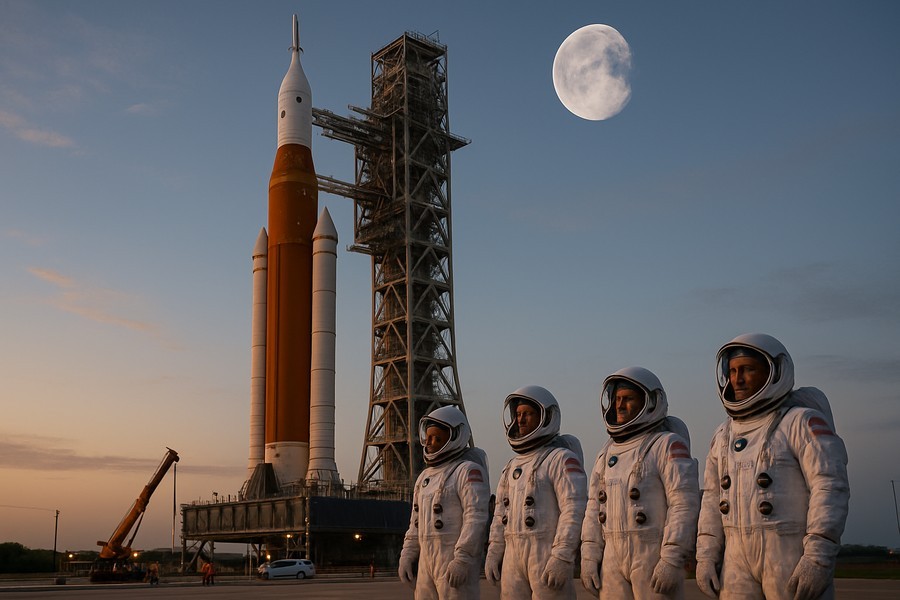
A New Era of Moon Exploration: Preparing for the Artemis II Mission
For the first time since the 1970s, a team of astronauts is preparing for a voyage to the Moon. The journey, known as the Artemis II mission, is slated to take place in the coming years. The mission will use a powerful rocket to transport a manned spacecraft, named Orion, into space. The astronauts will then spend 10 days orbiting the Moon.
The Road to Artemis II
Tracing the path leading up to this momentous mission, it's necessary to go back to the 1980s and 1990s. Following the tragic space shuttle Challenger accident, many were left wondering about the future of space exploration. The cost of operating the space shuttle program was steep, prompting discussions about potential successors.
A number of high-risk alternatives were considered, including single-stage-to-orbit space planes. However, when these ideas failed to materialize, it wasn't a major setback as the space shuttle was still operational.
The 2003 space shuttle Columbia accident forced a difficult decision: halt operations for a decade or so until technology improved, or transition the existing infrastructure to a new system. The decision was made to develop a new system using what was available — solid rocket boosters and external tanks.
For safety, crew capsules were introduced. These capsules, equipped with escape systems, were one of the few immediate ways to enhance crew survival odds. The development of these capsules, along with the creation of a heavy-lift vehicle to launch larger crews and heavier payloads, led to the current mission setup.
The Excitement of the Artemis II Mission
Four astronauts will embark on the 10-day mission orbiting the Moon. The initial launch, using solid rocket boosters, will be a critical moment as these boosters, while reliable, can fail quickly if not functioning correctly.
Once in Earth's orbit, an important decision has to be made — whether to perform a translunar injection. This maneuver involves firing the engine to escape Earth's orbit and set the spacecraft on course to orbit the Moon. Before making this decision, the environmental control and life support system will be checked to ensure the crew's safety.
Unlike previous missions, Artemis II will not require as many engine firings. The spacecraft will use the Moon's gravity to swing around and return to Earth, making it somewhat less risky. Upon reentry, the spacecraft's heat shield performance will be closely monitored.
The Importance of Lunar Presence
There's been much debate about the importance of establishing a permanent presence on the Moon. The future of space exploration depends on whether it's possible to utilize local resources and generate an economic return. If both are achievable, then permanent human activity beyond Earth could become a reality.
If not, space could remain a frontier for adventure and symbol of human achievement, much like Mount Everest. Alternatively, if economic returns can be realized but life cannot be sustained in the long term, space could be likened to an oil platform in the North Sea, a challenging environment that people visit for economic reasons.
The Artemis missions aim to determine which future is feasible. If the Moon proves to be economically viable, we may see a shift from government-led operations to private sector activities. If not, the focus will likely shift to Mars, but a scientific presence on the Moon would likely be maintained regardless.