
An Unexpected Spectacle: K1 Comet Disintegrates in Space
The Hubble telescope has made a remarkable discovery. It has captured a rare event of a comet, named K1, breaking apart into pieces. This event is not only rare, it is also extraordinary, because the chance of witnessing such a spectacle is incredibly slim.
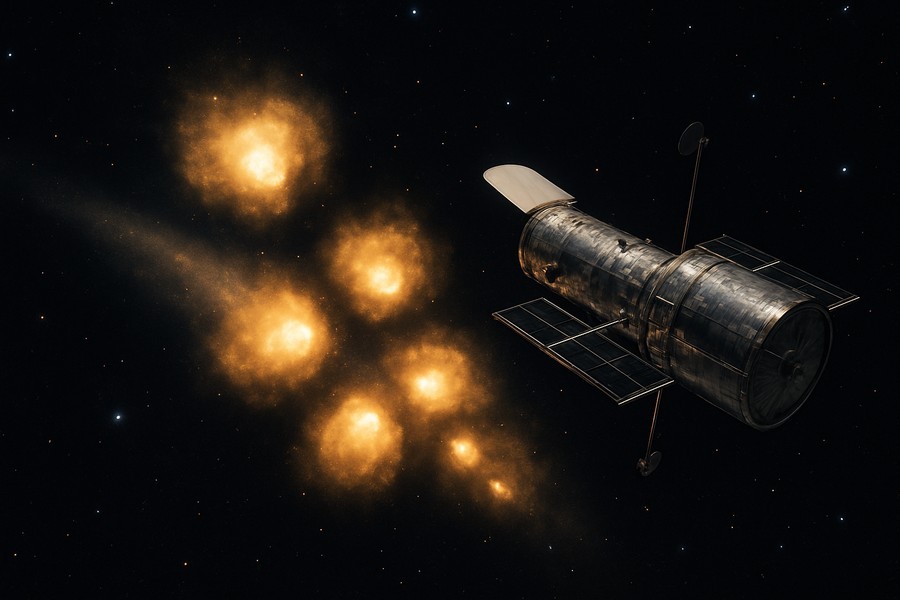
The comet, known by the full name of C/2025 K1 (ATLAS), was captured in the process of disintegrating into at least four fragments. These fragments were surrounded by an envelope of gas and dust, illuminating them like a fuzzy halo in the deep expanse of space.
The Beauty of Serendipity in Space Exploration
The disintegration of comet K1 was an unexpected surprise. John Noonan, a research professor in the Department of Physics at Auburn University in Alabama, explained that the study was originally focused on a different comet. However, due to some new technical constraints, they had to change their target to K1. As luck would have it, just when they began observing it, the comet started to break apart.
"This is one of those serendipitous moments in science where we stumbled upon something magnificent by pure chance," said Noonan. He was unaware of the comet's fragmentation until he saw the telescope's images a day later.
Closest Approach to the Sun: The Key to Fragmentation
Comet K1, which is about five miles long, had made its closest approach to the sun about a month before these images were captured. This approach to the sun subjects the comet to intense heating and maximum stress, often leading to fragmentation.
However, the likelihood of witnessing this fragmentation while observing the comet is almost negligible, making this discovery incredibly special. "It was like finding four comets in the place of one," said Noonan.
Studying Comets: Windows to the Past
Principal investigator and professor in Auburn University’s Department of Physics, Dennis Bodewits, explained that comets are remnants from the era of our solar system's formation. They are made of the same ancient materials that created our solar system.
However, these celestial bodies are not in their original state. Over time, they have been heated and irradiated by the Sun and cosmic rays. "The big question we always ask when studying a comet's composition is whether its current state is a primitive property or a result of evolution," said Bodewits. "By observing a comet breaking apart, we get a glimpse of the ancient, unprocessed material."
Final Destination: A Collection of Fragments in Space
Today, comet K1 is a collection of fragments floating about 250 million miles away from Earth, in the constellation Pisces. Scientists believe it is unlikely to make a return appearance. Despite this, the rare spectacle of its fragmentation has provided researchers with valuable insights into the nature and history of our solar system.
